

Aurora Borealis Could Be Visible Over the UK — And Parts of the US Are Also on Watch
Best viewing is expected in northern Scotland, Northern Ireland, and rural northern England, with clear, dark skies essential for visibility
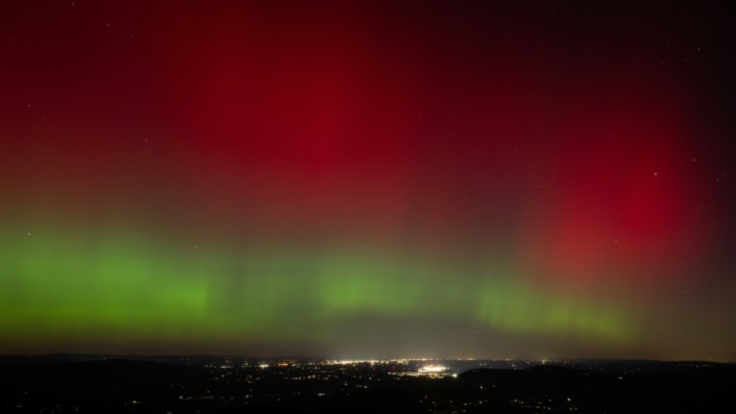
Britain could experience a rare natural spectacle this week, with space weather forecasters warning that the aurora borealis may become visible across parts of the UK following a period of heightened solar activity.
Monitoring agencies say a geomagnetic storm is expected to reach Earth, increasing the likelihood that the Northern Lights could be seen from northern regions including Scotland, Northern Ireland and parts of northern England, provided weather conditions remain favourable.
The same solar event is also being tracked across North America, where alerts have been issued for Canada and several northern US states, indicating that the disturbance affecting Earth's magnetic field is widespread.
Solar Activity Increases Aurora Potential
Solar activity has increased following the detection of a coronal mass ejection, a large release of plasma and magnetic energy from the Sun that is moving towards Earth. According to updates from the UK Met Office, the event could trigger moderate to strong geomagnetic conditions, potentially reaching G2 to G3 levels, which would be sufficient to generate auroral activity across northern parts of the UK during the evening and overnight hours.
The aurora borealis displays are normally concentrated near the Arctic Circle, where Earth's magnetic field channels solar particles more directly. During periods of heightened solar activity, the auroral zone can expand further south, allowing sightings at lower latitudes.
Space weather forecasts measure geomagnetic disturbances using the Kp index, which reflects changes in Earth's magnetic field. Higher values on this scale are associated with a greater likelihood of auroras being visible over a wider geographic area.
— Michael Goulish (@Mick_Goulish) January 19, 2026
Where and When Sightings are Most Likely
Forecast guidance suggests that locations with dark skies and limited light pollution will offer the best viewing conditions. Areas in northern Scotland, parts of Northern Ireland and rural sections of northern England are considered the most promising locations.
Auroras typically appear low on the northern horizon and can fluctuate in brightness and movement. Clear skies are essential, as cloud cover can prevent visibility even during strong geomagnetic activity. Observations are expected to be most likely late in the evening and into the early morning, when solar particle interactions tend to intensify.
In some cases, auroral colours may appear faint to the naked eye. Cameras equipped with night or long-exposure settings can capture colours and patterns that are less visible during direct observation.
Aurora Borealis is back in the UK skies! pic.twitter.com/qKnu0baM3D
— Jay Anderson (@TheProjectUnity) January 19, 2026
Hoping we get some fun here so I can add to the catalogue 😁 pic.twitter.com/MiqlJAZYu6
— Kevin Dennison (@KDog1979) January 19, 2026
Middle of the night aurora. Glimpses over Lough Neagh in brief cloud gaps between midnight and 5am, clear skies now and still ongoing! @TamithaSkov @barrabest @WeatherCee @chunder10 pic.twitter.com/ggv6FQYO6T
— Tam Mullen (@TamMullen) January 20, 2026
#Auroraborealis Northern lights visible in North #Norfolk tonight, easier to see with a phone. pic.twitter.com/qbBAezA90a
— Alex Redston (@AlexRedston) January 19, 2026
North America Also Monitoring Conditions
The geomagnetic storm is being monitored across the Atlantic by US agencies. The National Oceanic and Atmospheric Administration's Space Weather Prediction Centre has issued alerts suggesting that auroras could be visible across much of Canada and parts of the northern United States.
States including Minnesota, Michigan, North Dakota and Montana fall within the projected viewing zone, depending on local weather and geomagnetic strength. In stronger scenarios, activity may extend further south.
Space weather agencies have also noted that geomagnetic storms can affect satellite operations, navigation systems and radio communications. No significant disruptions have been reported so far.
Aurora over the Lake Ontario Snow band that is crushing Upstate NY right now.
— Will McWeather (@Billy_Ch4os) January 20, 2026
Taken at 11:15pm in Wilson NY, 42.5°n #Aurora pic.twitter.com/j0wPri8you
Monitoring Continues
Forecasts remain subject to change as solar conditions evolve. Visibility in the UK will depend on the intensity and duration of geomagnetic activity, as well as local weather patterns.
For UK residents, the coming nights present an opportunity to witness a phenomenon more commonly associated with polar regions. Further updates are expected as monitoring continues and space weather conditions develop.
© Copyright IBTimes 2026. All rights reserved.
- MOST POPULAR IN Trending


