Blue Wave of Doom: New Psychic Claim Revives CIA's Bizarre Mars Remote-Viewing File
A man identified as Brady says he witnessed a populated Martian city destroyed by a huge wave, but the account remains unsupported by scientific evidence
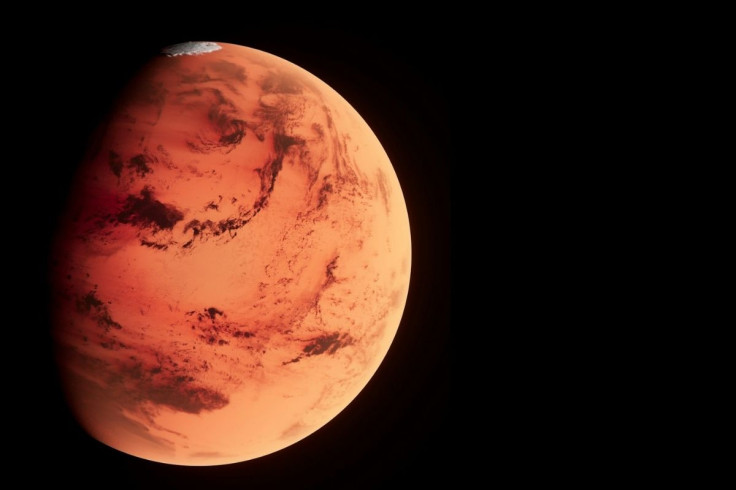
A newly publicised account from a man identified only as 'Brady' has revived one of the strangest chapters in US intelligence history: a 1984 remote-viewing session in which former US Army remote viewer Joe McMoneagle claimed to perceive an ancient civilisation on Mars.
Brady says he experienced an astral-projection episode in which he saw a populated Martian city destroyed by a gigantic blue wave.
Brady said he repeatedly attempted to project his consciousness to Mars and described a world that looked strikingly different from the barren planet known today. He said the city resembled modern Dubai, while its environment looked more like 'England on a summer's day'. Its inhabitants, he claimed, were tall, slender and pale, with a bluish appearance.
Brady said a huge celestial object appeared in the sky before the ground shook and a blue wall of water swept across the landscape. His account is not evidence that such an event happened, but its similarities to McMoneagle's decades-old account have renewed interest in the declassified US government files.
The 1984 Mars Session That Started It All
On 22 May 1984, McMoneagle took part in a remote-viewing session involving a target described as 'The planet Mars', with a time of interest of approximately one million years BC. The declassified material is part of the CIA's collection of documents relating to the remote-viewing programme.
McMoneagle was given geographic coordinates and was asked to describe what he perceived. His early impressions included a pyramid-like structure in a large depression, which he described as 'yellowish, okra colored'. He later reported seeing extremely tall, thin figures and structures that appeared to him to be associated with an ancient civilisation.
The session later involved instructions for McMoneagle to move backwards and forwards in time. His descriptions shifted towards what appeared to be a civilisation facing environmental disaster, with a deteriorating atmosphere and inhabitants apparently trying to survive or leave the planet.
The transcript documents what the viewer said during the session. It does not establish that the beings or structures he described actually existed.
A New 'Blue Wave' Account Adds Another Catastrophe
Brady's account has added a different image to the story: an enormous wave travelling across the Martian landscape. According to his account, people fled as a massive object appeared overhead, with the population panicking before seeing a wave approaching across the horizon.
He said it was large enough to engulf continents and that people were unable to escape. The description has attracted attention because other self-described remote viewers have also claimed to perceive a catastrophic event on ancient Mars.
Courtney Brown, who has written about alleged remote-viewing experiments involving Mars, has also claimed that the planet once supported a civilisation and that a major catastrophe killed many of its inhabitants. His claims, like those of McMoneagle and Brady, remain outside established planetary science.
What Science Actually Says About Ancient Mars
There is one important part of these stories that does have strong scientific support: Mars was once dramatically different from the cold desert planet seen today. NASA says Mars had a much warmer and wetter environment billions of years ago, with evidence of ancient rivers, lakes and other water-related features.
Scientists also believe the planet gradually lost much of its atmosphere, leaving its surface cold and largely inhospitable to liquid water.
That real history is sometimes used to frame claims about an ancient Martian civilisation, but evidence for ancient water is not evidence for intelligent life, and NASA has not reported evidence of a technologically advanced Martian society.
The famous Cydonia region also requires caution. The 'Face on Mars', photographed by Viking in the 1970s, was later observed in much higher resolution, with the feature identified as a natural mesa rather than an artificial monument.
Why the CIA File Still Attracts Attention
The fascination comes partly from the fact that the remote-viewing programme was real. The CIA and other US intelligence organisations did investigate whether people could obtain information about distant or hidden targets through purported psychic perception.
The programme was transferred to the Defense Intelligence Agency in 1977 and was later known as STARGATE. In 1995, an independent evaluation examined the research and operational record, after which the CIA said the programme was not restored because remote viewing was considered too unreliable and inconsistent for intelligence purposes.
That distinction is crucial. The existence of the government programme and its declassified documents is established history, while the existence of an ancient Martian civilisation remains an unverified claim.
Brady's 'blue wave' therefore adds another unusual chapter to a decades-old mystery, but it does not turn the remote-viewing accounts into scientific evidence. For now, the strange visions remain part of the historical record of America's experiments with psychic intelligence rather than proof that Mars once hosted a doomed civilisation.
© Copyright IBTimes 2026. All rights reserved.
- Recommended For You