Astronomers Confirm Youngest Known Exoplanet—a Jupiter-Sized World Still Forming 5,000 Times Younger Than Earth
Elias 2-24 b is about 450 light-years away and may challenge existing models of how quickly giant planets form at great distances
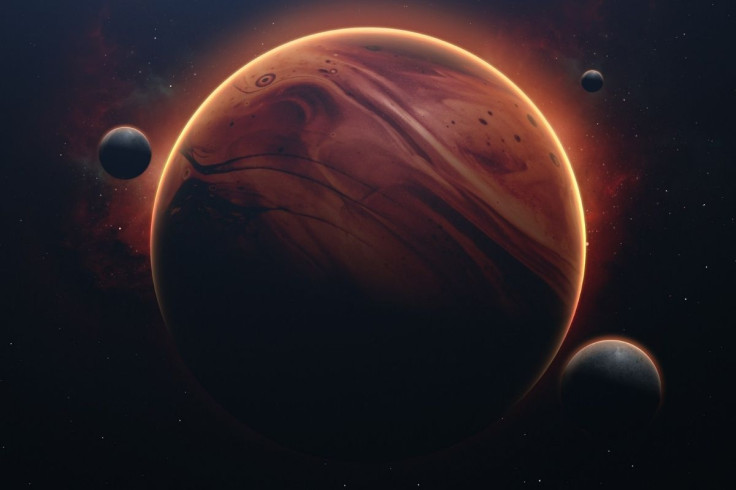
Astronomers have confirmed the youngest known exoplanet ever detected, a giant world less than 1 million years old that is still gathering material from the disc of gas and dust around its newborn star. Named Elias 2-24 b, the planet is roughly as massive as Jupiter and lies about 450 light-years from Earth.
Its extreme youth is what makes the discovery significant. Earth is about 4.5 billion years old, making Elias 2-24 b more than 4,500 times younger.
Unlike most known exoplanets, which are billions of years old and orbit relatively close to their stars, this world can be observed while its planetary system is still being built.
The discovery also addresses a long-standing question in astronomy: how quickly can giant planets form? Elias 2-24 b sits about 55 times farther from its star than Earth is from the Sun, yet it is already a giant planet less than 1 million years old while still gaining material.
That is far faster than some existing models predict for a Jupiter-sized planet at such a distance.
Youngest Planet Ever Confirmed
Elias 2-24 b orbits a young star surrounded by a protoplanetary disc, a rotating structure containing gas, dust, ice and rocky material from which planets emerge.
Astronomers had previously noticed a prominent gap in the disc around Elias 2-24, with observations from the Atacama Large Millimeter/submillimeter Array (ALMA) revealing the gap and the European Southern Observatory's Very Large Telescope later detecting a faint object within it.
The question was whether that faint object was genuinely a planet or simply an imaging artefact or distant background star. Researchers led by Andrea Bernardi of Universidad Diego Portales in Chile returned to archival observations from the W. M. Keck Observatory and found the same faint object in data collected in 2018 and 2020.
Tracking its movement showed that it behaved like an object orbiting the star, helping confirm Elias 2-24 b as a planet.
A Planet Still Growing
The discovery is especially valuable because Elias 2-24 b is not simply young by astronomical standards. It appears to be actively forming, with material from the surrounding disc still being drawn towards the giant world.
The planet sits inside a gap in its star's protoplanetary disc, supporting the idea that such gaps can be carved by forming planets. 'The planets should be found within the gaps, since they are carving them. And that's exactly where we found Elias 2-24 b,' Bernardi said.
The observations therefore provide strong evidence linking gaps seen in young stellar discs to planets developing within them.
Why Its Age Challenges Planet Formation
The discovery is also prompting astronomers to re-examine how quickly giant planets can form. NASA says existing planet-formation models suggest it takes roughly 5 million years to produce a Jupiter-sized planet at a distance comparable to Jupiter's orbit around the Sun, and potentially longer at greater distances.
Elias 2-24 b is estimated to be less than 1 million years old and sits roughly 55 times farther from its star than Earth is from the Sun. Its existence therefore presents a difficult case for models that predict slower formation at such a distant location.
Lucas Cieza, a co-author of the study, said existing models were already struggling to explain previous record holders that were more than 5 million years old. 'Elias 2-24 b shows us that even our best planet-formation models are still missing some important processes,' Cieza said.
A Rare Look at Planetary Birth
Most of the roughly 6,000 confirmed exoplanets have been detected using the transit method, in which a planet passes in front of its star and causes a tiny dip in starlight. That method is much harder to use for newborn planets buried inside dusty discs or orbiting far from their stars.
Elias 2-24 b was instead identified through direct imaging and archival observations, with multiple observatories helping establish its identity. The result shows why preserving old astronomical data can be as important as collecting new observations.
The planet is also close to the limits of current detection technology. Future observations with instruments such as NASA's Nancy Grace Roman Space Telescope could reveal more young worlds hidden within the glare and dust surrounding newborn stars.
© Copyright IBTimes 2026. All rights reserved.
- Recommended For You