Earth's Glaciers Lost Enough Ice to Fill 560 Million Olympic-Sized Swimming Pools in Three Years, UN Warns
The loss marks the fourth consecutive year of ice-mass decline across every major glaciated region, while river flows and global water storage also deteriorated
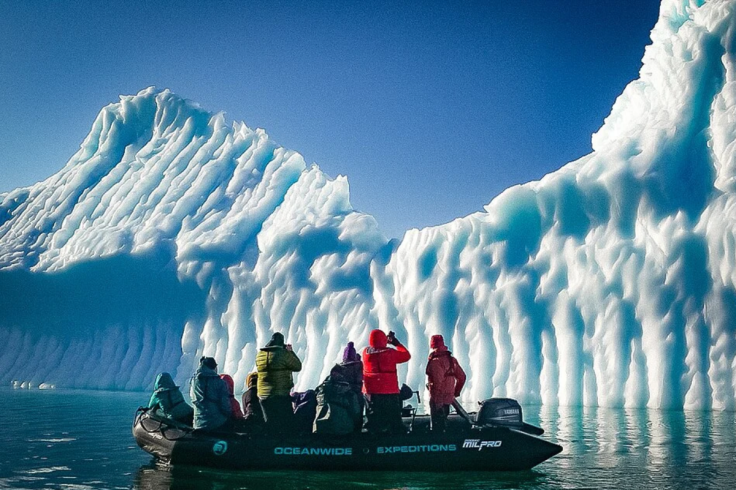
Between 2023 and 2025, the world's glaciers lost 1,400 gigatonnes of water. Enough, according to the World Meteorological Organization, to fill roughly 560 million Olympic-sized swimming pools, or about one third of annual global freshwater withdrawals. The loss was recorded across just three reporting years.
The figure comes from the World Meteorological Organization's State of Global Water Resources 2025 report, published on 17 September. It is not a spike. It is a streak: 2025 marked the fourth consecutive year in which every major glaciated region on Earth recorded a net loss of ice mass.
A Decade in Decline
Michael Zemp, Director of the World Glacier Monitoring Service (WGMS), said: 'The annual mass loss from glaciers in 2025 would have filled five Olympic pools in every second of that year.' The glaciers are among the most visible signs of a broader decline, as global terrestrial water storage has also continued to fall.
Global terrestrial water storage, the total amount of water held in groundwater, lakes and rivers, soil moisture, vegetation, ice and snow, has been declining since the mid-2010s, a decade-long trend with no sign of recovery.
Nearly two-thirds of monitored wells worldwide recorded conditions outside their historical norm in 2025, with the balance shifting further towards deficit compared with the previous year.
'We are depleting that savings account. Global terrestrial water storage has shown a declining trend since 2014–2016 - a persistent, decade-long signal. For the fourth consecutive year, every major glaciated region on Earth lost ice mass,' said WMO Secretary-General Celeste Saulo.
Drying Rivers and the Human Toll
The year 2025 was also one of the driest for river discharge globally in 35 years, with below-normal flows across 36 per cent of global basin area. For the seventh consecutive year, river basins with 'normal' flow conditions remained a clear minority, between 34 and 38 per cent of global basins, well below the 1991–2020 historical average of 46 per cent.
The consequences are measurable in lives and economies.
Asia and Africa together accounted for more than 80 per cent of reported deaths associated with water-related disasters over the past five years.
South and South-East Asia was hit by tropical cyclones and intense monsoon events, resulting in up to 3,600 deaths across affected countries in 2025.
Jamaica reported that Hurricane Melissa caused losses equivalent to 41 per cent of its GDP.
Regions Facing Peak Water Conditions
Some areas may have already reached what scientists call 'peak water conditions', the threshold at which a glacier reaches its maximum runoff from melting. Regions flagged by the WMO include the Caucasus, Western Canada and the United States, and Central Europe.
A peer-reviewed study in Nature Reviews Earth & Environment, based on data compiled by the WGMS, found that cumulative global glacier mass loss since 1975 has reached about 9,583 gigatonnes, equivalent to about 26.4 millimetres of sea-level rise.
For communities across South Asia, East Africa and the Andes that rely on glacier and snowmelt for seasonal water supplies, continued glacier retreat could reduce an important source of water during dry periods.
As those reserves shrink, the loss of this seasonal buffer could increase pressure on water availability in some regions. Saulo put it plainly: 'A glacier's retreat in one country reshapes water availability for populations hundreds of kilometers downstream... This is precisely why we need shared data, shared standards, and shared early warning.'
© Copyright IBTimes 2026. All rights reserved.
- Recommended For You