

DWP Payments Are Coming Early This August: Check If Your Benefit Is on the List
Benefit payments due on 29, 30 or 31 August will land on Friday 28 August, but the same money will need to stretch three extra days
The Department for Work and Pensions (DWP) has confirmed that payments due on Monday 31 August will now be paid on Friday 28 August. It has also published a list of 11 payments the change covers. Appearing on that list is not the same as being paid early, because only claimants whose own payment date falls across the bank holiday weekend will see any difference.
The department set this out on 14 August, 17 days before the summer bank holiday in England, Wales, and Northern Ireland. Sir Stephen Timms, Minister for Social Security and Disability, said the earlier date would let households and pensioners collect what they are owed 'without disruption'. The department also tied the timing to the new school year, saying it lets parents and carers plan their spending with confidence.
Which Payments the Department Named
The 11 payments the change covers are Universal Credit, the State Pension, Personal Independence Payment (PIP), Attendance Allowance, Carer's Allowance, and Disability Living Allowance (DLA). The rest are the Industrial Injuries Compensation Scheme, Income Support, Jobseeker's Allowance, Pension Credit, and Employment and Support Allowance (ESA). Child Benefit does not appear because His Majesty's Revenue and Customs (HMRC) pays that one and publishes its own bank holiday dates.
Universal Credit is the one growing quickest in raw numbers. The caseload rose by just over 1M in the year to August 2025 and had reached 8.3M by December.
Those 11 cover very different numbers of people. Departmental statistics published in February 2026 put the State Pension at 13.2M claimants in August 2025 and Jobseeker's Allowance at 71,000, as the chart below shows.
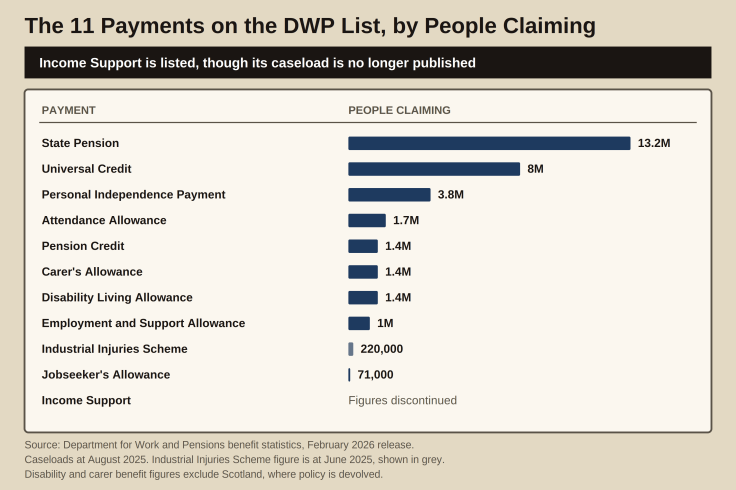
Income Support sits on the list with almost nobody left on it. The department said volumes had fallen so low that they would not rise again, and that it stopped publishing separate Income Support figures after November 2025.
Caseloads count everyone holding a benefit, not everyone due money across the bank holiday weekend. The department has not said how many people fall into the second group.
Money Arrives on Friday, Bills Leave on Tuesday
An earlier date does not mean a larger payment. Government guidance says Universal Credit is paid on the same date every month, and that a date falling at a weekend or on a bank holiday shifts to the previous working day. The next payment therefore stays where it always was, and the same sum has to cover three extra days.
The bank holiday moves money in the other direction too, because the system that pays a benefit in is the one that takes most household bills out, as the graphic below shows.
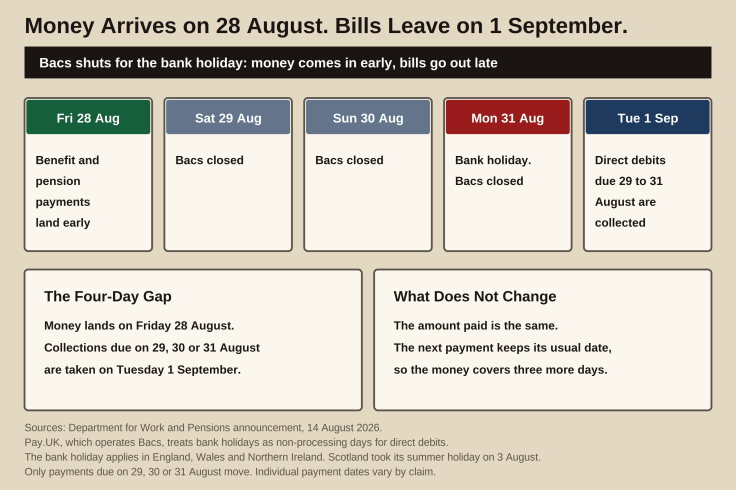
Bacs is the clearing system that moves benefit payments into bank accounts and direct debits out of them. Pay.UK, which operates it, treats bank holidays as non-processing days, and says a collection set for a bank holiday Monday moves to Tuesday.
That leaves a four-day window in which an account looks healthier than the month allows. The benefit arrives on the Friday. Rent, energy, and council tax collections due over the weekend sit unpaid until 1 September, by which point part of the balance has gone.
Universal Credit can include money for rent, which claimants usually pass to a landlord themselves. Where that leaves by direct debit over the weekend, the collection date matters more than the payment date.
Scotland Had a Different Date
Scotland took its summer bank holiday on Monday 3 August, four weeks earlier than the date marked in England, Wales, and Northern Ireland. The DWP said the early payment arrangement covers the whole United Kingdom even so, and that Scotland is treated no differently despite its separate holiday calendar.
The useful check is a claimant's own record rather than the published list. A Universal Credit payment date is fixed by the day the claim started, so two households on the same benefit, in the same street, can sit on opposite sides of 31 August.
© Copyright IBTimes 2026. All rights reserved.