

Dutch Doctor Who Ended Toddler's Life Says He Lived Under 'Sword of Damocles' for Almost a Year
Prosecutors closed the first case under a 2024 rule for children aged one to 12, but an ethicist objects
A Dutch doctor who carried out the termination of a gravely ill toddler's life will not be prosecuted. The decision was announced on Wednesday, 23 September. He told the current affairs programme Nieuwsuur the wait felt like 'a sword of Damocles hanging above your head for almost a year.'
Aged almost two, the child was the first reported case of life termination under a 2024 Dutch rule covering children aged 1 to 12. Belgium has allowed euthanasia for minors deemed capable of discernment since 2014, with no minimum age. This Dutch rule covers children under 12 who cannot request euthanasia themselves. At first, doctors outside the treating doctor's region said the suffering was not unbearable at all times.
Brain Damage, Seizures, and a Split Among Doctors
According to the ruling, the mother gave birth on a holiday abroad after 26 weeks and three days. Infections followed, including sepsis, in which the body's fight against germs harms its own organs. At four and a half months old, the baby moved to a hospital in the Netherlands. A brain scan showed widespread damage that no treatment could reverse. At eight months, doctors found severe epilepsy with daily seizures, as the timeline below shows.
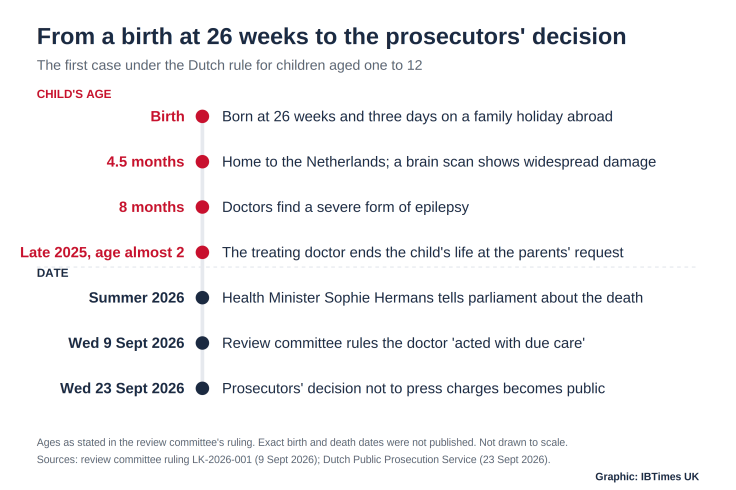
By age two, doctors assessed the child's development as that of a six-week-old baby. Both parents asked the doctor to end their toddler's life. Outside doctors had suggested other drugs for the fits, but the treating doctor said the new drugs only added to the distress. The parents also rejected long sedation ending in death from lack of food and fluid. A second outside doctor found no other reasonable way to ease the suffering.
How the Case Reached Prosecutors
Until 2024, the Groningen Protocol covered seriously ill newborns, and Dutch law allowed patients to request euthanasia from age 12. A special review committee of four doctors, a lawyer and an ethicist examines each reported case. The Public Prosecution Service then determines whether the doctor complied with the law. The child died in late 2025. On Wednesday 9 September, the committee's ruling said the doctor had 'acted with due care.'
The treating doctor hopes the decision helps other parents raise the option with their doctors. He sees the option as a step towards equal treatment. Adults can ask for euthanasia, but children under 12 cannot. Eduard Verhagen, a professor of comfort care for sick children, advised on the case. The ruling notes that no national guideline yet sets out how life termination should be carried out for children under 12.
Objections, Missing Guidance, and the Vote in Britain
Even Verhagen, who helped draw up the rule, said it remains 'complicated that you end the life of someone who does not ask for it.' Dutch ethicist Stef Groenewoud told the Reformatorisch Dagblad newspaper that ending a life nobody has asked to end is a step too far.
On Friday 11 September, Members of Parliament voted 286 to 270 against an assisted dying bill covering only adults in England and Wales expected to die within six months. The ruling notes that no national guideline yet sets out how life termination should be carried out for children under 12.
© Copyright IBTimes 2026. All rights reserved.