

Harvard's Avi Loeb Claims Interstellar 3I/ATLAS Is 'Anomalously' Aligned With the Sun
Avi Loeb reveals an anomalous solar alignment that challenges our understanding of interstellar visitors.
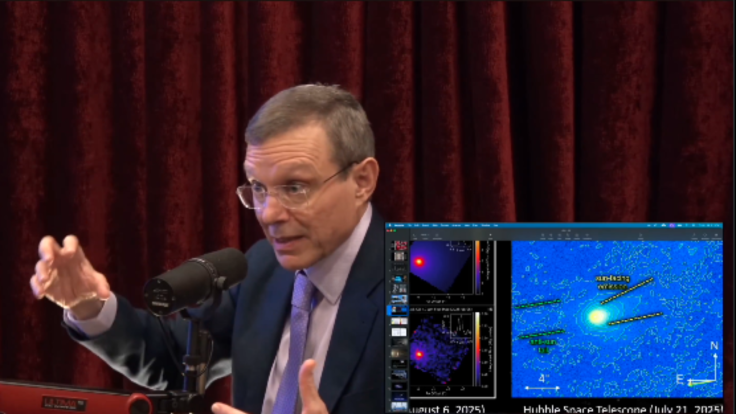
The third interstellar visitor to our solar system, 3I/ATLAS, is behaving with a precision that defies random orbital mechanics, according to a new study led by Harvard Professor Avi Loeb.
In a paper co-authored with Toni Scarmato of the Scarmato Observatory, Loeb identifies what he calls an 'anomalous' solar alignment.
The study, which used harmonic modelling and Hubble Space Telescope data, reveals that the object's rotation axis is aligned with the direction of the Sun to within 10–20 degrees, a phenomenon with only a 1.5% to 6% probability of occurring by chance in the chaotic void of interstellar space.
Their findings place 3I/ATLAS alongside earlier anomalies such as 'Oumuamua, reviving debate over whether rare cosmic interlopers are shaped purely by chance or influenced by forces not yet fully understood.
The paper, 'Rotation Period of 3I/ATLAS After Perihelion from Jet Position Angle Wobble and Photometric Variability,' states that this object is not just another piece of space ice. 'Instead, 3I/ATLAS moves with such precision that it is highly unlikely to be an accident.'

The Bizarre Precision of 3I/ATLAS and Its Uncanny Solar Alignment
Professor Loeb, a scientist who has become a lightning rod for debate in the scientific community for his willingness to consider extraterrestrial technology as a viable hypothesis, has identified what he calls an 'anomalous' alignment.
By using two independent methods—harmonic modelling of jet position angle variability and an independent photometric time series—the team discovered that 3I/ATLAS rotates roughly every 7.1 hours.
While a rotating comet is nothing new, it is the orientation of that rotation that has raised eyebrows. The study found that the rotation axis of 3I/ATLAS is aligned with the direction of the Sun to within 10–20 degrees.
In the chaotic, random environment of interstellar space, the chances of such an alignment occurring by pure luck are estimated to be between 1.5–6%. Loeb emphasises that this alignment is anomalous because most interstellar objects should, theoretically, have entirely random orientations upon entering our system.
Loeb notes that the 'periodic wobble of the jet around the rotation axis did not change during perihelion.' This stability is remarkable, especially given the immense gravitational and thermal stresses an object undergoes when it makes its closest approach to the Sun. As the nucleus rotates, the axis of the dominant outflow direction sweeps around the rotation axis as a result of the precession of the jet.
This complex movement modulates the column density of dust along the line of sight and the distribution of dust within the photometric aperture, while also altering the effective scattering phase function of the dusty coma. Essentially, this creates a rhythmic flickering in the object's brightness, much like a cosmic sprinkler system.
3I/ATLAS Rotates Every 7.1 hours After Perihelionhttps://t.co/79KS8P8Xa4
— Galileo Project (@GalileoProject1) January 15, 2026
Could 3I/ATLAS Be an Engineered Messenger from the Stars?
The implications of this finding are deeply human. We are forced to ask: Is this a natural phenomenon, or are we looking at something designed? Loeb and Scarmato are careful to offer a natural explanation, suggesting the alignment could be the 'result of a torque associated with sublimation of ice on the surface of the nucleus.' Essentially, as the Sun heats the comet, the escaping gas could act like a thruster, forcing the object into this specific alignment.
However, the precision remains haunting. The researchers observed that the average position angle (PA) of the jet was 270° +/- 3°, while the anti-sunward direction was 290° +/- 3°. This leads to the inference that the rotation axis of 3I/ATLAS is aligned with the Sun-3I/ATLAS axis to within 20 degrees.
Importantly, the paper suggests that the same underlying rotational state can manifest differently in photometry and in jet position angle; if the jet direction is tied to a fixed active area on a rotating nucleus, the PA can exhibit a periodic modulation as the jet alternately points closer to, or farther from, the line of sight.

For the public, the saga of 3I/ATLAS is a reminder that we are currently living through a golden age of discovery. We are no longer limited to peering at distant stars; the stars are occasionally sending pieces of themselves to us. Whether 3I/ATLAS is a primitive 'planetesimal'—a frozen relic from another star system—or something more complex, its presence confirms that the galaxy is much more 'connected' than we once believed.
Since the coma provides the dominant contribution to the total flux, even modest changes in jet orientation produced measurable periodic variations in the integrated magnitude of the object.
As Loeb continues to push the boundaries of conventional science, the world watches with bated breath, wondering if the next interstellar visitor will finally provide the definitive answer to our oldest question: are we alone?
© Copyright IBTimes 2026. All rights reserved.