

Is AI Setting McDonald's Prices? Burger Giant Sued Over Pricing Tool
Illinois lawsuit alleges algorithm coordinates prices across 14,000 stores
Days after McDonald's publicly insisted that artificial intelligence does not decide what you pay for a Big Mac, the burger giant has been sued over its AI pricing tool. A proposed nationwide class action claims the chain uses it to coordinate menu prices across its US restaurants, a claim the company flatly denies.
The suit was filed on 2 October in federal court in Chicago by Michael Thomas, an Illinois resident seeking to represent potentially millions of McDonald's customers nationwide. It accuses the company of breaking US antitrust law by conspiring with its independent franchisees to fix prices through algorithms trained on nonpublic data, and is seeking damages for the proposed class.
'Independent businesses must set their prices independently,' the filing states. It argues that since at least 2019, McDonald's has replaced that independence with a 'coercive price-fixing agreement' binding both company-owned and franchised outlets, with the algorithm programmed to tie one restaurant's price rises to whether others nearby have already raised theirs.
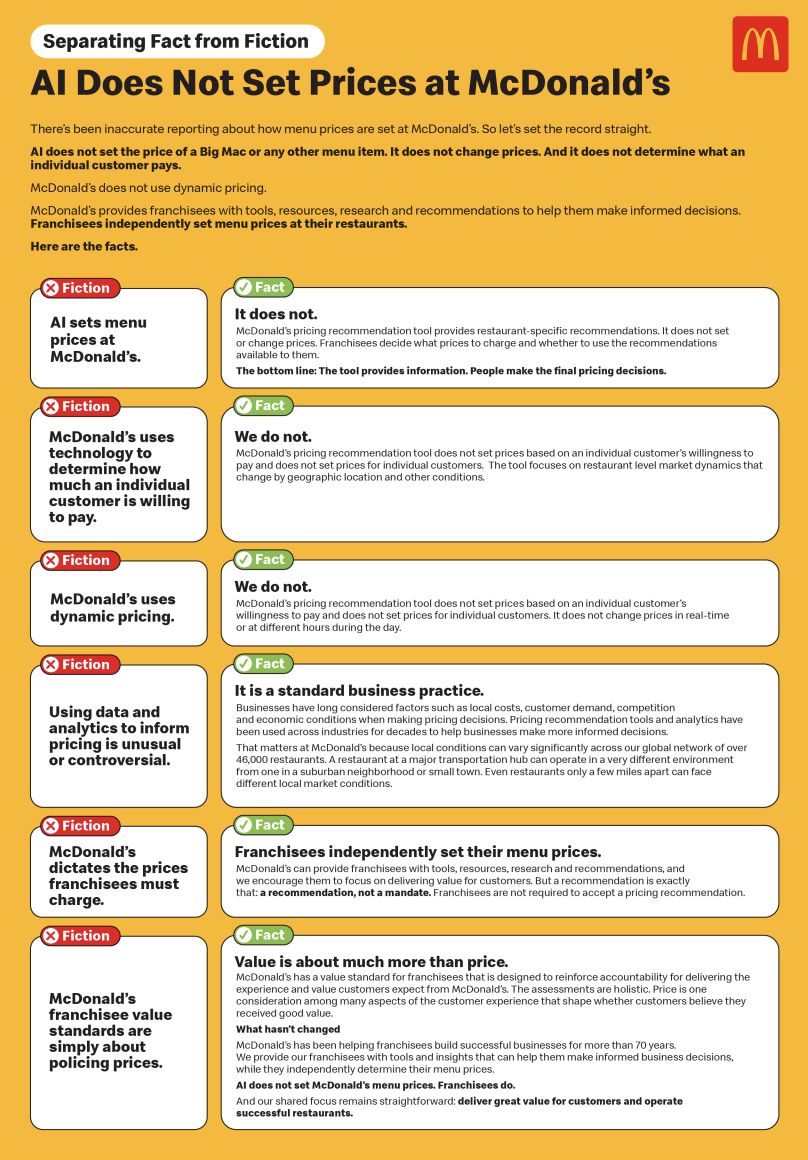
McDonald's has rejected the allegations as 'speculative and uninformed'. It had already made the same case in a 1 October notice headed 'Separating Fact from Fiction' that declared 'AI does not set the price of a Big Mac or any other menu item.'
Franchisees choose their own prices, the company says, describing its pricing portal as 'a tool, not a mandate' used widely across industries.
How McDonald's AI Pricing Engine Works
The claims trace back to a Reuters investigation, published on 29 September, into a system McDonald's calls its 'pricing engine'. It reported that machine-learning algorithms sift millions of daily transactions across the chain's nearly 14,000 US restaurants to produce an 'optimal price' for each item, weighing local demand, rivals' prices, and an estimate of what customers in a given area will pay.
For diners, that can mean the same Big Mac costs noticeably more at one branch than another. Reuters found price gaps of up to 21% between outlets barely two miles apart, and in a separate franchisee lawsuit the tool had suggested charging around $18 (about £13.40) for a Big Mac meal at a restaurant off a Connecticut turnpike.
Five owners said they felt pressured to use the recommendations despite being told they were optional.
McDonald's disputes that picture. It says the tool reflects 'restaurant level market dynamics' rather than any individual customer's willingness to pay, and that it does not use dynamic pricing or change prices by the hour. With more than 46,000 restaurants worldwide, the company says, even outlets a few miles apart can face very different costs, and franchisees stay free to reject any recommendation.
The claims land as McDonald's fights to protect its margins. US foot traffic has fallen year on year every full month since March, according to analytics firm Placer.ai, leaving the chain under pressure to wring more from each sale as it risks losing price-sensitive customers.
Lark Turner, a lawyer for the plaintiff, said McDonald's is 'leveraging its troves of data and its franchised system to nickel-and-dime consumers down to the last French fry.'
A Growing Legal Fight Over AI Pricing
The case echoes the battle over RealPage, whose rent-setting software the US Justice Department and several states sued in 2024, arguing that landlords sharing nonpublic data to align rents were effectively fixing prices. RealPage agreed to a proposed settlement last year that would bar it from using competitors' nonpublic, competitively sensitive information in its pricing software.
Antitrust specialists are paying attention. William Kovacic, a former Federal Trade Commission commissioner, noted that the warnings built into McDonald's own pricing portal, which cautions that nearby franchisees 'may be competitors', amount to 'an acknowledgment there's a potential problem.'
Several states have already acted. A California law that took effect this year restricts certain uses of common pricing algorithms that rely on competitor data to recommend, align, stabilise, set or influence prices. Separately, Maryland, Connecticut, and New Jersey have moved against so-called surveillance pricing, which can involve using personal data to set individualised prices.
None of the allegations has been tested in court, and filing a complaint does not establish that McDonald's broke the law. But with regulators increasingly focused on algorithmic pricing, the case could become an early test of how antitrust rules apply when a machine helps set the price.
© Copyright IBTimes 2026. All rights reserved.