

25-Year-Old Has Sent 300 Job Applications Since Layoff: $25K Savings Could Run Out in 3 Months
Early 401k withdrawals face a 10% penalty, not waived for job loss

A 25-year-old engineer in the United States has sent 300 job applications since being laid off three months ago. Now the engineer is weighing whether to take money out of a retirement account to keep paying the rent.
The savings are down to about $25,000 (£18,400). Unemployment payments have covered the rent so far. Three of the six months have gone, and when they stop, the savings start draining.
Rent is $2,175 (£1,600) a month on a rolling lease. The retirement account holds $50,000 (£36,800). The engineer wants the money as a buffer, and for the peace of mind it would buy.
Nobody has run out of anything yet. That is worth saying plainly, because the arithmetic looks better from the outside than it does at three in the morning.
How Long the Money Actually Lasts
Savings of $25,000 cover roughly 11 months of rent on their own. Add food, bills, and travel to interviews, and the money stretches less far. But three months is when the money starts going down, not when it runs out.
The distinction matters, because the retirement account is the most expensive money in the room. Reaching for it early costs more than most people expect, and the cost never comes back.
The post went up on the r/personalfinance forum on Reddit and drew more than 4,400 votes and 1,200 replies, as the screenshot below shows.
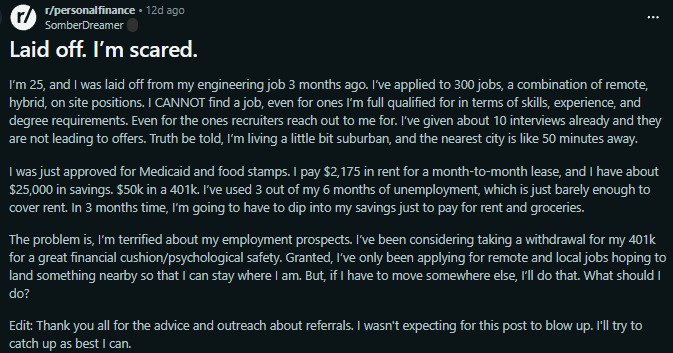
Plenty of the Reddit replies offered job referrals. Almost none answered the actual question, which was whether the retirement money can be accessed without a penalty.
The money can be accessed. It is simply expensive, and losing a job does not make it cheaper.
Losing a Job Earns No Exemption
Money taken out of a workplace retirement account before the age of 59 and a half carries an extra 10% tax. That sits on top of the ordinary income tax already owed. The Internal Revenue Service (IRS) applies it whether or not the person needs the money.
The IRS publishes a list of situations that waive the extra charge. Death, disability, terminal illness, a court order, large medical bills, a federally declared disaster, and domestic abuse are all on it.
Losing a job is not on that list. The closest thing is a rule for people who leave an employer in the year they turn 55. This engineer is 30 years short of that.
What Taking It Out Would Cost
A $50,000 withdrawal does not arrive as $50,000. Ten per cent goes straight out as a penalty, which is $5,000 (£3,700), and the income tax comes on top. Chris Chen, a certified financial planner who founded Insight Financial Strategists, told Business Insider: 'You often end up taking it at the peak of where your income is.'
Wages already earned this year sit underneath any withdrawal, and unemployment payments are taxable too. The higher cost is what leaves with the money. Marshall Clay, a wealth adviser at The Welch Group, told the Alabama television station WAFF that a withdrawal is 'a permanent loss of that tax-deferred growth.'
One route avoids the penalty, though not the income tax. A 2022 law lets savers take $1,000 (£735) a year for an emergency, once. Set against rent of $2,175, that covers less than half a month.
Why This Keeps Happening
The wait is getting longer. In July, 1.8 million Americans had spent 27 weeks or more without a job. That is just over a quarter of everyone counted as unemployed, according to the Bureau of Labor Statistics.
More savers are reaching for the money anyway. A record 6% of people in retirement plans run by Vanguard Group took money out early for hardship in 2025. That was the sixth annual rise in a row.
Before the account is opened, two things need checking. The first is whether the former employer's plan still allows a loan, since a loan carries no penalty while it is being repaid. The second is whether the money does more sitting where it is and growing while the search goes on.
On the arithmetic, the account is the last thing that needs touching. Three months of payments are still to come, and they are the thing to spend first.
© Copyright IBTimes 2026. All rights reserved.