

'She's Better Off Than 95%': 68-Year-Old With $2.7M Still Can't Relax About Money
Financial advisers say lifelong savers often fear spending their own money
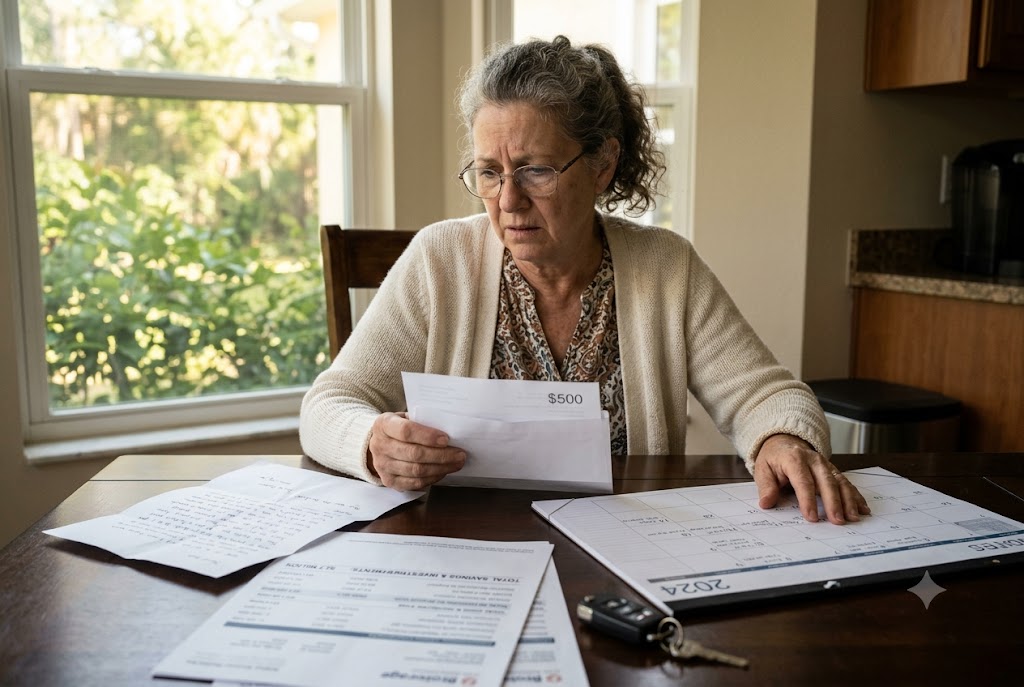
Her son says she is set for life. She does not believe him.
A 68-year-old woman in East Central Florida has close to $2.7M (£2M) in savings and investments, a car she owns outright, and a home she is steadily paying off. Even so, a single unexpected $500 (£370) bill is enough to ruin her week, her son wrote.
Hoping strangers might succeed where he had failed, he laid out her entire financial picture on Reddit's r/personalfinance forum in a post titled 'Please help convince my mom she is SET.' His mother, he explained, has been 'scared out of her mind about finances' since divorcing his father, and 'agonizes over every little expense.'
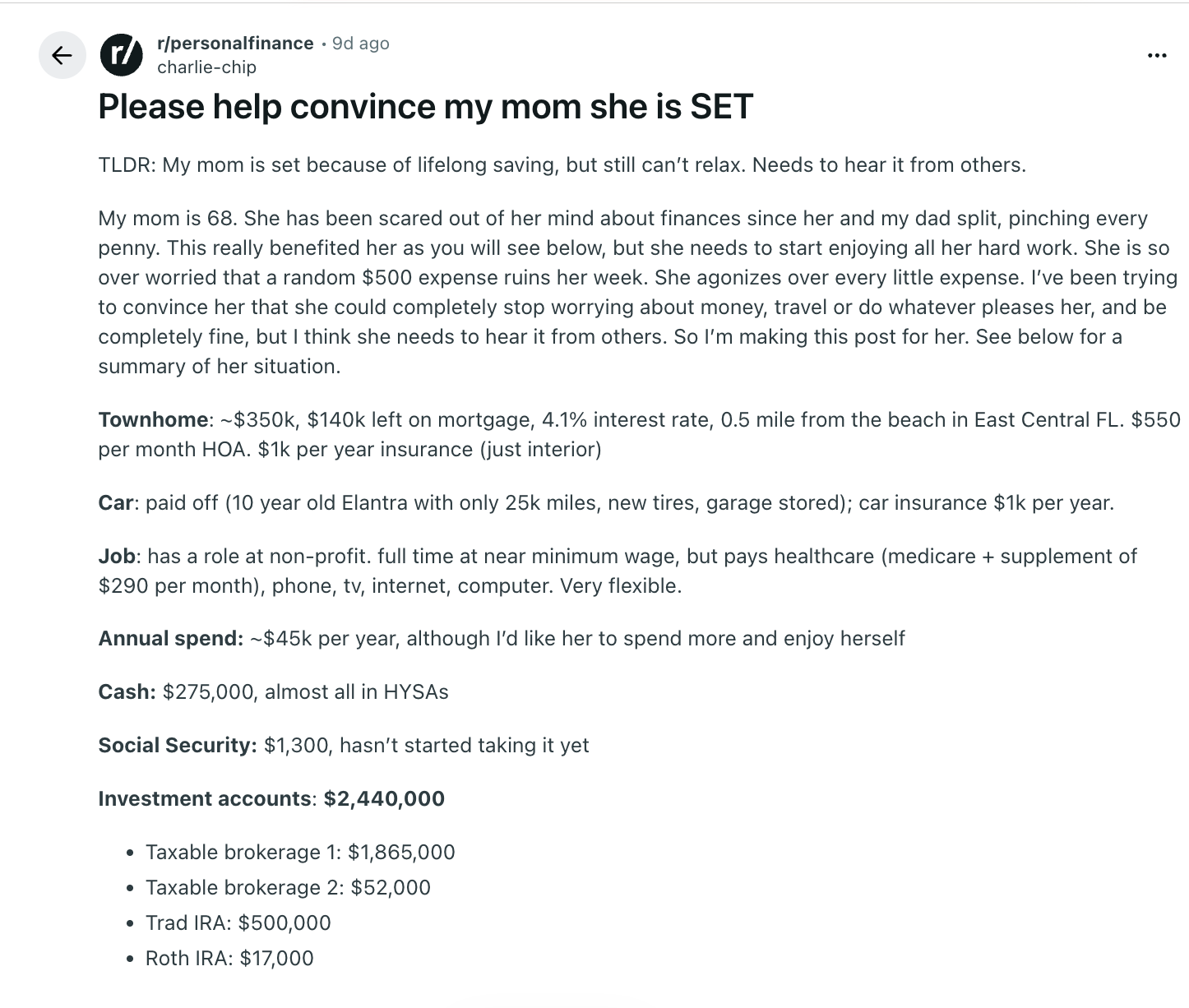
The reaction was close to unanimous. The thread's top reply summed up the mood: 'You should have led with the 2.4 million. She's better off than 95% of the population.' The same commenter called her worry a real 'phobia', adding that 'lifelong savers have a hard time hitting the reverse switch.'
Advisers have a term for the pattern. They call it underspending, and the woman is far from alone in it.

Why Lifelong Savers Struggle to Spend in Retirement
New research suggests a large share of retirees hold on to money they could safely enjoy. Approximately one third still have all of their original savings, or more, by their mid-80s, according to the Employee Benefit Research Institute (EBRI), whose latest study tracked household finances through the 1992 to 2022 waves of the long-running Health and Retirement Study. Economists have a name for the tendency, the 'retirement savings puzzle': people spend decades building a nest egg, then cannot bring themselves to run it down.
Craig Copeland, EBRI's director of wealth benefits research, said the habit is stubborn. 'Some people spent all their life saving money, and it's very hard to switch them to spending their assets down,' he told CNBC. So many people reaching their 80s with untouched savings, he added, points to retirees being 'way too conservative'.
Financial advisers who spoke to the same broadcaster said the cost is real, even when it never shows on a statement. 'It represents a life not lived, the vacations you didn't take because you were afraid you were going to run out of money,' said Marianela Collado, a certified financial planner in Plantation, Florida.
Another planner, Zach Teutsch, put it plainly: 'Overspending is risky. But underspending is risky too.'
Inside the $2.7M Retirement Snapshot
The Florida woman's own numbers make the case for her. Her son listed about $2.44M (£1.82M) across taxable brokerage and retirement accounts, plus roughly $275,000 (£205,000) in cash. She has not yet claimed the $1,300 (£970) a month in Social Security she is owed, and lives on around $45,000 (£33,500) a year.
Under the widely cited 4% guideline, a rule of thumb for sustainable withdrawals, she could draw close to $97,600 (£72,600) a year from her investment accounts alone, more than double what she currently spends. One commenter went further, calculating that even a simple ladder of inflation-protected government bonds could pay her about $80,000 (£59,500) a year until she turned 96, before she touched her cash or Social Security. Another noted her wealth was effectively self-sustaining: even if she raised her spending sharply, the balance would most likely keep climbing.
Her outgoings, by contrast, barely move the total. Her home is nearly clear of its mortgage, and her car is a 10-year-old Hyundai Elantra with 25,000 miles on it. She still works full time at a non-profit for close to minimum wage, chiefly because the role covers her healthcare.
Her son captured the paradox in a line: he understood that drawing down accounts felt strange, he wrote, but 'she isn't even making a dent.'
Several readers pointed to the same fix. A one-off review with a fee-only fiduciary planner, one noted, typically costs $1,000 to $2,000 (£740 to £1,490) for two or three sessions and can settle an anxious saver's fears without committing them to ongoing advice.
Others suggested the root of her anxiety lay in the divorce rather than the balance sheet, and urged the family to guard her against the scams that increasingly target asset-rich older people.
© Copyright IBTimes 2026. All rights reserved.