

New Study Confirms Interstellar Comet 3I/ATLAS Is Made of 'Bizarre' Alien Dust
Discover why interstellar comet 3I/ATLAS is baffling scientists with bizarre 'alien' dust that survives the sun's intense heat.

Space has a way of reminding us how little we actually know about the neighbourhood beyond our own front door. When a new visitor streaks through our solar system, scientists scramble to catch a glimpse before it vanishes back into the infinite dark. The latest guest, an interstellar object known as 3I/ATLAS (formally designated C/2025 N1), has just handed researchers a revelation that is as baffling as it is brilliant. It turns out this 'alien' comet is carrying a type of dust so strange and stubborn that it defies the typical rules of our own planetary system.
Unlike the comets we are used to seeing—those icy 'dirty snowballs' that begin to crumble and fizz as they approach the warmth of the sun—3I/ATLAS appears to be made of much sterner stuff. New independent polarimetric observations led by Seungwon Choi and a team of international astronomers from Seoul National University, which include the first-ever near-infrared measurements of such an object, have pulled back the curtain on its mysterious composition. By measuring how light bounces off the object's trailing debris as it travels at a staggering 130,000 miles per hour, astronomers have realised that we are looking at something fundamentally 'other.'

The Mysterious Glow of 3I/ATLAS Reveals a Composition Unlike Anything in Our Solar System
To understand what makes this discovery so significant, one has to look at the way light interacts with cosmic dust. Scientists used a suite of high-powered ground-based instruments, including the HONIR camera at the Kanata telescope and the NIC instrument at the 2.0-m Nayuta telescope in Japan, to track the degree of linear polarisation across a broad spectrum.
They monitored the object from visible RC bands at 0.64 µm right through to the near-infrared Ks band at 2.25 µm. What they found was a 'polarisation phase curve' (PPC) that looked nothing like the curves produced by typical solar system comets.
The data revealed an unusually large polarisation amplitude. In simpler terms, the light reflecting off 3I/ATLAS has a unique 'signature' that suggests its surface is covered in a specific type of refractory dust.
This isn't just a minor statistical deviation; it is a clear indicator that the building blocks of this object were forged in an environment chemically distinct from the protoplanetary disk that birthed our own planets. It suggests 3I/ATLAS originated in a corner of the galaxy with a very different chemical recipe than our own.
What is perhaps most striking is that this signature didn't change as the object made its closest pass to the sun during its perihelion in late 2025. Usually, when a comet crosses the 'water snow line'—the point roughly 2.7 astronomical units from the sun where it gets hot enough for ice to turn directly into gas—the resulting activity changes the way light reflects off it. Yet, the PPC of 3I/ATLAS remained remarkably stable. This tells us that the bizarre behaviour isn't caused by a temporary 'fizzing' of gases, but is instead an intrinsic property of the dust itself.
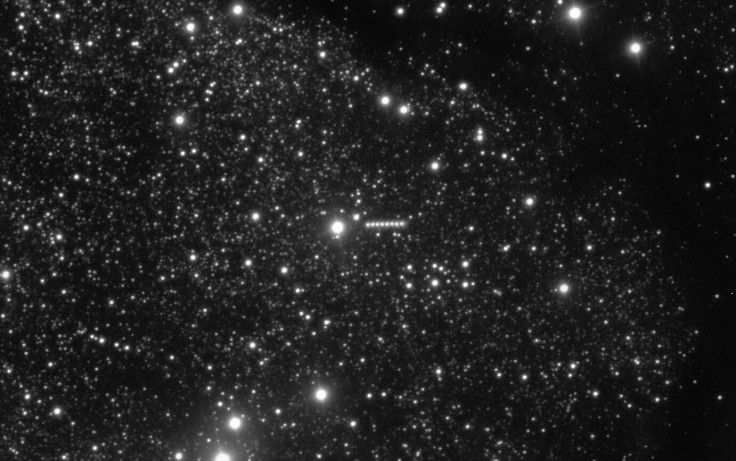
How the Stubborn Dust of 3I/ATLAS Withstood a Solar Encounter
The resilience of this material suggests that 3I/ATLAS is a primitive planetesimal—a frozen relic from the very early days of another star system. The 'polarisation colour curve' (PCC) showed a steady increase with wavelength between 0.6 and 1.2 µm, eventually peaking in the 1.5 to 2.0 µm range.
This specific pattern suggests the comet is comprised of dust aggregates made up of submicron-sized 'monomers.' These findings contrast sharply with 2I/Borisov, the second interstellar visitor discovered in 2019, which behaved much more like a traditional solar system comet.
While these tiny building blocks are roughly the same size as those found in our own comets, their 'refractory' nature—meaning they are highly resistant to heat and wear—is what sets them apart. The James Webb Space Telescope (JWST) had already found signs of this problem in its previous spectroscopic data, which showed a coma made up of carbon monoxide instead of water vapor.
3I/ATLAS seems to have been made to last through the worst conditions in the galaxy. By studying these particles, we can see the building blocks that might have made up alien planets in the past.
The data shows the team of astronomers on Earth that 3I/ATLAS is really a messenger from the other side of the void. It keeps the features of a world we may never see, giving us a real connection to a planetary system billions of miles away. The ATLAS survey in Chile first found the object in July 2025. It is still moving away from our sun.
It leaves us with the humbling realisation that while the laws of physics might be universal, the ingredients for a world can be wonderfully, strangely diverse. This 'alien' comet hasn't just passed through our system; it has rewritten our expectations of what a comet can be.
© Copyright IBTimes 2026. All rights reserved.