

Northern Lights May Be Visible Across 11 US States Before Dawn Tuesday as NOAA Watches Possible G1 Storm
Several incoming solar eruptions could give northern US skywatchers an overnight opportunity to see the aurora, although timing and conditions remain uncertain
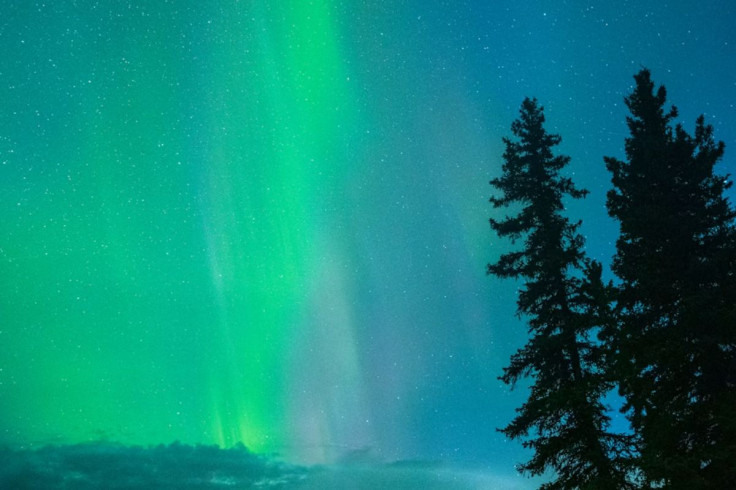
Northern lights could glow over parts of 11 US states before dawn on Tuesday, 8 September, as forecasters at the National Oceanic and Atmospheric Administration (NOAA) track several coronal mass ejections that may trigger minor G1 geomagnetic storm conditions.
The best chances are expected across Alaska and northern states close to the Canadian border. The aurora outlook follows recent solar activity, including three M-class solar flares, weaker eruptions and multiple coronal mass ejections (CMEs).
NOAA said some CMEs could reach Earth overnight on Monday, 7 September, into early Tuesday, although the timing and strength of any display remain uncertain.
Forecast Depends on Incoming CMEs
NOAA's Space Weather Prediction Center said geomagnetic activity could reach active to G1 storm levels on 7 and 8 September because of anticipated CME arrivals. One eruption from 2 September was initially expected to pass mostly ahead of Earth's orbit, but forecasters later said it might reach Earth on 7 September.
Another CME from 4 September could interact with an earlier eruption and produce a glancing impact late on 7 September or early on 8 September. NOAA modelling also indicated that three CMEs from 5 September could merge as they approach Earth on 8 September.
A further CME from 6 September may arrive late on 8 September or early on 9 September.
NOAA's latest forecast said isolated G1 (Minor) geomagnetic storm periods were likely on 8 and 9 September, with a slight chance of G2 (Moderate) conditions if the incoming CMEs reach Earth as forecast. The agency said confidence remained low over their timing and magnitude.
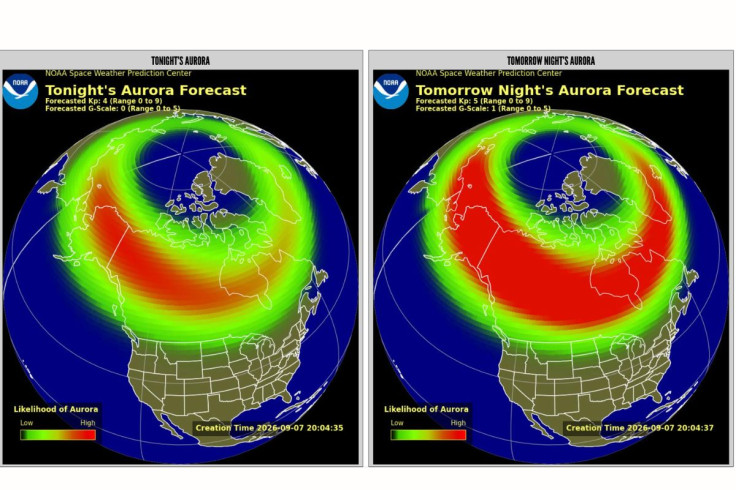
Could Reach 11 Northern US States
If G1 conditions develop, auroras could be visible from dark locations across Alaska and parts of North Dakota, Maine, Minnesota, Vermont, Montana, New Hampshire, South Dakota, Washington, Wisconsin and Michigan. Clear skies will still be essential, and a widespread display is not guaranteed.
Whether the aurora brightens will also depend partly on the interplanetary magnetic field, particularly its north-south component, known as Bz.
When Bz turns southward, solar wind can transfer energy into Earth's magnetic environment more efficiently, improving the prospects for geomagnetic activity.
Anyone hoping to watch should find a dark location away from city lights, face the northern horizon and allow time for their eyes to adjust. Viewing prospects are generally strongest late at night and around midnight, although auroras can appear at other times.
The forecast can also shift quickly as scientists receive better information about the timing and magnetic orientation of incoming solar material.
Northern Lights May Look Brighter Through a Phone
Even when an aurora appears faint or grey to the naked eye, a smartphone camera can sometimes record stronger colours.
For photographing faint auroras, a tripod or stable surface can help reduce blur, while Night Mode or Pro Mode and exposures of around five to ten seconds may capture colours that are difficult to see with the naked eye. Shooting in RAW format can also provide more flexibility when editing photographs later.
More Storms Possible Into Midweek
Further activity is possible into midweek. The UK Met Office said there was a chance of G2 (Moderate) geomagnetic storm conditions from later on 8 September, with the broad peak risk centred around midnight into 9 September.
September also tends to favour aurora activity around the equinoxes. The 2026 September equinox occurs on 22 September in the US, or at 00:05 UTC on 23 September, during a period when Earth's magnetic orientation can favour stronger interactions with the solar wind.
NOAA also anticipates active geomagnetic conditions from 14 to 16 September because of a recurrent negative-polarity coronal-hole high-speed stream. G1 storming is forecast again from 24 to 26 September because of a positive-polarity high-speed stream, with active conditions anticipated on 27 September.
NOAA's 30-minute aurora forecast and updated space weather guidance remain the main tools to watch as the expected CME arrivals develop.
© Copyright IBTimes 2026. All rights reserved.