

Company Plans to Project Corporate Logos Onto the Moon Using Lunar Rover Equipped With AI Computer
HPE's Spaceborne computer will run AI and supercomputing tests
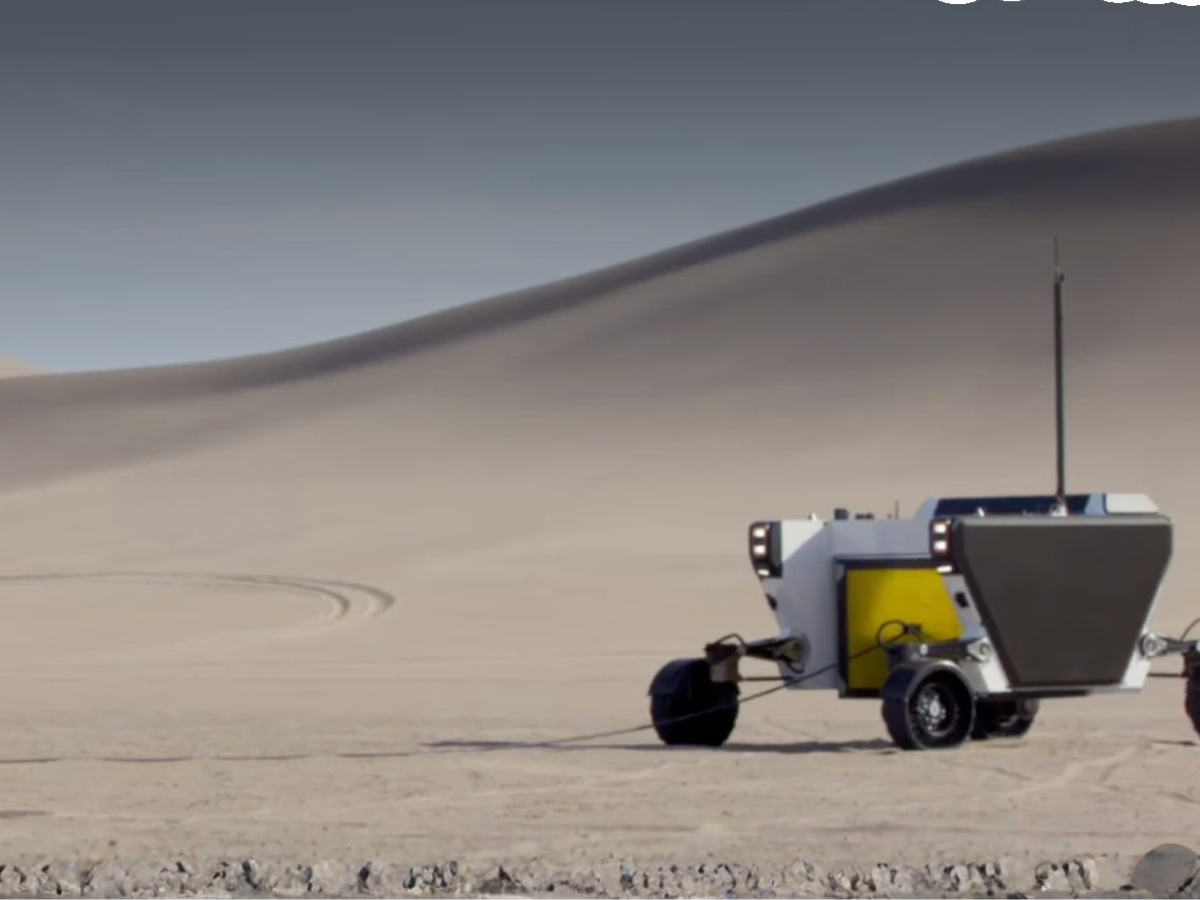
A half-tonne robot is about to turn a patch of the Moon into a billboard.
Astrolab, a California rover maker, has built its first lunar vehicle to do two very different jobs. One is commercial: a projector designed to cast partners' logos onto the surface near the Moon's south pole. The other is computational: carrying a compact artificial intelligence computer from Hewlett Packard Enterprise (HPE), among the most powerful machines ever bound for the lunar surface.
The vehicle is called FLIP, short for Flex Lunar Innovation Platform. At roughly 7 feet (2.13 m) long and about 500 kilograms, it is, by The Register's reckoning, the largest American rover bound for the Moon since the crewed buggies of the Apollo era. It is built to run for about a year, enduring lunar nights that stretch close to 14 Earth days.
Why a Lunar Rover Is Carrying a Projector
The projector is the detail that has drawn the most attention. The Register, which interviewed the firms behind the mission, describes its purpose as casting partners' logos onto the surface, an advertising gimmick aboard a rover that also tests new hardware. Astrolab has made no secret of wanting to commercialise its vehicles.
In 2024, it tied its larger FLEX rover to a lunar advertising venture with the creative agency Group of Humans, which named Volvo, Lego, and Nike among interested brands.
There is real money in prospect. A PwC study cited by the European Space Agency put cumulative lunar revenue opportunities at about €142 billion (around $159 billion or £119 billion) by 2040, and companies are already jostling for position.
The AI Computer Going to the Moon
The serious cargo is HPE's Spaceborne Computer 4, or SBC4, a box about 5 by 10 inches and an inch thick, built largely from off-the-shelf parts rather than specialist radiation-hardened chips. The unit pairs a low-power processor with a graphics chip, though HPE will not say who makes the silicon, telling The Register only that its compute partner preferred not to attach its name to so risky a venture. 'One of the best use cases of GPUs in space is imaging,' Nvidia chief executive Jensen Huang has said.
The computer is meant to process data where it is gathered rather than ferry raw footage home, which matters when a round trip between Earth and the Moon takes about 2.5 seconds, and bandwidth is scarce. 'It's important to ship back insight to Earth rather than all the raw data whenever possible,' Astrolab chief executive Jaret Matthews said.
SBC4 will run tuned large language models, machine learning on camera and LiDAR feeds, and two standard supercomputing benchmarks that could log the first such test ever taken on another world. One benchmark has a second use: the heat it throws off could help keep the rover from freezing through the fortnight-long lunar night.
Mark Fernandez, HPE's chief scientist of space tech and solutions, said the approach has held up, reporting 'zero SSD failure since 2019,' after early drive faults were traced to poor capacitors rather than radiation. He describes the method as hardening carried out in software, built to work 'at the edge of the edge.'
A Falcon Heavy Launch to the South Pole
Reaching the Moon rests on another firm entirely. FLIP travels as a passenger on Griffin Mission One, a medium-class lander built by Pittsburgh's Astrobotic Technology, now part of Voyager Technologies. NASA designated the flight Moon Base II in May 2026, a Commercial Lunar Payload Services task order it has held since 2020. The lander was first meant to carry NASA's VIPER ice-hunting rover, until the agency dropped that pairing in 2024 and rebuilt the mission around other cargo. VIPER has since been revived for a separate 2027 flight.
Launch is targeted for no earlier than November 2026 on a SpaceX Falcon Heavy from Kennedy Space Center, with touchdown planned in the Nobile Crater region near Mons Mouton. Venturi Space, Astrolab's strategic partner, supplied the rover's airless wheels and battery. For now, though, the attention stays with the projector, and the prospect of a corporate logo cast across a stretch of the Moon no advertiser has ever reached.
© Copyright IBTimes 2026. All rights reserved.