

Amazon Accused of Using AI to Predict Which Warehouses May Unionise by Analysing Reddit Posts and Worker Surveys
Court-disclosed documents describe warehouse-level risk scoring, raising questions about transparency and workers' rights
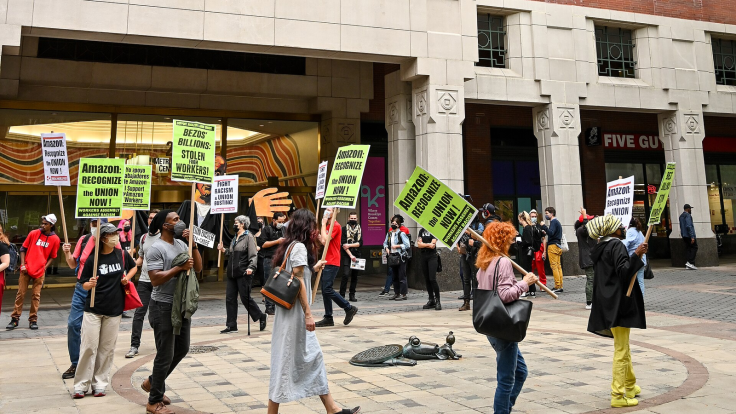
Amazon is facing scrutiny over an AI-assisted system reportedly designed to predict which warehouses are at greater risk of union organising, raising questions about how workforce data is used to anticipate collective action.
The framework, known as Atlas, reportedly draws on information including employee feedback, safety incidents, staff turnover, previous industrial action, local economic conditions, and Reddit discussions. Its assessments are intended to identify facilities considered more vulnerable to labour disruption.
The revelations raise questions about how such predictions influence management decisions, what safeguards govern the use of workers' information, and whether employees can challenge assessments that may shape how their workplaces are managed.
How Atlas Scores Union Risk
Atlas reportedly assigns warehouses scores between 100 and 900, with lower scores indicating higher perceived risk. The system also uses a five-tier classification to group facilities according to their assessed likelihood of labour disruption.
Documents disclosed during legal proceedings involving Amazon and Canadian union Unifor reportedly place two UK facilities, BHX4 near Coventry, and EMA4 in Sutton Coldfield, in the highest-risk tier. Fourteen other warehouses in the US and Canada were also reportedly classified in that tier.
These rankings are assessments, not proof that organising was imminent or that the system's predictions were accurate. Available reporting does not establish how well Atlas performed or whether the listed sites retain those classifications.
Amazon Denies Tracking Individual Workers
Amazon disputes the suggestion that Atlas was used to counter union activity. A spokesperson said the system operates at site or building level and does not track individual employees' opinions, affiliations, or union membership.
The company says its purpose is to identify where workers need support and where concerns should be addressed. Amazon has also reportedly said Atlas is no longer used under that name and is not currently deployed in the UK.
That qualification is significant: the disclosed material does not establish that Atlas is operating in British warehouses now, nor does it show whether a comparable system is used under another name.
Even without individual profiles, warehouse-level assessments could influence staffing, resource allocation or management priorities. The documents reportedly describe the framework as informing resource planning and labour-risk mitigation, but do not establish how managers acted on particular scores or whether workers were affected as a result.
Data Protection and Transparency Questions Remain
The Information Commissioner's Office says workplace monitoring must comply with data protection law, including requirements for lawful and fair processing, transparency, and limiting data collection to what is necessary. A data protection impact assessment may be required where processing is likely to pose a high risk.
These rules do not establish that Atlas is unlawful. That would depend on how the system operates, what information it processes, its purpose, and how its outputs are used.
Important details remain unclear, including how long data is retained, how predictions are tested, who reviews the scores, and whether workers can challenge inaccurate information or misleading interpretations of their feedback.
A risk score is not evidence that employees intend to organise. Without clear criteria and oversight, workers may have little insight into how their comments or online discussions contribute to an assessment of their workplace.
Unions Call for Answers
GMB has criticised the reported approach and demanded clarity about how Amazon assesses labour risks. Union organiser Rachel Fagan said, 'Workers deserve to be able to work free of the fear of excessive surveillance.'
Michael Newman, a partner at Leigh Day, also questioned the framing of higher scores as 'better' for company leaders, according to the reporting. The documents do not prove that Amazon used Atlas to punish individuals or unlawfully obstruct union membership. Amazon maintains that the system is intended to identify workplace concerns, rather than monitor individual workers' union affiliations.
The central question is whether such tools help employers resolve problems or prepare management for potential organising. Transparent criteria, independent scrutiny, and a meaningful way to challenge inaccurate assessments would help establish how the system is used and what safeguards protect workers.
© Copyright IBTimes 2026. All rights reserved.