

Trump's $5,000 Promise Could Cost Over $1 Trillion, but Congress Has Yet To Approve the Payments
The proposed nationwide dividend carries an estimated £906 billion cost and remains strictly conditional
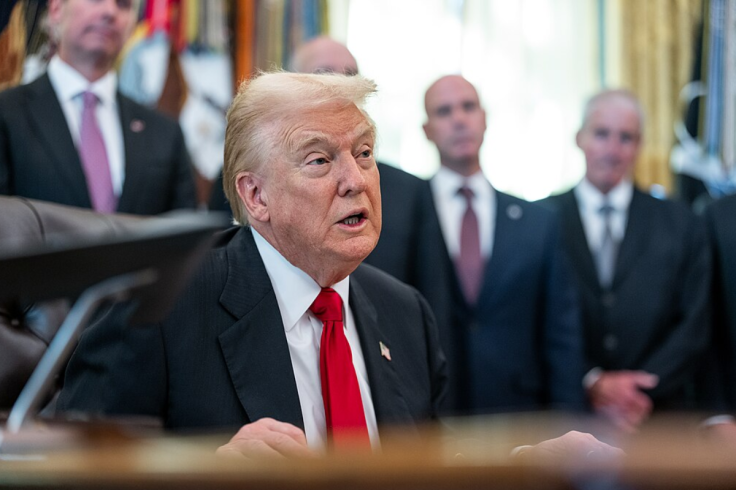
President Donald Trump renewed his promise to pay $5,000 (€4,470 and £3,780) to adult US citizens at a campaign rally in Youngstown, Ohio, on Monday, 12 October.
He said Republicans must retain both chambers of Congress in November's midterm elections. The proposal could cost about $1.2 trillion (€1.07 trillion and £906 billion), but lawmakers have not approved the payments.
The president first announced the proposed 'Trump Dividend' at the Republican midterm convention in Dallas, Texas, on 9 September.
He has repeated it in campaign appearances and videos, promising a nationwide payout if his party wins the House and Senate.
Donald Trump's $5,000 Payments Raise a Trillion-Dollar Question
At the Ohio rally, Trump said Republicans could fund the dividend using tariff receipts and what he called the country's record economic success. His remarks echoed an argument in a White House statement after the Dallas announcement.
But the sums involved are formidable. A Reuters calculation put the adult citizen population at roughly 240 million. Paying each person $5,000 would cost about $1.2 trillion (€1.07 trillion and £906 billion).
Republican Representative Chip Roy separately put the potential fiscal year 2027 cost at around $1.2 trillion (€1.07 trillion and £906 billion). That is an estimate of a proposed expense, not an allocation Congress has already made.
TRUMP DOUBLES DOWN ON HIS $5,000 PROMISE 💵
— TRUMP TV Report (@TRUMP_TV_News) October 12, 2026
"I'm going to give all adult citizens in The United States Of America $5,000."
"If the Republicans win, you will each have $5,000."
22 days. Your vote decides it. 🇺🇸 pic.twitter.com/hDOrHSj5Ac
Douglas Holtz-Eakin, president of the American Action Forum and former director of the Congressional Budget Office, was similarly sceptical. In an interview with The US Sun, he questioned whether officials could find $1.5 trillion (€1.34 trillion and £1.13 trillion) to finance the programme.
Asked how seriously voters should take the promise, he replied, 'not seriously at all'. His assessment concerned the plan's feasibility, rather than any formal budget decision.
Trump has cited tariff revenue and economic growth as potential ways to support the dividend. Yet neither provides a detailed financing plan, and current tariff collections fall well short of the estimated cost.
Borrowing could increase federal debt, while raising taxes or redirecting spending would create different trade-offs. The final economic consequences would depend on how, and whether, Congress financed the payments.
Eligibility remains unsettled, too. Trump has promised money to all adult citizens, although Vice President JD Vance suggested wealthier Americans might not qualify. Officials have not explained how they would verify recipients or deliver payments.
Earlier ideas have also fallen short of nationwide payouts. A proposed $5,000 dividend from government efficiency savings and a separate $2,000 (€1,790 and £1,510) tariff rebate were distinct schemes. Neither produced the envisaged payments.
Donald Trump's Election Condition Brings Congress and the Law Into Focus
Trump has tied his pledge expressly to Republican control of both the House and Senate after the 3 November vote. Republicans winning only one chamber would not satisfy the condition he announced.
The promise has divided politicians. Ohio Republican Senator Bernie Moreno said he would prepare legislation after the election, while Roy raised concerns over the cost.
Arizona Democratic Senator Mark Kelly went further. During a 4 October interview on CBS's Face the Nation, he accused Trump of 'trying to buy votes.' That was Kelly's criticism, not a legal finding.
Federal law prohibits certain payments intended to induce people to vote, abstain or support a candidate. A generally available public benefit offered as a campaign promise, however, is not automatically an unlawful inducement.
New Mexico attorney John Day argued that the proposal would be legal if recipients qualified regardless of whether they voted or whom they supported. Holtz-Eakin likewise stopped short of saying the pledge crossed a legal line.
Congress controls federal appropriations, and Republican majorities would not eliminate the need for lawful authorisation. Lawmakers would still have to establish eligibility, determine funding and decide how any programme would operate.
As of 13 October, no approved nationwide $5,000 dividend is available to claim. Whatever the November result, the government cannot issue cheques under the proposed programme without further action.
© Copyright IBTimes 2026. All rights reserved.