

NASA Detects 'Anomalous' Signals as Scientists Debate If New Interstellar Visitor 3I/ATLAS Is Artificial
Is 3I/ATLAS artificial? New data on the 14-billion-year-old interstellar comet reveals 'impossible' emissions
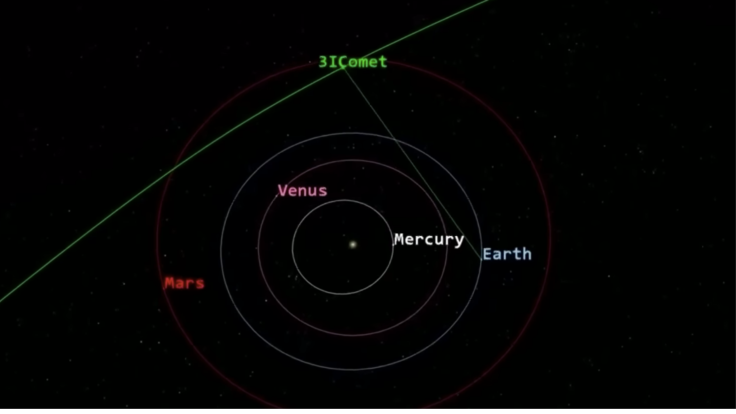
In a time when the night sky seems mapped out and predictable, one traveler from the deep galactic dark has come to remind us that the universe can be mysterious. NASA's Asteroid Terrestrial-impact Last Alert System found the interstellar comet 3I/ATLAS in Chile on July 1, 2025. It has quickly become the most talked-about celestial object of the decade.
This visitor moves at an astonishing 58 kilometers per second and is not affected by our Sun's gravity. It is a real outsider — it's the third confirmed interstellar object ever found, after the mysterious 'Oumuamua in 2017 and 2I/Borisov in 2019.
But as 3I/ATLAS makes its last pass through our area, it brings with it a storm of controversy about its age, chemistry, and even what it really is. In early January 2026, reports came out about strange radio emissions picked up by NASA's Deep Space Network and the Europa Clipper spacecraft. This made planetary defense protocols kick in so that the emissions could be closely watched.

The Ancient Origins of 3I/ATLAS
While most comets in our solar system are roughly 4.6 billion years old, 3I/ATLAS appears to be a relic from a far more distant epoch. Research led by Associate Professor Michele Bannister of the University of Canterbury suggests the object could be between 8 and 14 billion years old. If the latter figure holds true, this comet was already ancient when our Sun was nothing more than a swirling cloud of dust.
Its chemical makeup further cements its 'alien' status. As it drew closer to the Sun's warmth, spectrometers detected unusually rich emissions of atomic nickel and iron — materials that are typically rare in the comas of local comets. Also, data from the James Webb Space Telescope showed that there was a huge amount of carbon dioxide, which suggests that the comet formed in a much colder place than our Kuiper Belt.
Many people think that 3I/ATLAS was made in the 'thick disk' of the Milky Way, which is where some of the oldest stars in the universe are located. Some scientists have said that the object's water emission rate, which is about 40 kilograms per second, is 'impossible' for a natural body that is so far away from the sun's heat.
Alien Signals or Natural Wonder: The Debate Over 3I/ATLAS
The unusual traits of 3I/ATLAS have inevitably revived the debate over extraterrestrial technology. Harvard astrophysicist Avi Loeb has been a vocal proponent of investigating the object's anomalies, specifically an unexplained 'sunward-facing anti-tail' — a jet of gas and dust that appears to point towards the Sun rather than away from it.
Loeb has tentatively estimated a 40% probability that such objects could be artificial in origin, noting that the CIA's 'neither deny nor confirm' response to FOIA requests regarding the comet marks the first time such secrecy has been applied to an astronomical body.
In response, the Breakthrough Listen project used the Green Bank Telescope and the MeerKAT array to scan the comet for technosignatures across a 1 to 12 GHz frequency range. Despite picking up nearly 471,000 candidate signals during its 18 December 2025 Earth flyby, researchers concluded that these were merely local radio interference.
'We all would have been thrilled to find technosignatures coming from 3I/ATLAS, but they're just not there', noted lead researcher Benjamin Jacobson-Bell. The Green Bank search was so sensitive it could have detected a transmitter as weak as 0.1 watts, less than a standard mobile phone.
Even as it leaves Earth in its rear-view mirror, the drama is far from over. On 16 March 2026, 3I/ATLAS will pass just 0.36 astronomical units (roughly 33 million miles) from Jupiter. This encounter is expected to provide a final, high-resolution look at the object as it passes near the Hill radius of the gas giant before it is ejected forever back into the interstellar void.
For now, 3I/ATLAS remains a haunting reminder that while we have mapped our own backyard, the fence between us and the rest of the galaxy is far more porous than we ever imagined.
© Copyright IBTimes 2026. All rights reserved.