

Harvard's Avi Loeb Suggests 3I/ATLAS Anti-Tail Must 'Contain Something Else'
Avi Loeb claims the 3I/ATLAS anti-tail contains large objects unaffected by the Sun. Is it alien technology?
In the vast, usually predictable ballet of the cosmos, the arrival of a single object has been enough to send shockwaves through the astronomical establishment. That object is 3I/ATLAS, only the third confirmed interstellar visitor to our solar system, and according to one of the field's most controversial figures, it is behaving in ways that suggest it is far from a standard comet.
Harvard astrophysicist Professor Avi Loeb has long argued that we should keep an open mind about these cosmic travellers. He initially gained notoriety for suggesting that the first interstellar object, 1I/'Oumuamua, could have been an extraterrestrial artefact. Now, he is turning the same piercing gaze on 3I/ATLAS, and his latest observations regarding its baffling 'anti-tail' are throwing down a gauntlet to conventional physics.
This interstellar anomaly is currently baffling experts with a whole host of bizarre features—its strange colour profile, a pulsating 'heartbeat' light curve, and an unusual chemical cocktail rich in methanol and hydrogen cyanide. But it is the behaviour of its mysterious 'anti-tail' that most recently caught Professor Loeb's attention.
He observes that this stream of material appears to flip in its orientation as the comet passes the Sun, yet does so without demonstrating the expected response to solar radiation. The professor argues that this is highly unusual for a normal comet and could signify a composition or even an origin that science is currently unwilling to admit.
The Strange Case of 3I/ATLAS and Avi Loeb: A Celestial Reversal
In standard cometary physics, as a comet streaks towards the Sun, the intense pressure of solar radiation and the solar wind typically push the liberated gas and dust away from the star, creating a vast, classic tail. However, 3I/ATLAS displays another feature: an 'anti-tail.'
An anti-tail is a common phenomenon that is simply an optical illusion. It is material that is still following the comet's orbit but, from our viewing angle on Earth, appears to trail ahead of the comet's nucleus, pointing roughly toward the Sun. This effect is caused by the large, heavier dust grains that are only gently pushed by the solar wind and radiation pressure, meaning they remain close to the orbital plane.
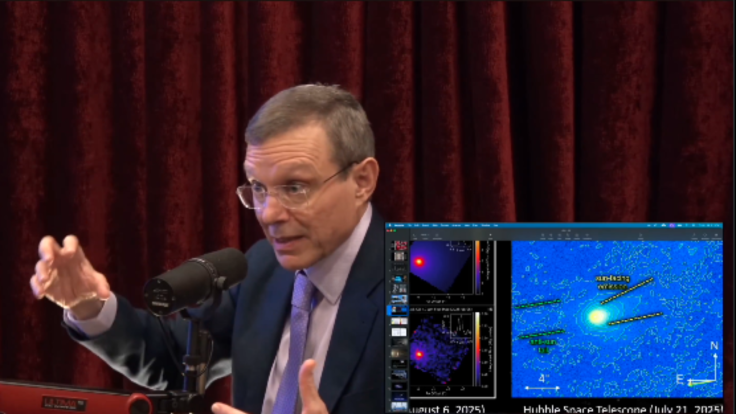
Professor Loeb highlights that images from the Hubble Space Telescope, both before and after 3I/ATLAS reached its closest point to the Sun (known as perihelion), show this anti-tail appearing to 'flip' relative to the object's direction of motion.
In a recent critique, the professor stated that a significant number of scientists are attempting to dismiss this and other anomalies—including the strange cluster of jets confirmed by the HiRISE camera near Mars—as mere observational quirks or conventional, albeit unusual, cometary behaviour. Loeb, however, is not satisfied with the quick dismissal, stating that the flipped anti-tail, which appears to point toward the Sun regardless of the comet's motion, 'is definitely not a matter of perspective.'
He suggests that the material making up the anti-tail must either consist of large fragments of ice that evaporate before the Sun's radiation can turn them around, or, more provocatively, that the anti-tail contains 'large objects that are not affected much by the solar radiation or wind.' This lack of response to the Sun's most powerful forces is where the argument for an unconventional structure—or even an artificial one—takes hold.

The Unflinching Stance of 3I/ATLAS and Avi Loeb
The stakes in this debate are high. 3I/ATLAS is only the third object of its kind we have ever encountered, and it offers a rare, possibly once-in-a-lifetime, chance to probe the physical and chemical composition of objects born around distant stars. It is believed to be incredibly old, originating in the Milky Way's 'thick disk' up to 11 billion years ago, making it substantially older than our four-and-a-half-billion-year-old Sun.
This antiquity, coupled with its highly unusual chemical makeup—which includes a high ratio of life-associated methanol to hydrogen cyanide—only fuels Professor Loeb's desire for a deeper, more agnostic investigation. He has suggested a 30 to 40 per cent chance that the object is not naturally formed, and has even theorised it could be a 'seed' carrying life, or something more sinister.
While NASA remains firm that 3I/ATLAS is a comet with complex but natural behaviour, Professor Loeb criticises the scientific community for what he calls a failure of imagination. He argues that by forcing every observation to fit into the 'comet' box, researchers risk overlooking a discovery that could fundamentally change humanity's place in the universe.
The comet will make its closest approach to Earth on December 19, 2025, before leaving our solar system forever. The coming weeks, as astronomers continue to scrutinise the object's trajectory and features, will be the final opportunity to gather the definitive data that could either confirm the complex, yet natural, comet hypothesis or lend further credence to Professor Loeb's extraordinary claims about a technological origin.
The clock is ticking on 3I/ATLAS. As this enigmatic visitor speeds towards the edge of our solar system, the scientific community faces a critical choice: to dismiss its anomalies as complicated but conventional physics, or to finally open the door to Professor Loeb's extraordinary hypothesis. With the object's closest approach on December 19, 2025, the moment to gather the definitive evidence, and to witness a potential paradigm shift, is now.
© Copyright IBTimes 2026. All rights reserved.