

NASA Comet 3I/ATLAS: How Government Shutdown Sparked Fears of an Alien Cover-up
3I/ATLAS: Inside the viral hysteria and NASA's 'cover-up' during the shutdown

It came from the dark, quiet parts of interstellar space, maybe from a place where the sun doesn't have much of an effect. It could have been born near a star that is much older than our solar system. We may never know for sure where it came from, but the arrival of comet 3I/ATLAS in the summer of 2025 has been one of the strangest events in modern astronomy, mixing real science with a storm of social media hysteria and government conspiracy theories.
The NASA-funded ATLAS survey in Chile found the object on July 1, 2025. It was quickly recognised as the third interstellar visitor to come to our cosmic neighbourhood. It was going much faster than its predecessors, at an incredible 137,000 miles per hour (221,000 km/h).
It was like the cigar-shaped 1I/'Oumuamua in 2017 and the clearly cometary 2I/Borisov in 2019. It was a golden ticket for astronomers to study a piece of another world. But for the internet, it was a chance to let your imagination run wild.
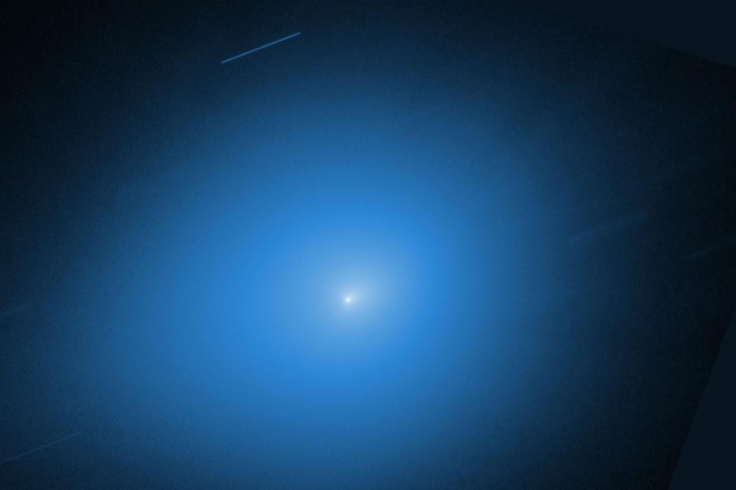
Alien Probes or Ancient Ice? The Mystery of 3I/ATLAS
The frenzy began almost immediately. Unlike previous visitors, 3I/ATLAS was spotted months before its closest approach to Earth, leaving a massive window for speculation to fester. By the latter half of 2025, claims that the comet was actually an extraterrestrial scout ship or an 'alien probe' were spreading like wildfire across social media.
The narrative was helped along by a perfect storm of political chaos. From Oct. 1- Nov. 12, a 43-day US government shutdown effectively silenced NASA's public affairs offices. As the agency went dark, the comet was racing through our system, and images captured by the Mars Reconnaissance Orbiter from just 18.6 million miles away remained behind closed doors.
In this information vacuum, conspiracy theorists thrived, accusing the space agency of 'holding the truth hostage' while the world watched from the sidelines. The blackout even affected the Minor Planet Center, which saw intermittent outages in the automated data streams usually used by global researchers to track the object's trajectory.
Even A-list celebrities joined the fray. Kim Kardashian took to X to demand that acting NASA administrator Sean Duffy spill the 'tea' on the object, while members of Congress began firing off letters demanding transparency. The 'post-truth' era had arrived in deep space, and the actual data was struggling to keep up with the drama.
Behind the Viral Hysteria: The Science of 3I/ATLAS
While the public 'lapped up' tales of alien technology, the scientific community remained grounded. Most of the sensationalism was traced back to a single, high-profile source: Harvard professor Avi Loeb.
Just weeks after discovery, Loeb published a non-peer-reviewed paper suggesting the comet's traits pointed toward alien tech, citing what he eventually termed '14 anomalies'. These included a strange periodic wobble and a 'jet-sun geometry' where the comet's rotation axis was aligned within 8 degrees of the sun — a feat he calculated had only a 0.005 chance of occurring naturally.
'It's because of Avi Loeb,' science writer Mick West noted. He argued that the prestige of a Harvard professorship makes such claims an 'easy sensational story' for the media to digest. Loeb, however, stood by his 'detective story', citing millions of views on his essays and a viral appearance on the Joe Rogan Experience as proof of the public's hunger for the extraordinary.

However, as NASA's Nicky Fox confirmed during a November briefing, the reality is far more 'typical'. Observations from the Psyche spacecraft and Europe's Mars Trace Gas Orbiter showed the comet behaving exactly as expected.
The 'anomalous' acceleration that Loeb attributed to thrusters was, according to experts, simply the result of frozen gases escaping as the sun warmed the nucleus. Detailed spectroscopic analysis by the James Webb Space Telescope further debunked the 'tech' theory, revealing the object was rich in carbon dioxide and cyanide gas, hallmarks of a natural, albeit alien, comet.
Recent data from the Gemini North telescope and X-ray observatories like XMM-Newton have revealed a massive cloud of gas streaming 250,000 miles around the comet's core. Interestingly, while the comet originally appeared deep red, it turned a vivid green as it approached its perihelion on Oct. 29, a result of diatomic carbon being excited by sunlight.
It is a stunning display of natural physics, yet it lacks the tabloid punch of an alien invasion. As discoverer Larry Denneau admitted, fighting misinformation is 'always an uphill battle', especially when the truth is far less cinematic than the fiction.
The idea of an alien visitor fascinated people all over the world, but the data shows that 3I/ATLAS is a natural wonder, not a man-made mystery. As it makes its lonely way back into the emptiness of space, it reminds us of how big, beautiful, and often misunderstood our universe is.
© Copyright IBTimes 2026. All rights reserved.