

3I/ATLAS Discovery: Only 6% Chance That Object's Alignment Is a Mere Accident
Interstellar visitor 3I/ATLAS reveals a strange 'heartbeat' and improbable solar alignment

The depths of interstellar space have thrown another cosmic puzzle into our solar system. The most recent information about the visitor known as 3I/ATLAS has astronomers both confused and interested. The object has started to show secrets about its internal rhythm and a strange, almost haunting alignment that is hard to explain after it got close to the sun on Oct. 29, 2025, a point known as perihelion.
Professor Avi Loeb from Harvard University has been tracking the object's 'heartbeat' with the help of Toni Scarmato. The team was able to figure out how fast this interstellar nomad is spinning by looking at pictures from the Hubble Space Telescope taken between Nov. 20 and Dec. 27, 2025, and data from the 0.25-meter MPC L92 telescope in Calabria, Italy, taken between Dec. 9 and 22, 2025. The results point to a post-perihelion rotation period of about 7.1 hours, but the direction of this spin is what has scientists talking.
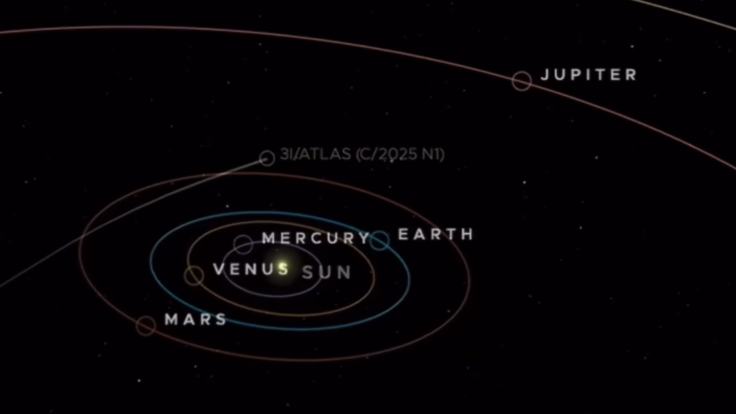
The Mystery of the 3I/ATLAS 'Heartbeat' and Solar Alignment
One of the most startling findings is that the rotation axis of 3I/ATLAS appears to be aligned with the sun-3I/ATLAS axis to within 20 degrees. This was inferred because the average position angle of the jet structure is 270 (+/-3) degrees, while the sun-3I/ATLAS axis sits at 290 degrees.
In the vast, chaotic vacuum of interstellar space, where the object's rotation was established long before it ever felt the sun's warmth, such an alignment is statistically improbable. According to Loeb's analysis, there is only a 1.5% to 6% chance of this happening by mere accident.
'This surprising alignment needs to be explained, as the rotation axis was set in interstellar space, far from the sun,' Loeb noted. The anomaly suggests that the way the object is 'beaming' its material into space is far more complex than a simple tumbling rock.
The research utilised two distinct methods to clock the object:
- First, they tracked the periodic 'wobble' of the jet structures — essentially plumes of gas and dust — using a Larson-Sekanina Rotational Gradient filter on Hubble images. This showed a wobble of +/-20 degrees every 7.20 (+/- 0.05) hours.+3
- Second, they measured the 'heartbeat' of the object's brightness, which modulated by roughly 30% every 7.136 (+/- 0.001) hours.+1
This 'heartbeat variability' is a process where the jets pump dust and gas into the coma like a heart pumping blood through veins into a body.
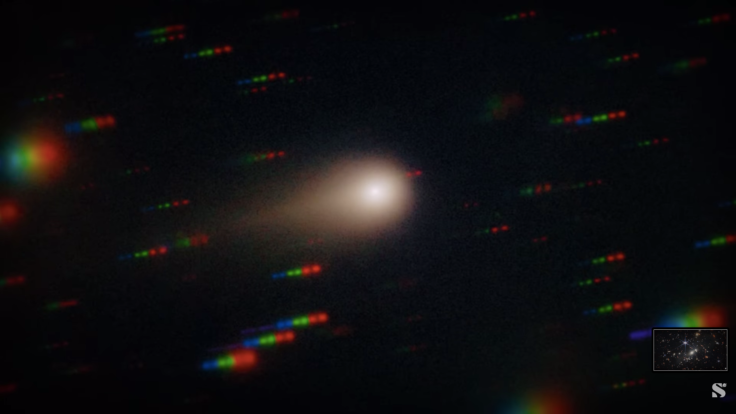
Why the 3I/ATLAS Perihelion Passage Changed Everything
Interestingly, the object's behaviour seems to have shifted since it rounded the sun. Before perihelion, observations suggested a much slower rotation period of roughly 16 to 17 hours based on brightness.
However, the jet precession — the 'wobble' — has remained relatively stable, previously measured at 7.74 (+/-0.35) hours before its closest solar approach. This discrepancy suggests that the Sun's heat may have activated a second jet.
As the object passed perihelion, the sun likely began to illuminate a second rotation pole that was previously in darkness. This 'double jet' effect would explain why the brightness now fluctuates twice as fast as before, even if the underlying physical rotation of the nucleus hasn't sped up quite so dramatically.
The data confirms that the light we see isn't actually reflecting off a solid surface. In fact, based on the first Hubble image from July 21, 2025, less than one per cent of the scattered sunlight originates from the surface of the nucleus. Instead, we are seeing the glow of the 'coma' — the cloud of debris surrounding it.
As the nucleus rotates, the dominant outflow direction sweeps around the rotation axis, changing the column density of dust along the line-of-sight and the distribution of dust within the photometric aperture.
As 3I/ATLAS continues its journey, all eyes are now on Jan. 22, 2026. On this date, the object will reach 'opposition,' sitting within 0.69 degrees from a perfect alignment opposite the sun with the Earth positioned directly in the middle.
This rare geometric alignment will provide the clearest view yet of this interstellar mystery, offering a final chance to determine if 3I/ATLAS is a natural curiosity or something even more extraordinary.
© Copyright IBTimes 2026. All rights reserved.