

3I/ATLAS Mystery: Why Is NASA Hiding Observation Logs Of Interstellar Visitor?
NASA faces transparency concerns as the interstellar object 3I/ATLAS exhibits 'anomalous' behavior that defies standard physics.

When an object tumbles through the cosmos exhibiting behaviours that defy established physics, the institutions responsible for studying it bear an obligation to the public—and to science itself. Yet as 3I/ATLAS continues its journey through our solar system, a troubling gap has emerged between what NASA's most sophisticated instruments can observe and what the agency is willing to share. The question now is whether legal action might be the only way to force the disclosure that scientific integrity demands.
The first clue came not from what was released, but from what remained conspicuously absent. When reviewing NASA's observation logs for 3I/ATLAS, the contrast becomes immediate and striking: despite deploying some of the most advanced space-based instruments humanity has ever built, the publicly available imagery remains surprisingly sparse, heavily processed, and delayed by weeks.
Meanwhile, multiple independent observers—both professional astronomers and serious amateurs—have flagged behaviours in this object that simply do not fit the textbook. That chasm between capability and transparency now raises an uncomfortable legal question: could someone with sufficient standing take this matter to court and demand fuller disclosure, particularly as the observational window for this ancient visitor continues to narrow?
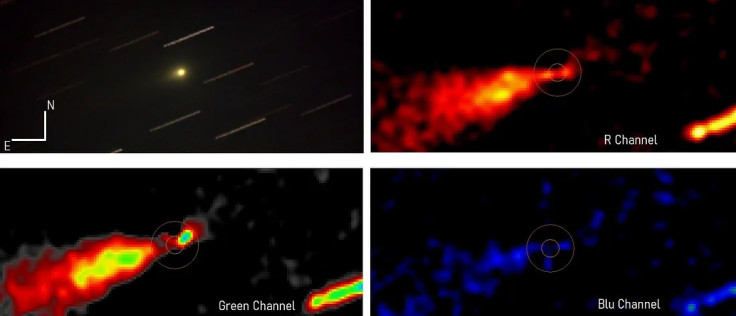
The Anomaly That Refuses to Fit: Understanding 3I/ATLAS
3I/ATLAS is far from an ordinary comet. The fact that it originated from another star system alone places it outside the normal statistical patterns of near-Earth object monitoring. But what truly sets this object apart are the peculiarities that months of observation have revealed—both from professional teams and amateur observers alike.
But what truly sets this object apart are the peculiarities that months of observation have revealed—both from professional teams and amateur observers alike.
The evidence is accumulating. There is a persistent sun-facing anti-tail, which violates simple comet models. There are episodic jet-like structures that appear to pulse rhythmically rather than fade smoothly as physics would normally predict. There is unexpected non-gravitational acceleration—the object is moving in ways that don't align with gravitational influence alone.
Analysis by the Two-metre Twin Telescope at Tenerife's Teide Observatory has detected a faint jet of gas and dust blasting from 3I/ATLAS that slowly wobbles as the comet rotates, confirming a rotation period of 14–17 hours tied to visible activity on its surface—the first time astronomers have directly measured such movement in an interstellar comet. And then there are the thermal and ultraviolet signatures, fluctuating in patterns entirely inconsistent with the simple melting and vaporisation of ice.
Observations by the James Webb Space Telescope reveal that 3I/ATLAS is unusually rich in carbon dioxide and contains water ice, water vapour, carbon monoxide, and carbonyl sulfide—elements more exotic than those found in most solar system comets. Individually, each of these anomalies might be brushed aside as a freak case, an edge of natural variance. But woven together, they compose a pattern demanding genuine scrutiny.
The scientific establishment knows this. Yet what the public has received remains decidedly limited—a handful of processed frames, reduced composites, and vague summaries, often delayed by weeks after collection. Historical precedent tells a different story: objects far less anomalous have been released with substantially greater clarity and far more rapidly. That disparity is not accidental; it raises questions about institutional priorities.

The Legal Path Forward: Transparency and Accountability in Space Science
From a legal standpoint, the central question is not whether NASA has acted unlawfully in some blanket sense, but whether the agency has a duty to disclose information under existing federal transparency legislation when the subject implicates public safety, planetary defence, or significant scientific uncertainty. The Freedom of Information Act provides one mechanism, though FOIA requests—governed under existing federal statutes—have well-documented vulnerabilities.
They move at glacial pace. Responses are heavily redacted. Agencies routinely invoke broad exemptions citing deliberative process or national security. When that happens, litigation becomes the only meaningful path to force judicial review of whether those exemptions are genuinely justified.
It would be very important to stand. A potential plaintiff must exhibit more than mere curiosity; a definitive interest, whether scientific, professional, or related to public safety, is required. This could include astronomers and research institutions that need quick access to raw data from space-based observatories, planetary defence organisations that need to look at near-Earth objects and possible threats, or journalists who can say that not giving them information stops them from telling the public about things that are important.
Historically, courts have been more open to nondisclosure when it is linked to real risk assessment rather than just intellectual curiosity. The scientific cost of silence is equally profound. Harvard astrophysicist Avi Loeb has been explicit: interstellar objects represent an entirely new class of astronomical data—one potentially carrying information about other star systems, or at minimum about physical processes rarely observed in detail.
Delaying or suppressing access to the highest-fidelity data does not simply frustrate curiosity; it undermines verification, replication, and falsification—the three pillars upon which scientific integrity rests. International collaboration, which both NASA and the European Space Agency continually champion, becomes meaningless when the fundamental evidence is kept from view.
There is also the planetary defence dimension, one that transcends academic interest. With 3I/ATLAS's closest approach to Earth occurring on 19 December 2025 and subsequent passes by Venus (3 November 2025), Mars (3 October 2025, already completed), and Jupiter (16 March 2026), the gravitational interactions of this ancient visitor offer unprecedented opportunities to refine our understanding of celestial mechanics and detection capabilities.
Objects displaying unexplained acceleration or structural peculiarities raise questions—however distant—about impact modelling, detection thresholds, and response protocols. Even if every anomaly ultimately resolves into a natural phenomenon, the method by which that conclusion is reached matters profoundly. Transparency builds institutional trust; opacity manufactures speculation. In fact, withholding data may generate more public unease than candid disclosure ever could.
As the observational window on 3I/ATLAS gradually narrows, the defining question may no longer be what this object actually is. Instead, it becomes whether the institutions entrusted with observing it will permit independent scrutiny of the evidence in their possession.
© Copyright IBTimes 2026. All rights reserved.