

3I/ATLAS Update: South African MeerKAT Telescope Unveils Truth Behind Radio Signals
South Africa's MeerKAT telescope confirms 3I/ATLAS Is a natural interstellar comet, not an alien artefact
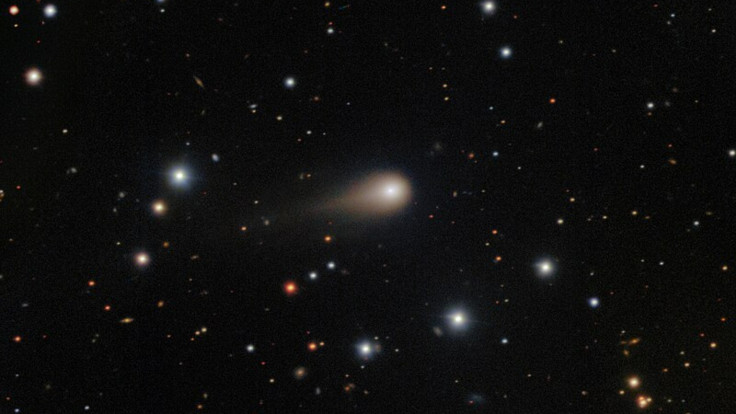
The third interstellar visitor, 3I/ATLAS, came into our solar system this summer. It did more than just set off astronomical alerts; it made us even more curious about what lies beyond our own sun. Like 'Oumuamua and 2I/Borisov, this new traveler came with a lot of expectations.
The Asteroid Terrestrial-impact Last Alert System (ATLAS) first saw the object on July 1, 2025, in Río Hurtado, Chile. It was easy to see because it was moving in a very strange way and at an incredible speed of 137,000 miles per hour. Is this the one? Could this finally be the evidence of work done by a civilisation outside our solar system?
But new information from the southern hemisphere's strongest 'eye' has brought us back to earth, or at least to the cold truth of deep-space chemistry. A group of researchers from around the world has been able to figure out what this cosmic guest is using the powerful MeerKAT radio telescope in South Africa. Their results show that 3I/ATLAS is definitely a rare wonder, but it is not a piece of alien technology; it is a natural phenomenon.
Deciphering the Icy Fingerprints of 3I/ATLAS
To understand what 3I/ATLAS is made of, scientists looked for a specific cosmic 'smoking gun': the hydroxyl maser. Most comets are essentially 'dirty snowballs' composed of water ice. As they venture into the warmth of our inner solar system, solar heat causes that ice to sublime, turning directly into gas. Ultraviolet light from the sun then tears those water molecules apart, leaving behind hydrogen and hydroxyl (OH) fragments.
It is here that the MeerKAT telescope, located in the Karoo region, proves its worth. The hydroxyl molecules act like tiny radio transmitters, absorbing or emitting signals at very specific frequencies that fall right within MeerKAT's operational sweet spot. Between September and November 2025, the team, led by experts from the University of Cape Town, SARAO, and Sweden's KTH Royal Institute of Technology, hunted for these signals.
Initially, the search was frustrating. Observations in late September yielded nothing, though the telescope did manage to pick up a signal from a distant Mira-type variable star in the background — a serendipitous 'sanity check' that proved the equipment was functioning perfectly. The breakthrough finally arrived on Oct. 24. At a staggering distance of over 350 million kilometres from Earth, MeerKAT detected hydroxyl absorption from 3I/ATLAS.
At this stage, the visitor was rapidly approaching its perihelion — the closest point to the sun — which it reached on Oct. 29, 2025 at a distance of approximately 1.4 astronomical units (AU), placing it just inside the orbit of Mars. This was followed by more detections in early November, which eventually flipped from absorption to emission as the comet's geometry relative to the sun shifted.
'Detecting the hydroxyl signal is an important confirmation that 3I/ATLAS is behaving like a comet,' explained Professor Mykola Ivchenko of KTH Sweden. For the scientific community, this was the definitive proof: the visitor was a natural comet, likely formed in the icy outskirts of a distant, unknown star system located in the direction of the constellation Sagittarius.

Breakthrough Listen Fails to Find Tech Signatures in 3I/ATLAS
Despite the 'natural' explanation gaining ground, the search for something more exotic continued in the background. Running alongside the standard scientific instruments was the BLUSE hardware, operated by the Breakthrough Listen project. This high-spec kit is designed for one specific purpose: to sift through the noise of the universe for 'technosignatures' — narrowband radio signals that simply do not occur in nature.
The sensitivity of this search was truly mind-bending. Analysis from Nov. 5 confirmed that no such signals were detected between 900 and 1670 MHz. To put the precision of this equipment into perspective, the team established a power limit of 0.17 W. In layman's terms, if there were a mobile phone tucked away on the surface of 3I/ATLAS, hundreds of millions of kilometres away, MeerKAT and BLUSE would have heard it ringing.
The silence, in this case, was profound. While the lack of an alien greeting might disappoint some, the feat of tracking a small, dark object — estimated by the Hubble Space Telescope to be anywhere from 440 metres to 5.6 kilometres across — is a triumph for South African astronomy. SARAO chief scientist Fernando Camilo noted that the team is proud to contribute to the understanding of this 'remarkable natural phenomenon'.
As 3I/ATLAS makes its closest approach to Earth today, Dec. 19, 2025, passing safely at a distance of 170 million miles, it begins its long journey back into the interstellar void. It leaves us with a better understanding of how water — the essential ingredient for life — is distributed throughout the galaxy.
As 3I/ATLAS begins its long journey back into the interstellar void, it leaves us with a better understanding of how water — the essential ingredient for life — is distributed throughout the galaxy. While this visitor was not the alien craft some had hoped for, its presence serves as a reminder of the vast, unexplored mysteries still waiting in deep space.
© Copyright IBTimes 2026. All rights reserved.