

Where Is 3I/ATLAS Heading Next After Making Closet Pass of Earth?
Green interstellar comet zooms past Earth, heading towards Jupiter and beyond

A silent messenger from the farthest reaches of the galaxy came the closest to our home early Friday morning, when most of the world was still asleep. At around 1:00 a.m. EST on Dec. 19, Comet 3I/ATLAS, a frozen remnant from a star system far beyond our own, flew past Earth. This was a big deal for both astronomers and skywatchers. The Asteroid Terrestrial-impact Last Alert System (ATLAS) in Chile found the object just a few months earlier, on July 1, 2025. At first, it looked like a faint smudge coming into the inner solar system at an incredible speed of 137,000 mph (221,000 km/h).
Though it remained a safe 168 million miles (270 million kilometres) away — roughly double the distance between the Earth and the sun — this flyby provided an unprecedented window into the composition of an object that hasn't seen our solar system in billions of years.
As the third-ever interstellar visitor detected, following the mysterious 'Oumuamua in 2017 and Borisov in 2019, this comet carries the chemistry of a distant, alien sun. Unlike its predecessors, 3I/ATLAS is remarkably active; while 'Oumuamua was a dry, rocky cigar-shaped object, this new interloper is a classic 'dirty snowball' with a sprawling coma.
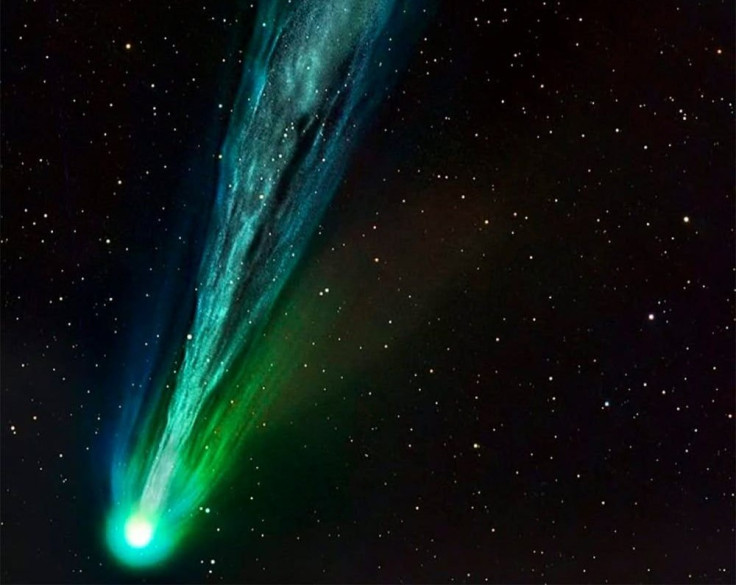
A Rare Green Glow for 3I/ATLAS
What has truly captivated the scientific community is the comet's striking transformation. As it warmed during its journey through the inner solar system, recent observations from the Gemini North telescope in Hawaii revealed that 3I/ATLAS has taken on a vivid green hue.
This emerald brilliance is caused by the release of diatomic carbon molecules, which glow green when bombarded by solar radiation. Detailed measurements from the Hubble Space Telescope have allowed researchers to finally constrain the size of its solid heart, estimating the nucleus is between 1,000 feet (320 metres) and 3.5 miles (5.6 kilometres) in diameter.
Interestingly, the comet has also displayed a rare 'anti-tail' — a jet of dust that appears to point towards the sun rather than away from it. While some, including Harvard professor Avi Loeb, have pointed to such anomalies as potential 'technosignatures' of an artificial probe, NASA remains firm.
During a televised briefing in late November, the agency confirmed that the object's behaviour, while exotic, is consistent with a natural comet reacting to the sun's intense heat. NASA Associate Administrator Amit Kshatriya noted that the 'anti-tail' is a physical jet of outgassing, rather than a mere perspective effect, reinforcing its status as a highly volatile interstellar comet.
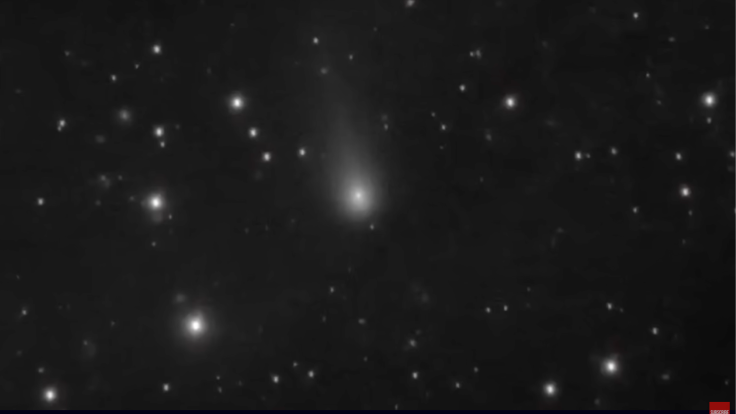
The Long Goodbye of 3I/ATLAS
For those hoping to catch a glimpse, the window is far from closed. While the comet is too faint for the naked eye, it will remain visible through small telescopes in the pre-dawn sky until the spring. Stargazers should look towards the constellation Leo, just below the bright star Regulus, to find this 'fuzzy' interstellar interloper. If you lack the equipment, the Virtual Telescope Project in Italy is hosting a live-streamed event to track the comet as it begins its long trek back into the void.
The visitor is currently racing away from the sun at a staggering 137,000 mph (221,000 km/h). Its itinerary for the coming years is already mapped out: it will make a close pass of Jupiter on March 15, 2026, coming within just 33 million miles of the gas giant.
NASA is especially interested in this meeting because the Juno spacecraft is currently orbiting Jupiter and may be able to take close-up pictures of the comet as it passes by. In July 2026, it will cross the path of Saturn, in April 2027, it will cross the path of Uranus, and in March 2028, it will cross the path of Neptune.
Researchers will have a lot of data to work with when 3I/ATLAS fades into the darkness of the outer solar system. The first results from the James Webb Space Telescope have already shown that there are a lot of carbon monoxide molecules in the comet. This suggests that the comet was born in a very cold stellar nursery.
According to Paul Chodas, director of NASA's Center for Near Earth Object Studies, the comet will not fully exit our solar system for interstellar space until the mid-2030s, never to return. While we may never know exactly which star forged this wanderer, its brief visit has served as a stunning reminder that our solar system is not an island, but a busy junction in a vast, interstellar sea.
As 3I/ATLAS begins its long journey back into the interstellar void, it leaves behind a treasure trove of data that could redefine our understanding of how star systems are formed. While the 'dirty snowball' will soon vanish from our view, its brief visit serves as a powerful reminder of the vast, interconnected nature of our galaxy.
© Copyright IBTimes 2026. All rights reserved.