From $1,000 Concert Tickets to $120 Yarn: Americans Reveal the Hobbies They Can Barely Afford
Youth hockey now costs over $2,500 a year, Aspen Institute data shows
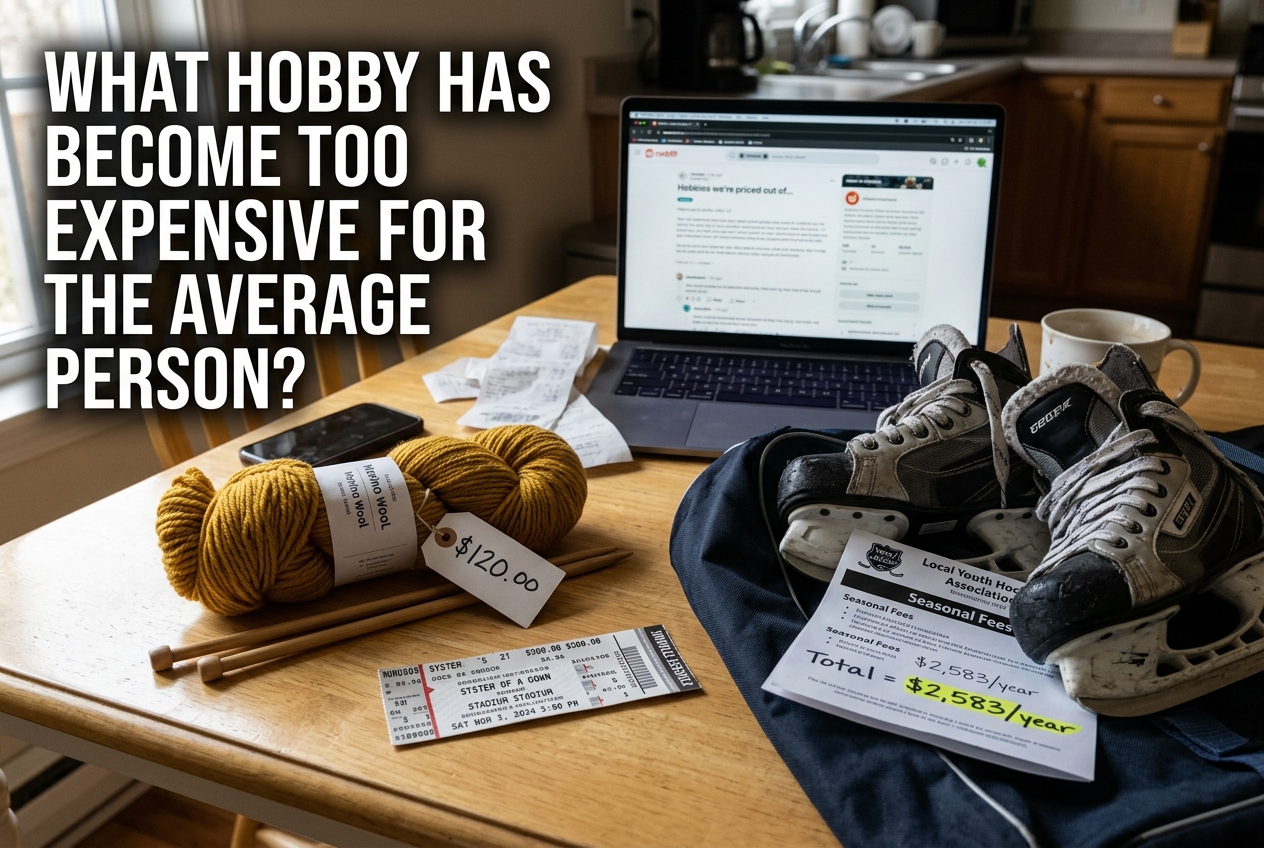
Two standing tickets to a rock gig for $1,000 (£746). The yarn for a single child's jumper at $120 (£90). These are the sums Americans have been comparing online, and the verdict is blunt: the hobbies they grew up with have slid out of reach.
The tally came from a Reddit thread that asked which pastimes people had been priced out of, and the replies stretched from knitting needles to hockey rinks. Any one of them is just an anecdote, self-reported and impossible to verify. Line them up against the hard numbers, though, and they point the same way.
Across music, crafts, and children's sport, the arithmetic that once made doing it yourself the cheaper choice has quietly reversed.
When a Night Out Costs a Week's Wages
Live music produced the starkest figures. One user recalled paying $1,000 (£746) for two pit tickets to see System of a Down; another walked away from Rush at $400 (£299) a seat. Older fans remembered a different era, when $18 (£13) was enough to catch Elton John, Tom Petty, or Metallica in the 1980s.
The nostalgia is grounded in fact. Figures from live-music trade publication Pollstar show the average ticket to the top 100 North American tours has climbed from about $26 (£19) in 1996 to roughly $136 (£101) in 2024. The average first pushed past $100 only in 2022. Adjust that old $18 stub for inflation, as one commenter did, and it still reaches only about $73 (£55) today, barely half the current average.
Not everyone in the thread was convinced the whole sector had run away.

Several pointed out that small venues remain affordable, citing a $36 (£27) acoustic set and $10 (£7) door charges, and argued the pain is concentrated at the stadium end.
Yarn, Fabric, and the End of Joann
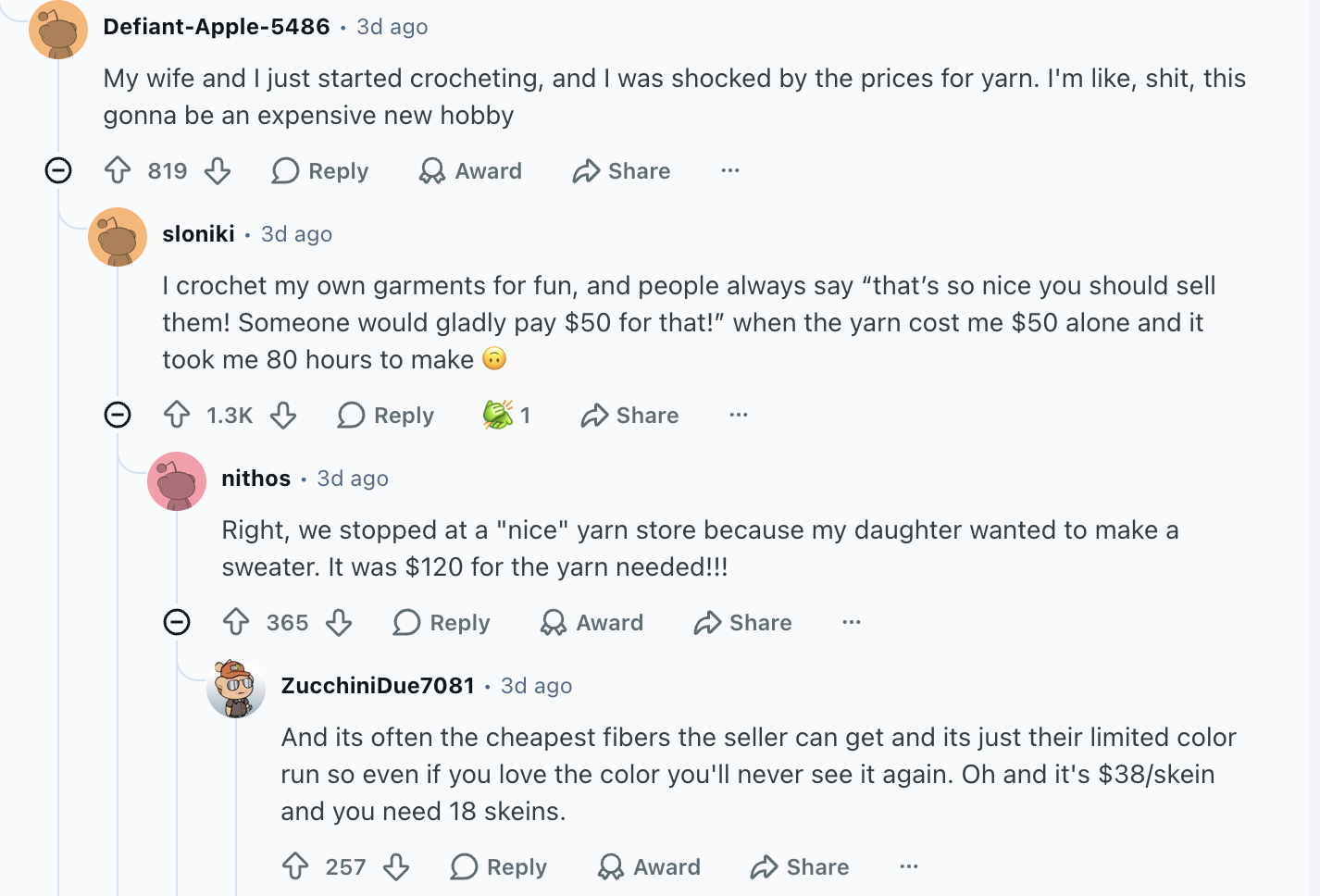
Crafters were just as pointed, and their complaint carried an extra sting: the hobby sold to them as thrifty rarely is any more. A parent said a child's sweater alone needed $120 (£90) of yarn. Another reckoned a decent pattern could call for 18 skeins at $38 (£28) each, close to $684 (£510) before casting on. One crocheter said the yarn for a single garment cost $50 (£37), on a piece that also took 80 hours.
Some of that squeeze is structural. Joann, the fabric and craft chain that served American sewers for eight decades, filed for Chapter 11 bankruptcy in January 2025, its second filing in under a year. It shut all of its roughly 800 stores by the end of May. The collapse stripped many towns of their only place to buy fabric in person, forcing shoppers online, where they say they can no longer feel a material before committing to it.
The deeper frustration is that making things by hand no longer undercuts buying them. One sewer who recreates vintage dresses said she might spend $250 (£187) and two dozen hours on a frock she could buy for $100 (£75).
'I'm certainly not saving any money doing it,' she wrote. Others pointed to the odd economics of wool: farmers are paid a pittance for a fleece, yet the finished yarn on the shelf can cost more than a factory jumper.
The Sports That Can Bankrupt Families
For parents, the numbers stop being a talking point and start reshaping the household budget. Commenters described travel hockey built on tournaments, hotels, and fresh kit, one recalling a colleague who lived on dollar-store noodles to fund her child's season. 'Hockey is a rich sport,' one wrote, saying it had drifted beyond ordinary families.
The research bears them out. The Aspen Institute's Project Play initiative found the average American family spent $1,016 (£758) on a child's main sport in 2024, up 46% since 2019, roughly twice the pace of general inflation. Ice hockey topped its table at about $2,583 (£1,928) a year, with skiing and snowboarding close behind at $2,249 (£1,679) and gymnastics, a sport several parents singled out, near $1,580 (£1,179).
Why the Maths No Longer Works
Even woodworking, once a cheap route to a bookshelf, drew grumbles. 'Lumber is growing in price every year,' one hobbyist wrote, blaming duties on Canadian timber. The charge holds: the US Department of Commerce lifted combined anti-dumping and countervailing duties on Canadian softwood above 35% in August 2025, then added a fresh 10% tariff from 14 October.
That is the thread running under every complaint. Whether the hobby is a gig, a jumper, a hockey season, or a homemade table, the sums that once made it the sensible, cheaper option have flipped. For a growing number of Americans, the pastime has become the luxury.
© Copyright IBTimes 2026. All rights reserved.
- Recommended For You