

White House Backchannel Exposed After CIA Chief Sneaks Into Moscow To Deliver Ultimatum on NATO and Iran
John Ratcliffe's undisclosed Moscow visit raises questions about US-Russia relations and NATO security
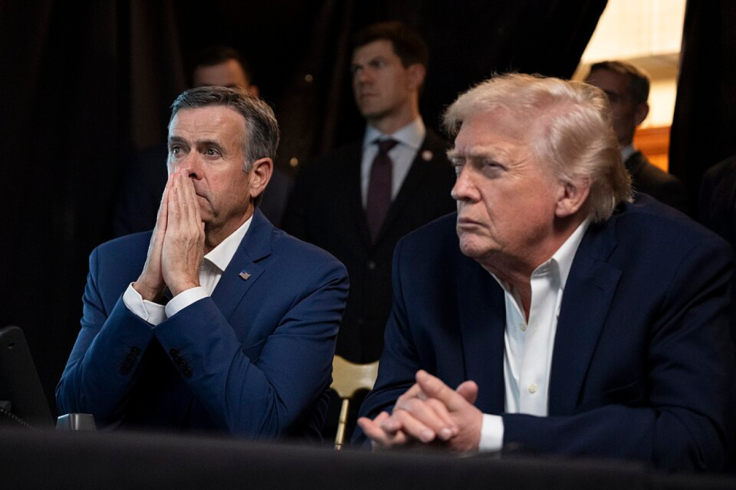
CIA Director John Ratcliffe made an undisclosed trip to Moscow this week to warn Russian officials against attacking a NATO member state, reports said.
The trip, Ratcliffe's first publicly known visit to Russia since becoming CIA director, came to light on Tuesday 25 August 2026 after a US Air Force jet was spotted landing in Moscow and a diplomatic motorcade was filmed moving through the city.
The CIA has declined to comment on why Ratcliffe travelled to the Russian capital.
The Secretive Trip Comes To Light
According to CBS News, the purpose of Ratcliffe's visit was to warn Russia against attacking a NATO member state, amid growing US intelligence assessments that President Vladimir Putin could try to test the alliance's resolve.
CBS News, quoting sources, said Ratcliffe separately raised Iran during his meetings, warning that further sanctions would follow if the Strait of Hormuz remains closed to shipping traffic.
Ahead of the trip, the United States told Ukrainian officials that a senior delegation would be travelling to Moscow and asked Kyiv to hold off on strikes for its duration, according to a senior Ukrainian official cited in the same report.
Kremlin spokesperson Dmitry Peskov confirmed that Ratcliffe held talks with Russian intelligence officials during the visit but said he did not meet with Putin himself. That contrasts with the last publicly known visit by a sitting CIA director, when William Burns travelled to Moscow in November 2021 and spoke directly with the Russian president.
Ratcliffe's contact this week, in President Trump's own description, took place 'more or less at the level of the special services'.
Conflicting Accounts From Washington and Moscow
Trump publicly confirmed the visit on Wednesday during a radio interview with host Glenn Beck, but downplayed its significance, calling it 'semi-routine' and denying that it was connected to either Iran or to concerns about Russian aggression toward NATO.
Asked directly whether the trip involved Russian designs on NATO territory or the pressure campaign against Iran, Trump said it was neither, though he added that 'something may come out of' Ratcliffe's visit as part of his broader push to end the war between Russia and Ukraine.
Peskov offered a similarly guarded account from Moscow, describing the contact as 'positive' while cautioning that it was too early to say whether it would help pull the two countries' relationship out of what he called its deepest crisis in years.
Neither the Kremlin nor the White House has confirmed the specific NATO warning that multiple US outlets attributed to Ratcliffe, leaving an official account and a reported one sitting side by side uneasily.
The gap between the two versions is itself notable. Washington and Moscow rarely disagree so openly on the basic purpose of a high-level contact, and the fact that both sides confirmed the trip happened while disputing why it happened suggests each government sees an advantage in controlling the narrative around it.
For Trump, minimising the visit protects his broader claim that engagement with Moscow is about ending the Ukraine war rather than managing a NATO crisis.
For the Kremlin, calling the contact 'positive' without elaborating allows it to appear open to dialogue without conceding that Washington delivered anything resembling a warning.
A Pattern of Escalation Along NATO's Eastern Flank
The visit follows weeks of rising concern among American and European officials that Russia could attempt a limited, deniable move against a NATO member, with some assessments pointing to a Baltic state as a target, to test both the alliance's unity and the Trump administration's willingness to invoke its mutual defence guarantee.
Officials have pointed to a string of recent incidents, including drone incursions into Romanian airspace and a Russian missile that crossed briefly into Polish territory last month, alongside a rise in suspected sabotage operations and cyberattacks across Europe.
Under Article 5 of the North Atlantic Treaty, member states are obligated to come to one another's defence if attacked, a clause invoked only once before, after the 11 September 2001 attacks on the United States.
Trump has long questioned whether NATO allies contribute enough to their own defence and has periodically cast doubt on the alliance's reliability, adding a layer of uncertainty to how Washington might respond if Moscow tested the provision directly.
US officials briefed on the intelligence assessments have said the likely Russian goal would not be to trigger a full-scale war but rather to probe how far the alliance, and the Trump administration specifically, would go to defend a member state under a scenario short of outright invasion.
A hybrid or deniable action, such as a cyberattack or an unattributed sabotage operation, would allow Moscow to test that resolve while retaining the ability to deny direct responsibility.
Iran, Russia and a Sanctions Campaign Building in the Background
Ratcliffe's trip came a day after Treasury Secretary Scott Bessent unveiled what he called 'Operation Economic Outcast', a sweeping new sanctions campaign intended to sever Iran's remaining financial lifelines.
Bessent, comparing the effort to the D-Day landings, announced fresh sanctions on nearly 60 entities, individuals and vessels across countries including the United Arab Emirates, Hong Kong, China, Singapore and Switzerland, and said Washington would target Iranian revenue from digital assets, gold, aviation, technology and shipping until, in his words, 'this regime stands alone'.
Russia has remained one of Iran's closest partners throughout the ongoing US-Iran war, providing Tehran with intelligence on American military positions in the region and cooperating with it for years on drone manufacturing, according to CBS News.
That relationship gives Ratcliffe's private message on the Strait of Hormuz added weight, tying the outcome of Washington's economic pressure campaign against Tehran to a channel of communication that, until this week, nobody outside a small circle of officials knew existed.
The details of what passed between Ratcliffe and his Russian counterparts may stay hidden, but the trip itself has confirmed a direct channel between Washington and Moscow at one of the tensest moments in their relationship in years.
© Copyright IBTimes 2026. All rights reserved.