

Comet 3I/ATLAS Flyby: Interstellar Visitor Zooms Past Earth Today Before It Is Gone
How to see interstellar comet 3I/ATLAS on its final, record-breaking flyby of Earth today.

A quiet messenger from the farthest reaches of the Milky Way is making its last, dramatic appearance on this day, December 19, 2025. The interstellar comet 3I/ATLAS, which is a frozen remnant from the orbit of a faraway, alien sun, is now getting as close to Earth as it can get.
People think the comet is between 440 meters and 3.5 miles (5.6 km) wide, which would make it the biggest object ever seen in space. It's a scary thought that this is the last time any human eyes—or even our most powerful sensors—will ever see it before it disappears into the infinite void and never comes back.
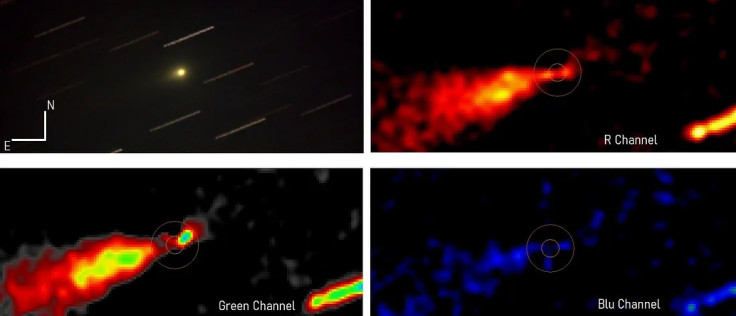
The Transient Beauty of 3I/ATLAS
The Asteroid Terrestrial-impact Last Alert System (ATLAS) survey telescope in Rio Hurtado, Chile, found the comet on July 1, 2025. It quickly caught the attention of scientists all over the world. It is the third confirmed interstellar visitor to our solar system, following the mysterious 'Oumuamua in 2017 and 2I/Borisov in 2019.
3I/ATLAS is not like the rocks in our own Asteroid Belt. It is a 'dirty snowball' made of old ices that has chemical signatures from a star system we may never visit. The data show that it came from the direction of the constellation Sagittarius, which means it probably drifted away from the dense centre of our Milky Way galaxy for billions of years.
While its closest approach occurs at 06:00 GMT today, 'close' is a relative term in the cosmos. The visitor remains a staggering 170 million miles (273 million km) from our planet—nearly double the distance between the Earth and the Sun. Astronomers have reassured the public that there is zero risk of impact, as the object is 700 times further away than the Moon.
Because of this vast gap, you won't be able to spot it with the naked eye. In fact, NASA suggests that even those with serious backyard equipment, such as a 12-inch (30 cm) telescope, will only see it as a faint, moving speck near the constellation of Leo. Specifically, stargazers should look east to northeast in the pre-dawn hours, where the comet will appear just below the bright star Regulus.

Digital Gateways to the 3I/ATLAS Flyby
NASA's Eyes on the Solar System is the best way for armchair astronomers to see the journey in their minds. You can see the comet's hyperbolic path in real time with this advanced 3D tool. You can see it fly by Mars' orbit and head towards its last meeting with Jupiter on March 12, 2026, by searching for '3I/ATLAS.' The simulation is especially powerful because it shows the 'slingshot' effect, which is how the Sun's gravity has sped this visitor up to record-breaking speeds of about 153,000 miles per hour (246,000 kph)—the fastest speed ever recorded for a visitor to our solar system.
If you prefer raw data over simulations, the Comet Observation Database (COBS) provides a fascinating look at the comet's 'lightcurve.' Since its perihelion—the closest point to the Sun—on 29 October 2025, 3I/ATLAS has been fading. Recent images from the Gemini North telescope in Hawaii show the object has developed a striking green hue and a rare 'anti-tail'—a spike of dust that appears to point toward the sun—due to the intense vaporization of its ancient ice.
A Final Glimpse via 3I/ATLAS Livestreams
For many, the highlight of the day will be the Virtual Telescope Project. Hosted by astrophysicist Gianluca Masi, a free YouTube livestream features real-time imagery captured by robotic telescopes in Manciano, Italy. The live feed, which follows a successful broadcast in November, is scheduled to start at 04:00 UTC on 20 December 2025 for those who missed the peak today.
As the weeks progress, 3I/ATLAS will gradually vanish from the view of even the most powerful observatories. By the mid-2030s, it will have crossed the threshold back into interstellar space.
For now, we are left with the brief, flickering evidence of a world beyond our own—a reminder that we are part of a much larger, interconnected galactic neighbourhood. If you have a smartphone, apps like Stellarium can still help you point your phone toward Leo to acknowledge the patch of sky where this lonely traveller is saying its final goodbye.
© Copyright IBTimes 2026. All rights reserved.