

3I/ATLAS Update: Harvard Expert Avi Loeb Warns Alien 'Serial Killer' Visitor Cannot Be Ruled Out

As the winter solstice approaches, Earth is preparing for a brush with a high-speed traveller from the furthest reaches of the cosmos. On Friday, 19 December, a gargantuan space object that has divided the world's most brilliant minds will reach its closest point to our planet, barrelling through the void at a staggering 130,000mph.
First detected on 1 July 2025 by the Asteroid Terrestrial-impact Last Alert System (ATLAS) telescope in Chile, the visitor has spent months being tracked by every major observatory on the globe. While most of humanity remains oblivious to the visitor passing 170 million miles away—roughly twice the distance of the sun—within the scientific community, the arrival of this celestial wanderer has sparked a debate that feels more like the plot of a science-fiction blockbuster than a standard astronomical update.
Astronomers call this icy giant 3I/ATLAS. It is only the third interstellar object ever found in our solar system, after the strange 1I/'Oumuamua in 2017 and the comet 2I/Borisov in 2019. It is a priceless 'cosmic fossil' from a galaxy far, far away, with a nucleus that is thought to be between 1,400 feet and 3.5 miles wide. But for Professor Avi Loeb, a well-known astrophysicist at Harvard University, it is a 'black swan event,' which is something that doesn't happen very often but could have huge effects on the world.

Decoding The Extraterrestrial Controversy Behind 3I/ATLAS
Professor Loeb, who previously stirred the pot with similar claims regarding the 2017 interstellar visitor Oumuamua, remains steadfast in his refusal to rule out an artificial origin for this latest guest, even suggesting it could be a 'mothership' sent to monitor our star. Speaking to Sky News, the professor warned that humanity must remain on high alert.
'Alien technology is a potential threat because when you go on a blind date of interstellar proportions, you never know whether you have a friendly visitor as your dating partner or a serial killer,' he remarked.
Loeb's suspicions are not merely philosophical; they are rooted in several puzzling observations recorded by space telescopes like Hubble and the James Webb. He points to the object's unusual 'anti-tail'—a plume of gas and dust that appears to point towards the sun rather than away from it—which some suggest could be a byproduct of a sophisticated propulsion system. He also notes the disproportionately high levels of nickel in its gas cloud, a ratio far higher than that found in any known natural comet.
Perhaps most jarring is the object's trajectory, which appears suspiciously aligned with the orbits of the planets in our own system. Loeb argues that such alignment is far too improbable to be mere coincidence. 'When there are implications to society, we must consider even an unlikely event and collect as much data as possible to convince us otherwise,' he added, accusing his peers of an 'arrogance of expertise' that prevents them from learning something truly new.
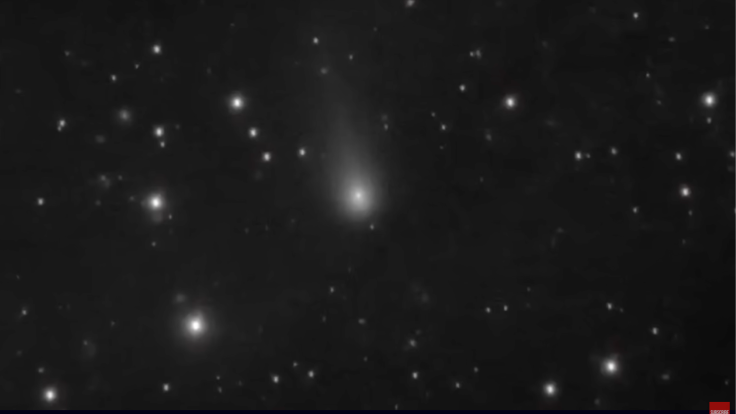
The Scientific Consensus Regarding The Origins Of 3I/ATLAS
Despite the headlines generated by the 'alien battleship' theory, the vast majority of the global space community remains unconvinced. NASA and the European Space Agency (ESA) have deployed a dozen spacecraft—including the Mars Express and the Jupiter Icy Moons Explorer (Juice)—to monitor the object, and their verdict is unanimous: it is entirely natural. NASA Associate Administrator Amit Kshatriya was blunt in his assessment. 'This object is a comet. It looks and behaves like a comet. All evidence points to it being a comet,' he stated.
Professor Chris Lintott, an Oxford University astronomer and presenter of The Sky at Night, was even more dismissive of the sensationalist claims. 'It is just nonsense,' he told Sky News. 'It's like saying we should consider the possibility that the moon is made of cheese. You could consider that possibility if you like, but my first question is why would you think that?' Lintott explains that the shifting colours and brightness of the object are simply the results of solar heat reacting with ancient ice and dust—a phenomenon well-documented in other comets as they are warmed by the sun's radiation.
Estimated to be eight billion years old, making it roughly twice the age of our own solar system, 3I/ATLAS is effectively a relic from the formation of a distant, unknown star. As it prepares to fly past Jupiter and vanish back into the interstellar dark, it leaves behind a fractured legacy: a rare scientific treasure for most, and a potential warning from the stars for others. Regardless of its true nature, the brief stay of this ancient traveller has reminded us how little we truly know about the neighbourhood beyond our atmosphere.
As 3I/ATLAS hurtles back into the dark reaches of interstellar space, the debate over its true nature remains far from settled. Whether it is a benign relic of a long-dead star or a sophisticated piece of alien technology, this visitor has forced us to look at the heavens with renewed curiosity.
© Copyright IBTimes 2026. All rights reserved.