

Interstellar Comet 3I/ATLAS: Why Experts Claim This Rare Object Is A 'One-And-Done'
Interstellar Comet 3I/ATLAS nears Earth with a bizarre 'anti-tail'. Discover why experts call this ancient relic a once-in-a-lifetime 'one-and-done' visitor.

A 33-billion-ton interstellar ghost is currently haunting our solar system, sporting a bizarre 'anti-tail' that has left the global scientific community in a state of fascinated debate. This object represents a rare opportunity for study, as it is the third interstellar visitor discovered within our solar system in the last decade.
On Friday, December 19, the ancient visitor 3I/ATLAS will come closest to Earth. This is a once-in-a-lifetime chance for scientists to study a relic that is older than our sun. While the object poses no threat to our planet, the sheer scale and mystery of this interstellar traveller are enough to capture the imagination of even the most casual stargazers.
'It'll be 167 million miles away from us,' explained Max Gilbraith, the planetarium coordinator at the University of Wyoming. He noted that this distance is slightly further than the expanse between the sun and Mars, placing the object well within the reach of our most sophisticated orbital 'eyes.'

The Mystery Of The Sun-Facing 'Anti-Tail' On 3I/ATLAS
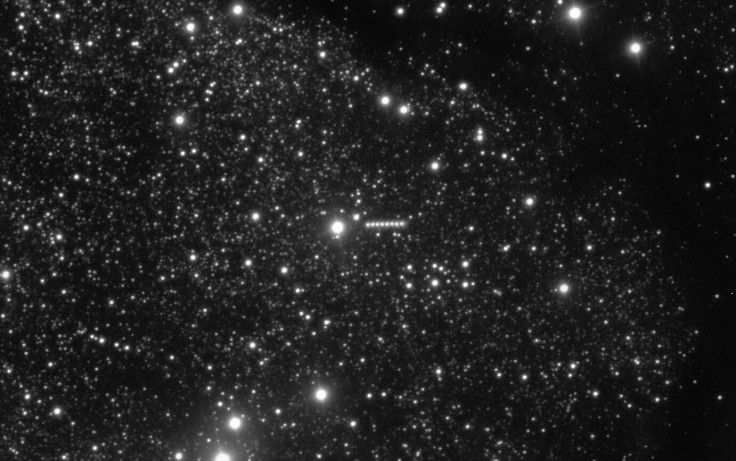
What has truly set tongues wagging in the astronomical world is the comet's peculiar 'protrusion.' Most comets are famously described as 'dirty snowballs' that leave a trail of gas and dust behind them as they are heated by the sun. However, 3I/ATLAS is behaving quite differently, exhibiting what experts call an 'anti-tail.'
'An anti-tail is a comet tail pointing towards the sun, which is in the opposite direction of a normal tail,' Gilbraith said. This phenomenon is exceptionally rare, often caused by a breach in the comet's outer shell—a crust of accumulated cosmic dust and debris. When solar energy hits the volatile materials hidden beneath this shell, they react violently.
Gilbraith compared the effect to the intense, concentrated heat created when sunlight is focused through a magnifying glass. In this instance, a specific region of 3I/ATLAS is being bombarded with direct sunlight, forcing volatile material to shoot out along the path of least resistance. Instead of trailing behind, this material is jetting straight towards the sun.
While this explanation is compelling, astronomers are currently debating other theories amongst themselves, with further images required to reveal the definitive source of the anomaly.
Why 3I/ATLAS Is A Pristine Time Capsule From Beyond Our Sun
Unlike the famous Halley's Comet, which returns to our skies with clockwork regularity, 3I/ATLAS is an interstellar outsider. It did not originate within our solar system, meaning it likely hasn't orbited a star in its entire 4.6-billion-year existence. This makes it older than the sun itself, a pristine sample of the material that existed before our corner of the universe was even a thought.
'Since this is an interstellar comet, the chances it has ever gone around a star are probably zero,' Gilbraith remarked. He suggested that this visit marks the very first time the object has ever developed a tail—or an anti-tail. The comet is currently on a 'fully hyperbolic orbit,' meaning it is a 'one-and-done' visitor.
While some might see this as a lucky coincidence, Gilbraith believes it is a testament to our advancing technology. 'We wouldn't have noticed these objects before because we didn't have the technology to see them,' he noted. If a sudden 'drought' of such objects occurs, experts may re-evaluate their rarity, but for now, it appears our improved tools are simply revealing visitors that have likely been passing through for aeons.
NASA is currently utilising the Hubble and James Webb Space Telescopes to capture hundreds of images. Even the MAVEN and Mars Reconnaissance Orbiter, currently circling the Red Planet, have been repurposed as 'impromptu observatories' to gather spectral data. The data from MAVEN is considered particularly interesting because the craft was positioned on the far side of the sun at the time of observation, providing a unique vantage point.
Debunking The Theory Of Alien Origin
The bizarre nature of the 'anti-tail' led some to postulate that 3I/ATLAS might actually be an alien spacecraft rather than a comet. However, Gilbraith remains dubious of such claims. He noted that if the object were performing 'secret alien things,' it would have been detected by sensors as it passed close to Mars. All current evidence points to a purely natural, albeit spectacular, celestial event.
For those hoping to spot the 33-billion-ton giant from their back gardens, the news is unfortunately sobering. At its closest approach, 3I/ATLAS will sit at the 13th magnitude. This makes it far too dim for amateur equipment or the naked eye to detect.
Gilbraith has cautioned amateur stargazers against getting their hopes up, as the comet will remain invisible to even the most advanced consumer telescopes on Earth. It remains a spectacle reserved for the world's most powerful sensors before it disappears back into the dark of interstellar space forever.
As 3I/ATLAS hurtles back toward the infinite void, it leaves behind a wealth of data that could reshape our understanding of the universe's earliest moments. While we may never see this interstellar ghost again, its brief visit serves as a powerful reminder of the mysteries still lurking in the dark reaches of space.
© Copyright IBTimes 2026. All rights reserved.