

Harvard Expert Claims 3I/ATLAS Jets Are Too Symmetric to Be a Natural Phenomenon
Avi Loeb: 3I/ATLAS mini-jets may signal active technology on interstellar visitor

When the interstellar object 3I/ATLAS first flew into our solar system in July 2025, scientists were both curious and amazed. It was only the third confirmed visitor from the vastness of interstellar space, a cosmic nomad moving at an incredible 58 kilometers per second. But when the object passed its perihelion on Oct. 29, 2025, the story changed from standard cometary science to something much more interesting.
Avi Loeb, an astrophysicist at Harvard who is no stranger to controversial cosmic theories, has dropped a new bombshell. New analysis of images captured by the Hubble Space Telescope suggests that 3I/ATLAS is not merely tumbling through the void, but may be sporting a geometric arrangement of 'mini-jets' so precise they challenge our understanding of natural formation. Loeb has even gone so far as to describe the object as 'potentially hostile', currently giving it a ranking of 4 on his self-devised 10-point 'Loeb Scale'.

The Mathematical Perfection of 3I/ATLAS Mini-Jets
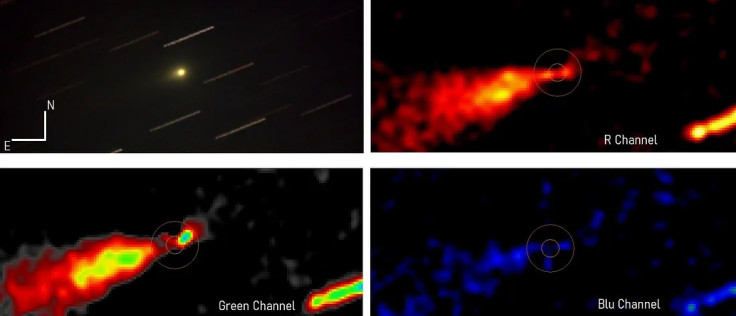
The Larson-Sekanina Rotational Gradient filter is a complicated imaging technique that made the discovery possible. Researchers have found a surprising structure by removing the circularly symmetric glowing halo that usually hides the nucleus of a comet. Three separate mini-jets stick out from the center of 3I/ATLAS and reach 25,000 kilometers into space.
Their symmetry is what has really gotten the scientific community excited. These jets are exactly 120 degrees apart in the sky, making a perfect geometric triangle. This trio is accompanied by a fourth 'anti-tail' jet that stretches ten times farther, pointing directly toward the sun — a direction that consistently defies the standard 'wind-blown' appearance of natural cometary tails. Notably, this anti-tail has been observed extending out to at least 400,000 kilometres, which Loeb argues is an outlier never reported before for solar system comets.
In a new paper co-authored with Toni Scarmato, Loeb demonstrates that this jet structure is not static. It wobbles periodically by roughly 20 degrees every 7.1 hours, a motion likely tied to the object's rotation. Perhaps most curiously, the rotation axis itself is oriented within a mere 10 to 20 degrees of the sunward direction, an alignment Loeb previously noted as statistically improbable for a random rock from the stars.

Active Technology or Cosmic Coincidence for 3I/ATLAS?
The precision of these features has led Loeb's colleague, Dr. Frank Laukien, to pose a question that many in the field have been hesitant to voice: could this be a technological signature? Laukien points out that a 120-degree angular spacing is an 'astounding' find in a macroscopic natural object. He suggests that such a configuration could represent the 'minimum viable' setup for a propulsion system designed to re-orient an object in three-dimensional space.
While human satellites typically use pairs of opposing thrusters, the (3+1) arrangement seen on 3I/ATLAS might be sufficient for attitude adjustments if the object is rotating around its major axis. If these jets are indeed thrusters rather than natural outgassing, the object's status on the 'Loeb Scale' — a classification system for interstellar significance — would skyrocket.
Currently, 3I/ATLAS sits at a Level 4, reserved for objects meeting potential technosignature criteria, but confirmed activity could push it toward the elusive Level 6: 'Suspected Active Technology'. This debate gained new intensity recently after the CIA issued a 'Glomar' response to records requests regarding the object, stating they could 'neither deny nor confirm' the existence of classified records on 3I/ATLAS.
The mystery may find a resolution sooner than expected. On Jan. 22, 2026, a rare alignment will occur. 3I/ATLAS will reach near-opposition, with the Earth positioned almost directly between the object and the sun.
During this window, which will maintain an alignment within 2 degrees for approximately one week, the rotating mini-jets may trace a perfect circle in the sky, offering astronomers a high-fidelity look at their true nature. Following this, the object is scheduled to travel past Jupiter on March 16, 2026. As Loeb himself notes, scientific progress requires patience, but the pursuit of symmetry in the stars remains the most invigorating hunt of all.
© Copyright IBTimes 2026. All rights reserved.