

Mysterious 3I/ATLAS Develops Strange 'Mini-Jets' And Sunward Anti-Tail, NASA Reveals
NASA reveals 3I/ATLAS's bizarre sunward anti-tail and mini-jets

New data from NASA's SPHEREx and the Hubble Space Telescope show that the object known as 3I/ATLAS has changed in ways that contradict scientists' expectations. The mysterious visitor from the far reaches of space was discovered on July 1, 2025.
It is the third interstellar object ever found in the solar system, following 1I/'Oumuamua and 2I/Borisov. The celestial body recently approached the sun as closely as possible and has developed a number of unusual features, including an 'anti-tail' that points toward the sun and three evenly spaced 'mini-jets' that appear to wobble with clockwork precision.
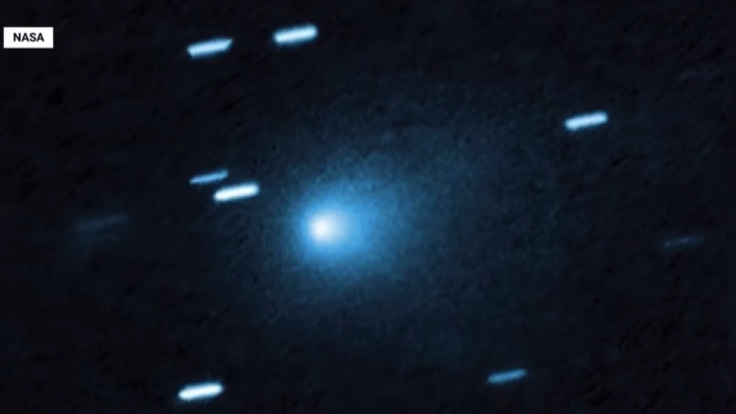
Strange 'Mini-Jets' and Sunward Anti-Tail
In mid-January 2026, Harvard professor Avi Loeb wrote about the most recent discoveries, which suggest that the physical state of the material being released from 3I/ATLAS changed significantly after its perihelion, the point in its orbit closest to the sun. Observations show that the object entered the solar system at a record-breaking speed of 58 km/s, far faster than any other known interstellar object. In December 2025, the SPHEREx space observatory captured large-scale infrared images showing gas and dust emissions far stronger than those recorded previously.
According to a paper led by Carey Lisse and summarised by Loeb, the water mass-loss rate from the object is now roughly 180 kilograms per second. This rate is comparable to the loss of carbon dioxide and about two-thirds the rate of carbon monoxide.
Curiously, earlier data indicated the gas plume was remarkably water-poor, containing only 4% water by mass, a significant departure from the composition of typical solar system comets. While water and carbon gases appear to originate from a symmetric region centred on the nucleus, brightness maps show that cyanide and organic emissions arise from the surrounding dust.
Researchers also noted an unusual chemical signature in the plume, with nickel present in significantly higher quantities than iron — a ratio more commonly found in industrial alloys than in natural space rocks. The geometry of these plumes has captivated scientists. SPHEREx data showed that while six identified gas plumes appeared nearly round, the distribution of dust and organics formed a distinct pear-shaped pattern.
Most striking was the presence of an anti-tail extending directly toward the sun, a feature confirmed by the Hubble Space Telescope on Jan. 14, 2026. These Hubble images revealed a glowing halo stretching more than 130,000 kilometres toward the sun, accompanied by three peculiar mini-jets.

Altered Mass Loss Patterns Around 3I/ATLAS
What makes 3I/ATLAS particularly unusual is how its behaviour deviates from standard cometary models. In typical comets, radiation pressure from the sun pushes dust particles away, creating a tail that points in the opposite direction. However, SPHEREx noted a total absence of sub-micron dust particles.
The existing dust grains are estimated to be much larger, around 0.1 mm in radius, making them too heavy to be easily pushed back by solar radiation. This lack of fine dust explains why there is no traditional radiation-pressure-driven tail extending away from the sun, allowing the sunward anti-tail to dominate the visual profile.
Spectral analysis has also shown a massive shift in composition compared to pre-perihelion data from August 2025. The prominent water-ice absorption features that were once present have completely vanished.
Instead, the continuum is now dominated by thermal emission and scattered sunlight from 'organo-silicaceous' dust grains. Curiously, the emission of water gas has increased by a factor of twenty, and cyanide and organic spectral features have newly appeared, suggesting they were released during this high-activity phase.
Adding to the mystery is the rhythmic nature of the object's activity. Analysis of Hubble data co-authored by Loeb and Toni Scarmato found that the jet system orientation is not static; it wobbles with a 7.1-hour period. This is distinct from the 16.16-hour cycle of brightening and dimming that has also been observed, suggesting complex rotational dynamics.
This exact rotation makes an object that already makes it hard for us to understand how small bodies in our solar system interact with solar heat even more complicated. Professor Loeb has even thought that these strange things could be the result of technology, which means there is a 30–40% chance that the object is an artificial probe using the sun's gravity to move.
The SPHEREx and Hubble datasets together show a post-perihelion configuration that is still unusual in astronomy. As 3I/ATLAS moves away from the sun, it continues to raise more questions than it answers because of the huge rise in gas production and the strange shape of its plumes. The object is expected to make its next big pass by Jupiter on March 16, 2026, and then it will leave our solar system for good.
© Copyright IBTimes 2026. All rights reserved.