

Margaret Hamilton, the Software Pioneer Whose Tower of Apollo Code Became an Iconic Photo, Dies at 90
The MIT computer scientist pioneered software engineering and led the team behind the priority-driven code that helped overcome Apollo 11's computer overload alarms
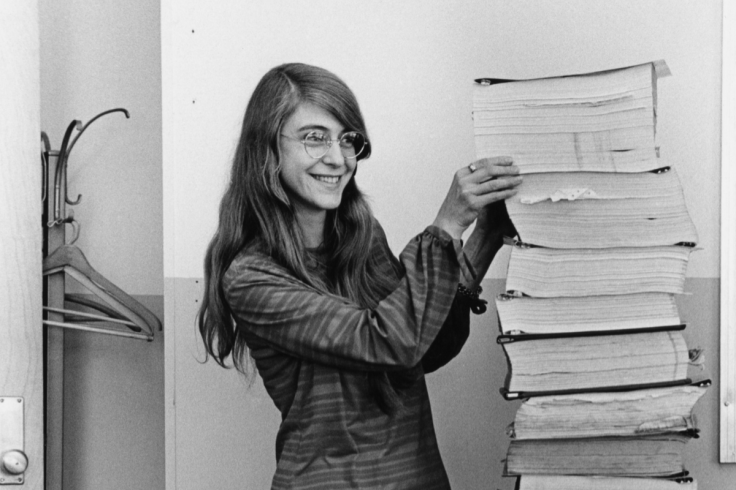
Margaret Hamilton, the computer scientist whose software helped guide Apollo 11 to the Moon, died on 30 September 2026 at the age of 90. The Massachusetts Institute of Technology (MIT) and Earlham College announced her death.
Born in Paoli, Indiana, in 1936, Hamilton joined MIT's Instrumentation Laboratory in 1965 as the first programmer and first female programmer hired for its Apollo project. She later led the development of onboard flight software, overseeing work by a team of more than 400 people.
From Weather Prediction to Space Exploration
Hamilton graduated from Earlham College in 1958 with a degree in mathematics and a minor in philosophy. She began programming at MIT in 1959, developing weather prediction software for meteorologist Edward N. Lorenz, whose research helped shape chaos theory.
In 1961, she joined MIT Lincoln Laboratory to work on the Semi-Automatic Ground Environment (SAGE) air defence system. The software helped the US Air Force detect potentially hostile aircraft. The work also sparked her interest in software reliability, a concept that was still largely unexplored.
At the time, software development lacked the recognition given to traditional engineering disciplines. Hamilton championed the term 'software engineering' to establish its legitimacy and encourage rigorous standards. Colleagues initially treated the phrase as a joke.
She also became associated with core rope memory, a technology in which software instructions were physically woven into wires threaded through magnetic cores. The process relied heavily on female technicians and earned Hamilton the nickname 'Rope Mother'.
Daughter's Mistake Led to New Apollo Safeguards
Hamilton's focus on preventing errors was reinforced by an incident involving her four-year-old daughter, Lauren, who accidentally crashed a flight simulator by activating a pre-launch program during a simulated flight. Hamilton proposed a software fix, but management rejected it on the grounds that trained astronauts would not make the same mistake.
During Apollo 8 in 1968, astronaut Jim Lovell inadvertently activated the same program, erasing navigational data. Hamilton's team restored the information, and the proposed safeguards were incorporated into the software.
In July 1969, the Apollo 11 lunar module Eagle encountered computer overload alarms shortly before landing. The 1201 and 1202 alarms indicated that the onboard computer was struggling to process its workload.
Hamilton's team had designed priority-driven software that could discard lower-priority tasks and focus on critical calculations. The system continued operating, allowing Neil Armstrong and Buzz Aldrin to complete the landing.
An Iconic Photograph Brought Wider Recognition In The Internet Age
A 1969 photograph of Hamilton standing beside a towering stack of printed Apollo software listings later became widely recognised online. The image helped establish her as a symbol of women's contributions to science, technology, engineering and mathematics.
Hamilton founded Higher Order Software in 1976 and Hamilton Technologies in 1986. Her later work focused on preventing errors and improving the reliability of complex software systems.
In 2016, US President Barack Obama awarded her the Presidential Medal of Freedom, the country's highest civilian honour. She also received the NASA Exceptional Space Act Award in 2003 and was inducted into the National Aviation Hall of Fame in 2022.
A 2017 LEGO set celebrating women at NASA included a figure of Hamilton. She is survived by her daughter, Lauren, son-in-law Richard Selesnick, two grandsons, four great-grandchildren and three siblings.
© Copyright IBTimes 2026. All rights reserved.