

Private Security Now Patrolling Essex After Women Say Migrants Make Them Feel Unsafe – Should the Rest of Britain Follow?
Essex's £150,000 trial is testing whether visible patrols can boost public confidence without replacing conventional policing
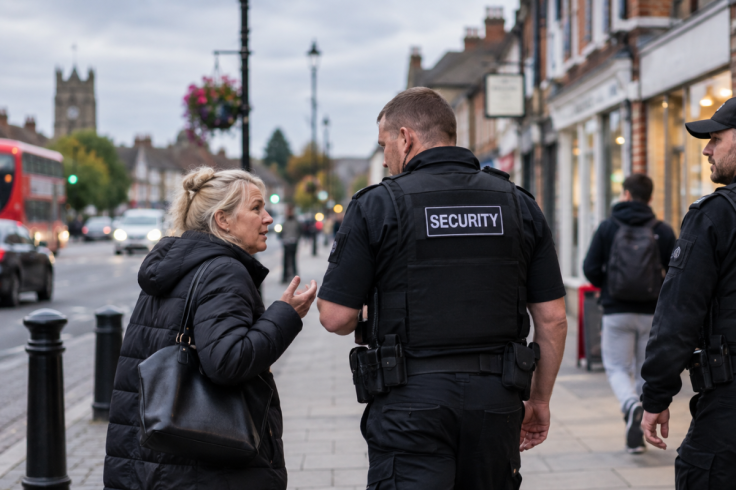
Private security guards have begun patrolling three Essex town centres after residents raised concerns about intimidation and antisocial behaviour amid the arrival of groups of male asylum seekers from nearby Wethersfield.
Six operatives started work in Braintree, Chelmsford, and Colchester on 14 September under Operation Vanguard, a three-month trial backed by up to £150,000. The guards will patrol seven days a week, from approximately 10 a.m. to 6 p.m., including areas where antisocial behaviour has previously been reported.
The experiment now puts Essex at the centre of a wider debate over whether councils elsewhere could use private security to improve public confidence in town centres, particularly around areas close to asylum accommodation.
Why Essex Has Introduced Private Patrols
Essex County Council says Operation Vanguard was launched following concerns about groups of men staying at the Wethersfield asylum accommodation centre and travelling into Braintree, Chelmsford, and Colchester.
The council says up to 17 minibuses travel from Wethersfield to the three towns each day. It has described the patrols as a way of providing a visible presence, reassuring residents, and deterring antisocial behaviour.
The move follows accounts from women and other residents who told the Daily Mail they had experienced unwanted comments, staring, following, or behaviour they found intimidating. Sophie Edmonds, 33, a Colchester shop worker, said she and her friends no longer walk around the city alone because they find the experience 'too worrying'.
However, those accounts represent individual residents' experiences and concerns. They should not be treated as evidence that asylum seekers generally are responsible for harassment or crime.
What the Security Guards Can and Cannot Do
The six operatives, supplied by My Local Bobby, are licensed by the Security Industry Authority and trained in safeguarding, conflict management, de-escalation, lawful use of force, incident reporting, and public-facing conduct. They are not police officers and have no police enforcement powers. Essex County Council says they cannot stop or search people, and any matter requiring law enforcement must be referred to Essex Police.
My Local Bobby says its operatives have no more powers than members of the public. They can use reasonable force in circumstances permitted by law, while any arrest power available to them would be the same limited citizen's-arrest power available to members of the public.
The distinction matters because Operation Vanguard is primarily a visibility and reassurance scheme, rather than a substitute for police enforcement. Essex County Council says the trial is funded from its Community Innovation and Improvement Fund reserve and will not increase council tax.
Crime Evidence Adds a Complication
The strongest challenge to the scheme is the distinction between perceived safety and recorded crime. An Essex County Council report acknowledges that the Home Office says there is no evidence that Wethersfield has had an impact on local crime levels.
That does not invalidate residents' concerns about how safe they feel. But it does mean the council is introducing the patrols as a preventative and reassurance measure rather than in response to evidence of a migrant-driven increase in crime.
The approach has attracted criticism from opposition politicians and local refugee organisations. Marie Wilby, of Colchester Refugee, Asylum Seeker and Migrant Action, said the scheme gave the impression that Wethersfield residents were a problem despite there being no major increase in antisocial behaviour or crime.
Chelmsford City Council leader Stephen Robinson argued that effective policing and community investment would be preferable to private security. That opposition gives the trial a second test: whether it can improve residents' confidence without deepening tensions around asylum accommodation.
Wethersfield Expansion Could Test the Model
The debate is unlikely to disappear soon. The Home Office says the Wethersfield site has 1,245 bedspaces, compared with a previous regular occupancy cap of 800, and intends to use all of the available bedspaces throughout the year. Any increase is being phased in gradually and remains subject to operational reviews.
The Home Office also intends to extend the site's use as asylum accommodation beyond April 2027, subject to appropriate planning permission. That makes Operation Vanguard more than a short-lived response to local concerns. If the patrols improve measurable public confidence or reduce antisocial behaviour, other councils could see private security as a practical addition to their town-centre strategies.
If the results show little change, however, the trial could strengthen arguments for directing resources towards conventional policing, community services, and other measures.
For now, Essex is conducting a live test of whether private security can bridge the gap between residents demanding greater visibility and police forces retaining responsibility for enforcement. Its results could determine whether Operation Vanguard remains a local experiment or becomes a model considered elsewhere in Britain.
© Copyright IBTimes 2026. All rights reserved.
- Recommended For You


