

NASA Spotlights 'Super-Earth' GJ 3378b: Next-Door Neighbour Planet Sits in the Perfect 'Sweet Spot' for Alien Life
Astronomers have identified GJ 3378b, a super-Earth in the habitable zone, sparking interest in its potential to support life.

Nasa has drawn fresh attention to a nearby exoplanet, dubbed the super-Earth GJ 3378b, after astronomers confirmed it sits in a 'sweet spot' around its host star where conditions could, in theory, support alien life. The planet, located around 25 light-years from Earth, was identified by researchers at the University of California, Irvine, with findings published in the Astrophysical Journal in late June.
Scientists have been steadily cataloguing planets beyond our solar system for decades, but only a small fraction fall within what is often called the 'Goldilocks zone,' the narrow orbital range where temperatures allow liquid water to exist. GJ 3378b now joins that shortlist, and its relative proximity, at least in cosmic terms, has sharpened interest.
Super Earth GJ 3378b and the 'Sweet Spot' Explained
At more than twice the size of Earth, GJ 3378b is classified as a super-Earth, a rocky world larger than our own but smaller than ice giants like Neptune. It orbits a red dwarf star, which is cooler and dimmer than the Sun, completing a full orbit in just 21.5 days.
Paul Robertson, associate professor of astronomy at UC Irvine and lead author of the study, described the find in measured but unmistakably excited terms. 'This one's exciting,' he said in a university release. 'It's one of our closest cosmic neighbours. 25 light-years sounds like a long way, but the Milky Way is about 100,000 light-years across, so in that respect it's our next-door neighbour.'
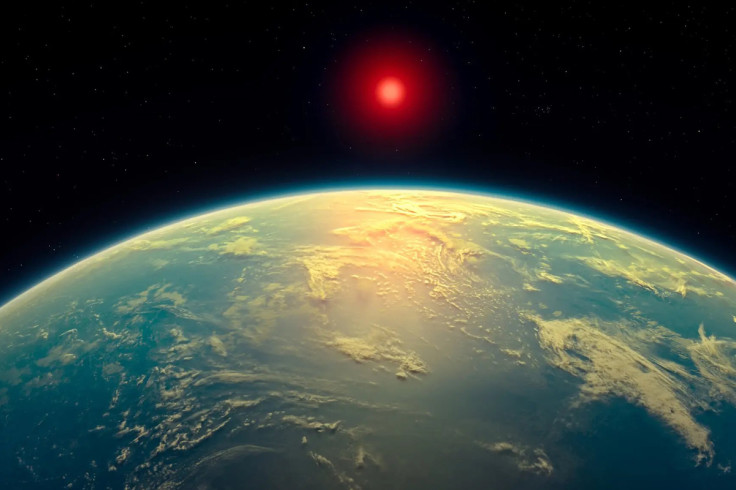
What makes the planet stand out is its position. Robertson noted that GJ 3378b receives roughly 90 per cent of the radiation Earth gets from the Sun, placing it squarely in what researchers call the 'cosmic shoreline.' That balance matters. Too much radiation, and an atmosphere is stripped away. Too little, and a planet freezes over.
Scientists believe it may once have had a thicker, more hospitable atmosphere before solar radiation eroded it. GJ 3378b, by contrast, appears to sit just far enough from danger, at least on paper.
There is, however, a crucial caveat. Researchers have not confirmed the presence of an atmosphere on GJ 3378b. 'We don't know for sure,' Robertson acknowledged, even as he pointed to modelling that suggests the planet could retain one of the right thickness to support surface pressure and, potentially, liquid water.
Alien Life Possibility and Scientific Reality
The idea of alien life inevitably grabs headlines, but the science remains cautious, sometimes frustratingly so. More than 6,000 exoplanets have been identified to date, according to Nasa, yet Earth is still the only world known to host life.
Detecting whether a distant planet is actually habitable hinges on reading faint signals. As an exoplanet passes in front of its star, its atmosphere, if present, subtly alters the starlight reaching Earth. Scientists analyse these shifts for biosignatures, chemical markers such as oxygen that could indicate biological processes.
Lisa Kaltenegger, director of the Carl Sagan Institute at Cornell University, has described this process in strikingly simple terms. 'Signs of life are written in a planet's light, if you know how to read it,' she said in earlier commentary.
Her team previously compiled a list of 45 potentially Earth-like planets, underscoring just how crowded, and uncertain, this field has become. GJ 3378b fits into that broader search, one candidate among many, not a confirmed outlier.
Much of the search for life is based on Earth-like assumptions, oxygen, water, familiar chemistry. Kaltenegger has questioned whether that framework might be too narrow. Life elsewhere, she suggested, could operate under entirely different conditions, perhaps in environments dominated by methane or ethane rather than water.
That uncertainty has not stopped the story from gaining traction online. On X and Reddit, users have latched onto the 'next-door neighbour' framing, with some expressing excitement at the relatively short, by cosmic standards, 25 light-year distance. Others have pointed out the obvious reality check. Even at the speed of a bullet train, the journey would take tens of millions of years.
Closer planets are easier to observe with next-generation telescopes, which could, in time, confirm whether GJ 3378b actually has an atmosphere and what it contains. That is where the real story sits, not aliens spotted, but a target identified.
The discovery itself relied on precision instruments, including the Habitable-zone Planet Finder on the Hobby-Eberly Telescope in Texas and the NEID Spectrometer on the WIYN Telescope in Arizona. These tools measure tiny wobbles in a star's motion caused by orbiting planets, a method that has become standard in exoplanet detection.
For now, GJ 3378b remains a promising but unproven candidate. It ticks several boxes, size, location, radiation levels, but the biggest question remains unanswered.
© Copyright IBTimes 2026. All rights reserved.