Teachers Union Forces Microsoft Into First-Ever AI Privacy Deal That Bans Tracking Students
AFT-Microsoft deal sets AI privacy rules for US schools, including limits on student tracking, data use, and automated decisions

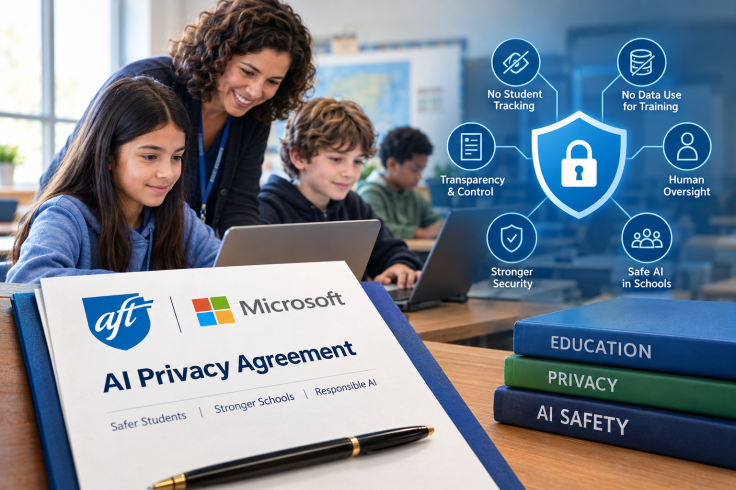
A new agreement between the American Federation of Teachers and Microsoft establishes contractually enforceable protections for artificial intelligence in US schools. The National AI Safety & Privacy Standard bars the use of student and educator data to train AI models, prohibits student tracking, and requires human oversight for certain AI-driven decisions.
The agreement was announced on 9 September by AFT President Randi Weingarten, United Federation of Teachers President Michael Mulgrew, and Microsoft Vice Chair and President Brad Smith. AFT and Microsoft described it as a first-of-its-kind framework for protecting students, educators, and families as AI use expands in schools.
The protections are not a federal regulation. Instead, school districts can incorporate them into their Microsoft customer agreements, making the provisions contractually enforceable.
A New Line on Student Data
The standard contains 10 protections covering privacy, safety, transparency, and human oversight. One central provision prevents student and educator data from being used to train AI models. Schools also retain control over how data is used, retained, and deleted.
The agreement prohibits students from being tracked through covered Microsoft AI technology. It also requires clear information about AI tools, including what information they collect and what safeguards are in place.
The training restriction includes a narrow exception for safety and security purposes. The provision is not a broad exemption from the agreement's privacy requirements. The standard also establishes additional requirements covering AI companion chatbots, security, and responsible use.
Human Oversight Stays in the Classroom
The agreement addresses a central concern surrounding AI in education: whether software should make important decisions about students or educators without human involvement.
Under the standard, AI cannot independently make certain high-risk decisions without meaningful human oversight. The framework is intended to keep people responsible for decisions rather than allowing automated systems to become the final authority.
The agreement does not prohibit AI from being used in schools. Instead, it establishes contractual conditions governing how covered AI products handle data and how certain systems can be used.
Weingarten said the framework is intended to give parents and educators greater control over children's education. Microsoft has said the standard is designed to give schools stronger safety and privacy protections.
The Deal Has Legal Teeth
The biggest difference from a voluntary set of AI principles is the contract mechanism. School districts can incorporate the protections directly into their Microsoft customer agreements. Once incorporated, the provisions become contractually enforceable. The agreement allows districts to terminate contracts for qualifying breaches and seek damages, according to AFT and Microsoft.
The standard also includes requirements covering security, certifications, transparency and reporting. One provision requires notification of a confirmed or reasonably suspected security breach within 72 hours.
The framework is therefore not an automatic nationwide ban on AI in schools. Its practical effect depends on whether individual districts incorporate the protections into their agreements with Microsoft.
Other AI Companies Are in the Union's Sights
Microsoft may not be the only technology company considered for the framework. AFT has been working with OpenAI and Anthropic through its National Academy for AI Instruction, and Weingarten has expressed hope that both companies will adopt similar protections. The push comes as major US school systems impose tighter limits on student-facing AI.
New York City Public Schools announced a one-year moratorium on student-facing generative AI for grades 2-K through 8 for the 2026-27 school year. High school students can have limited access to approved programmes under the city's rules.
Los Angeles Unified has also imposed a moratorium on student use of generative AI on district-owned devices during the current school year.
The Microsoft agreement does not settle the wider debate over whether children should use AI in classrooms. It establishes a contractual framework focused on privacy, tracking, transparency, and human oversight.
For parents and teachers, that may be the most significant part of the deal. As AI becomes increasingly common in education, the debate is shifting from whether schools will use the technology to who controls it, what happens to children's data, and whether a human remains accountable when AI is involved in an important decision.
© Copyright IBTimes 2026. All rights reserved.
- Recommended For You