

Australia Weighs the AI Copyright Exemption Britain Scrapped After Paul McCartney and Elton John Fought It
Canberra ruled out a carve-out for tech firms last year, but leaked slides show officials testing opt-outs

Leaked slides show the Australian government weighing a plan to let artificial intelligence (AI) firms train on Australians' creative work unless owners opt out. Britain dropped a similar opt-out plan in March, after Paul McCartney, Elton John and hundreds of other artists fought the change.
The plan would flip copyright, the legal right that stops others from copying a work without asking. Creators, not AI firms, would have to act. OpenAI and Anthropic have linked potential Australian investment to copyright-law clarity. In October 2025, Attorney-General Michelle Rowland ruled out an AI training exemption, and ministers deny weakening copyright.
What the Leaked Australian Plan Would Do
Slides titled 'AI on Australian Terms', seen by the broadcaster ABC, set out two options Rowland's department put to rights-holder groups in September. Both would let AI firms train on online material whose owners had not opted out. Under the first, companies would pay a central body or deal with royalty-collecting groups. The second would require only a set number of deals with rights holders, with no further payment to creators.
The slides also promise penalties for ignoring opt-outs and protections for Indigenous cultural knowledge. Shadow Attorney-General Michaelia Cash called the plan 'a text and data mining exception with an opt-out bolted on.' OpenAI's Ann O'Leary said the company could not build a training centre under current law, and a Treasury briefing said Anthropic would tie its investment to clear copyright rules. Deputy Prime Minister Richard Marles denied OpenAI had issued an ultimatum.
How Britain's Artists Defeated a Similar Plan
Britain's government proposed an AI training exception with an opt-out in December 2024. McCartney, Elton John, and Dua Lipa fronted the campaign against it. More than 1,000 musicians, including Kate Bush and Damon Albarn, released a silent protest album in February 2025. Hundreds of artists, including Coldplay, signed an open letter, as the timeline below shows. The Ivors Academy, the songwriters' body, said 88 per cent of respondents wanted stronger copyright.
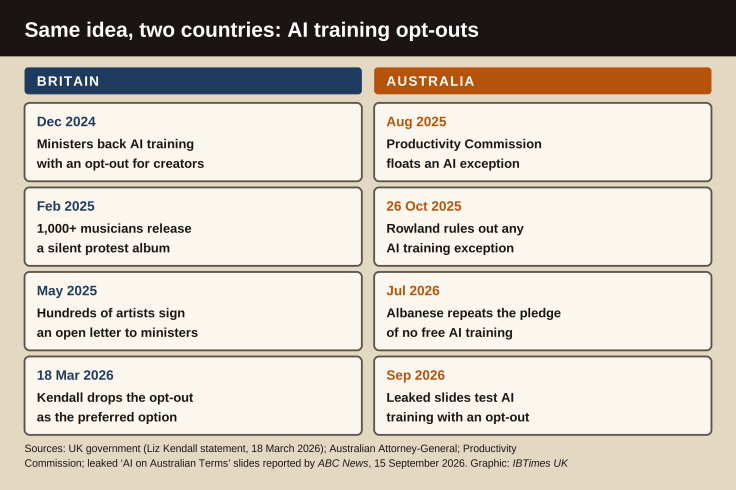
McCartney urged ministers to defend young songwriters, telling the BBC, 'You're supposed to protect us. That's your job.' On 18 March 2026, Technology Secretary Liz Kendall confirmed the government no longer favoured the plan. She said it was 'overwhelmingly rejected by the vast majority of the creative industries.' UK Music, which says the sector employs 220,000 people and generates £8 billion ($10.6 billion) a year, called on ministers to rule out reviving the plan.
What Happens Next in Canberra
Rowland's office says consultation continues on options that give creators control and fair pay. Dean Ormston, who runs the music licensing body APRA AMCOS, said, responding to OpenAI, that investment conditional on rewriting intellectual property law 'is not investment'. His group says no major AI platform has asked it for a licence in the four years since.
Independent ACT senator David Pocock said the plan would 'protect AI companies first and Australians second.' The government plans wider AI and data-centre rules next year. On 14 October, Father Paolo Benanti, an AI adviser to Pope Leo XIV, told the ABC's 7.30 Australia's proposed changes risked a 'new form of colonialism.'
© Copyright IBTimes 2026. All rights reserved.