

Man Who Used AI Songs and 10,000 Bots to Out-Stream Taylor Swift Jailed for 18 Months Over $8 Million Fraud
Prosecutors wanted nearly four years in prison, but the term fell below even the two years probation advised
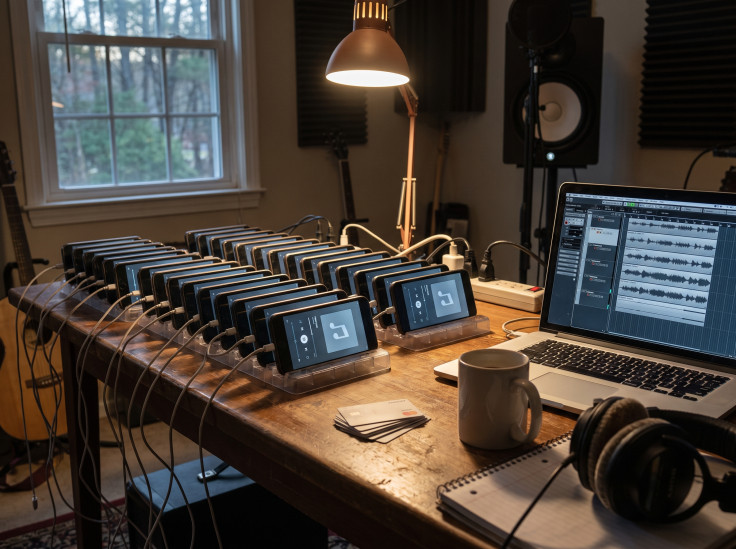
A Manhattan judge jailed Michael Smith for 18 months on Tuesday, 6 October, in what both sides call the first US criminal streaming fraud case. Smith, a 54-year-old musician from Cornelius, North Carolina, ran up to 10,000 bot accounts at once. They streamed songs mostly made with artificial intelligence (AI).
Prosecutors said Smith's accounts played his AI tracks 80.9 million times on YouTube Music family plans in April 2023. Taylor Swift's entire catalogue drew 9.3 million such plays. Family plans offered the cheapest route to running many accounts. The fake plays brought him over $8 million (about £6 million) from royalty pools real artists share.
How the Bot Accounts Worked
According to the US Attorney's Office for the Southern District of New York, Smith ran the scheme from 2017 to 2024. He bought email accounts in bulk and got debit cards by telling a Manhattan firm that dozens of invented names were his staff. He then opened thousands of accounts on Spotify, Apple Music, Amazon Music, and YouTube Music. Software played hundreds of thousands of AI songs on repeat, and Smith spread the plays thinly so no track stood out.
In an email prosecutors cited, Smith wrote that he needed a huge catalogue to get around the platforms' anti-fraud policies. The government's sentencing letter says royalty payers sent him more than $14 million (about £10.6 million). The agreed loss of over $8 million deducts estimated earnings from genuine plays and money he spent on subscriptions. Spotify said in 2024 its checks capped his earnings there at about $60,000 (about £45,000).
What Prosecutors and the Defence Wanted
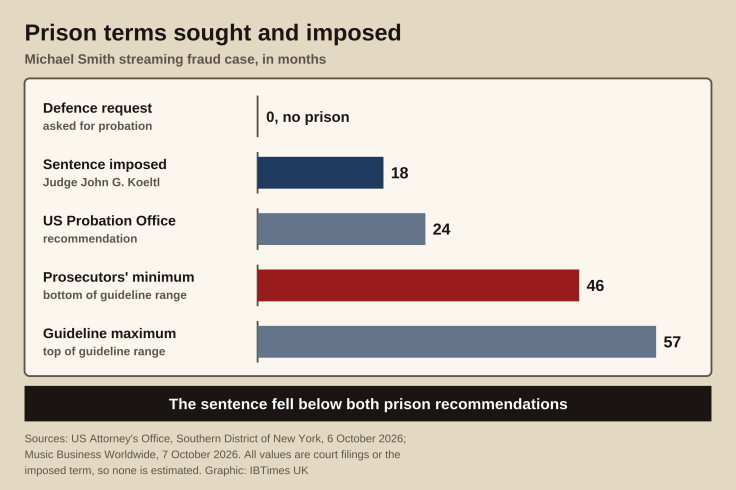
Prosecutors asked Judge John G. Koeltl to impose at least 46 months, the bottom of a guideline range ending at 57 months. Smith's lawyers wanted probation and no prison time, arguing no musician or songwriter lost a meaningful sum. The US Probation Office advised 24 months. The 18-month term came closer to the defence request than to the government's. It also fell below both proposals that called for prison, as the graphic below shows.
Smith told the court at the hearing, according to Rolling Stone, 'I betrayed the music community I care so much about.' His lawyers, Justine A. Harris and Noell P. Tin, wrote to the judge on 2 October. They argued that prison would only make it harder for Smith to pay off the forfeiture. The letter said a record label had offered him audio production work at $5,000 (about £3,800) a month.
What the Sentence Means for Streaming Fraud
The Music Fights Fraud Alliance, an industry group, had told the judge the sentence would signal what streaming fraud costs. Its executive director, Michael Lewan, said Smith 'undermined trust in the music industry'. The International Federation of the Phonographic Industry (IFPI) said the outcome sends 'a clear message that streaming fraud is a crime'.
The US Copyright Office opened a public inquiry into streaming fraud on Wednesday 7 October. It follows a May request from Republican congressman Scott Fitzgerald of Wisconsin to study how fraud affects royalties. Smith, who pleaded guilty to wire fraud conspiracy in March, faces two years of court supervision after prison.
© Copyright IBTimes 2026. All rights reserved.