

IndiGo Crisis: India's Top Airline Cancels 1,000+ Flights, Fuelling Claims It Deliberately Caused Chaos to Pressure Regulators
The airline's previously efficient scheduling model reportedly collapsed under the new pilot duty-time restrictions.
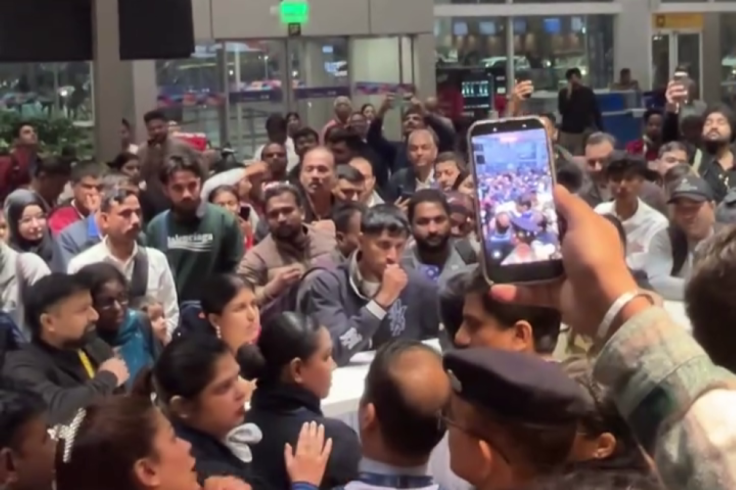
India's largest airline, IndiGo, grounded more than 1,000 flights this week, triggering widespread disruption at major airports across the country. In the capital, all domestic departures from Indira Gandhi International Airport in New Delhi were cancelled, along with services from other key hubs including Mumbai, Bengaluru, Hyderabad and Chennai.
Airports were overwhelmed with stranded travellers as long queues formed at help desks. Many passengers reported waiting for hours with little or no information, while some were forced to endure cramped conditions on airport floors or staircases.
For countless travellers, the chaos derailed holiday plans, business commitments and family events. The speed and scale of the disruption have taken the nation by surprise, especially given IndiGo's long-standing reputation for reliability and operational efficiency.
Why IndiGo Cancelled the Flights
The turmoil stems from the implementation of stricter safety rules known as Flight Duty Time Limitations (FDTL) by India's aviation regulator, the Directorate General of Civil Aviation (DGCA). The new regulations were introduced in phases from July 2025 and became fully enforceable on 1 November.
Under the revised duty-time framework, pilots must observe substantially longer rest periods, while night flying has been significantly restricted.
For example, the weekly mandatory rest period has been extended by 12 hours to a total of 48 hours, and the allowable number of night landings has been reduced from six per week to just two.
As the operator of one of the country's largest domestic networks, with thousands of daily departures, IndiGo has historically relied on tightly coordinated crew scheduling.
The new restrictions rapidly reduced the pool of legally available flight crews, leaving the airline unable to adjust its rosters quickly enough. Consequently, many flights were scheduled without compliant crews available to operate them at departure time.
In effect, IndiGo's previously efficient scheduling system collapsed under the pressure of the new safety rules, triggering a cascading wave of cancellations across its network.
Was the Airline Chaos Intentional?
With thousands of flights cancelled by IndiGo, social media has been buzzing with criticism and theories that the chaos may have been intentional.
The debate intensified after the DGCA temporarily reverse the new pilot duty-time restrictions, a move perceived by some as an acknowledgement to the airline's influence.
Gaurav Pandhi, a political commentator, said on X that IndiGo's actions went beyond mere flight cancellations, suggesting 'it practically held the country hostage ... and daring the govt to do anything about it.'
Professor Varsha Eknath Gaikwad, an academic and prominent politician, described the crisis' human impact. 'Exhausted. Hungry. Helpless. Abandoned,' she wrote, noting that families, elderly travellers, and children at airports across India were left waiting for hours with no guidance, information, or even basic necessities.
Abijit Ganguly, a social media analyst and commentator, characterised the mass cancellations as a calculated tactic: 'This was almost a planned strike to strongarm the government into giving it what it wants. What people went through doesn't matter to them, it's just collateral damage.'
While there is no definitive proof that IndiGo intentionally triggered the disruption, the combination of large-scale cancellations, visible passenger suffering, and regulatory adjustments has intensified public suspicion and sparked debate about the influence of dominant players in India.
IndiGo didn’t just cancel flights, it practically held the country hostage, grounding planes, flexing its muscle, and daring the govt to do anything about it. And instead of standing its ground, the BJP govt surrendered, withdrawing its own order.
— Gaurav Pandhi (@GauravPandhi) December 6, 2025
Compare that to how… pic.twitter.com/QRewbB9zw9
Exhausted. Hungry. Helpless. Abandoned.
— Prof. Varsha Eknath Gaikwad (@VarshaEGaikwad) December 5, 2025
For the last three days, thousands of Indigo passengers across the country, including Mumbai, have suffered unimaginable distress. At our own airport, families, senior citizens and children stood in queues for hours with NO information,… pic.twitter.com/QTSpqmY0Bj
The Great Indian Blackmail !
— Rofl Gandhi 2.0 🏹 Commentary (@RoflGandhi_) December 5, 2025
Indigo literally grounded the Indian government in less than a week and DGCA had to withdraw new safety protocols.
It tells us that in Modi's monopolistic India, one private player can shut down the entire industry. pic.twitter.com/8yHGAXUEqz
IndiGo Responds to Flight Disruptions
In a video message issued amid the crisis, IndiGo's CEO Pieter Elbers expressed regret and apologised to passengers.
'Cancellations were made for today as to align our crew and planes to be where they need to start afresh tomorrow morning,' he said, adding that the measures they did before were ineffective, which justified the mass cancellations. He pointed out that the decision was imperative for progressive improvements.
Elbers admitted the disruption diminished customers' trust in IndiGo's reliable service. He projected a gradual resumption of services, estimating operations might return to normal between 10 and 15 December.
Message from Pieter Elbers, CEO, IndiGo. pic.twitter.com/bXFdqoB0Q2
— IndiGo (@IndiGo6E) December 5, 2025
In a separate update on X, IndiGo shared their recovery effort. The airline promised free rebooking or refunds, and arranged ground transport and hotel accommodations for stranded passengers between 5 and 15 December.
They also made sure that food is being provided to the waiting customers and that lounge access is being offered to senior citizens, wherever possible.
Meanwhile, the regulator DGCA has reportedly formed a four‑member high‑level committee to probe what went wrong. The government has issued broad directives that includes flagging fare hikes, monitoring schedule stabilisation, and a warning that it expects full service restoration as early as 10 February 2026.
© Copyright IBTimes 2026. All rights reserved.