

Interstellar Comet 3I/ATLAS: Watch Live Images of The Alien Guest Closing in on Earth
Harvard's Avi Loeb and Michio Kaku weigh in on 3I/ATLAS as interstellar guest recedes from Earth

In the velvet darkness of the night sky, a visitor from the deepest reaches of the galaxy is currently making its final curtsy before vanishing into the void forever. It is a moment of profound cosmic serendipity. For the third time in human history, we are witnessing an object that was forged around a distant, unknown star, only to be cast out into the interstellar wilderness for billions of years.
As this celestial nomad, dubbed 3I/ATLAS, makes its closest approach to Earth this week — reaching its minimum distance at 1 a.m. EST (0600 GMT) on Friday, Dec. 19 — it brings with it a shifting scientific narrative that has moved from whispers of alien 'technosignatures' to the quiet awe of witnessing a 7-billion-year-old relic.
The NASA-funded ATLAS survey in Chile found the object in July 2025. It followed in the footsteps of the famous 1I/'Oumuamua and 2I/Borisov. Loeb recently called 3I/ATLAS a 'prominent anti-tail', and it had its own unique look: a confusing jet that faced the sun and changed from a dull red to a bright, glowing green. Avi Loeb, an astrophysicist at Harvard, thought these strange things were too important to ignore. He suggested that the object, which is the size of Manhattan, could be a piece of advanced alien technology.

The Quiet Departure of 3I/ATLAS and the Shift in Scientific Sentiment
As the object reached its closest point to Earth — a comfortable 170 million miles away — the scientific community held its breath. Would it manoeuvre? Would it emit a signal? Speaking on Elizabeth Vargas Reports this Monday, Loeb offered a grounded update that seemed to temper the earlier excitement. 'So far, so good,' he remarked, noting the absence of overtly artificial behaviour. '3I/ATLAS did not manoeuvre or display any unusual activity when it came closest to Earth'.
For a scientist who has built a reputation on investigating the anomalous, this admission carries significant weight. While the object's behaviour during its flyby was resolutely natural, Loeb isn't quite ready to dismiss the mysteries of its chemistry.
The comet's green hue, caused by diatomic carbon molecules reacting to solar heat, is a common trait in local comets but was unexpected for a visitor that began its journey as a deep-red wanderer. Loeb conceded: 'at this point, given all the data that we have, I would agree that it's most likely natural, but there are still a lot of things we don't understand about it'.
Unravelling the 7-Billion-Year-Old Mystery Behind 3I/ATLAS
If this is not a scout ship, its reality is perhaps even more staggering. Theoretical physicist suggests that the 'anomalies' are simply the scars of a journey that has lasted twice as long as the existence of our own sun. 'This is a very old object, perhaps 7 billion years old,' Kaku told NewsNation. He explained that its 'off-scale' nickel content and unusual chemical composition are likely the result of seven billion years spent accumulating elements from diverse interstellar environments.
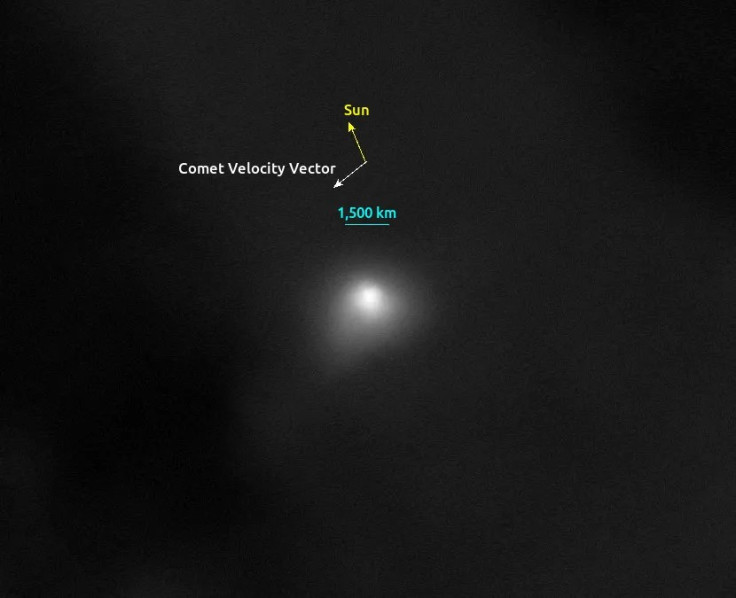
To capture this fleeting visit, NASA has mobilised a fleet of instruments, including the Europa Clipper spacecraft, which recently used its Ultraviolet Spectrograph (UVS) to snap images of the comet from 102 million miles away. For those hoping to catch a glimpse before it departs, the window is closing. While invisible to the naked eye at its faint magnitude of approximately 9.5 to 11, the comet can be tracked via the Virtual Telescope Project webcast or 'smart' telescopes like the Seestar S50 and Unistellar eVscope 2.
People who want to see the comet should look at the constellation Leo, specifically to the lower left of the bright star Regulus. The comet looks like a small, slightly out-of-focus point of light. As 3I/ATLAS fades into the dark, it reminds us that the universe is much older, stranger, and full of ancient travellers than we ever thought possible.
As 3I/ATLAS retreats into the interstellar void, it remains a powerful symbol of the mysteries still hidden within our universe. Whether a 7-billion-year-old remnant or a truly unique cosmic anomaly, its fleeting visit has provided a rare glimpse into the history of deep space.
© Copyright IBTimes 2026. All rights reserved.