Legendary Investor John Bogle's Timeless Advice for Volatile Markets Still Holds Up — Beware Of 'Loser's Game'
Bogle's simplest advice was to own the entire market through an index fund and stay the course, ignoring market noise
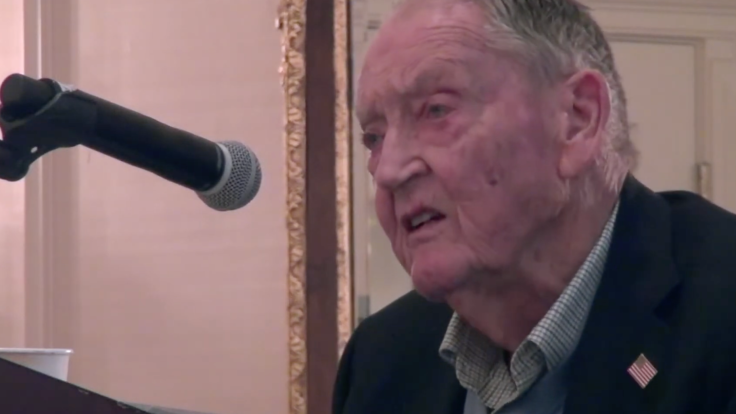
A clip of Vanguard Group founder John Bogle warning investors against speculation went viral on social media this week, racking up millions of views as tariff-driven sell-offs and central bank uncertainty rattle global portfolios in 2026, BlackEdgeFund shared on X.
Bogle, who died in January 2019 at the age of 89, spent six decades making the same argument: that the financial industry gets rich by encouraging people to trade, while the investors themselves get rich by doing the opposite.
'Don't do something. Just stand there!' He was fond of saying flipping Wall Street's favourite mantra on its head.
Why Bogle Called Speculation a 'Loser's Game'
The distinction Bogle drew between investing and speculation was central to everything he built. Investing meant owning a piece of real businesses for the long run. Speculation meant betting on price swings, often at high cost and with poor odds.
Jack Bogle on why most investors are actually just speculators:
— Black Edge (@BlackEdgeFund) May 14, 2026
In the midst of major market volatility, Jack Bogle was asked how investors should react.
His first move was to reframe the question entirely:
"I'd like to make a distinction about the difference between an... pic.twitter.com/ac6Hvy8vvU
His 2012 book, The Clash of the Cultures: Investment vs. Speculation, laid the case out bluntly. 'Speculation is a loser's game,' he wrote. 'Because of the costs, it has to be a loser's game.' He pointed to ETF turnover rates that averaged 320 per cent in 2011 as evidence that the market had become a place where people rented stocks rather than owned them.
Bogle did not pretend the urge to speculate could be stamped out entirely. He suggested investors cap what he called 'funny money' bets — high-risk plays on individual stocks — at roughly 5 per cent of a portfolio. The caveat was firm: only risk what you could afford to see drop to zero, CNBC noted in a 2015 profile of his investing rules.
His own portfolio reflected the philosophy. By his mid-80s, Bogle held a roughly 50/50 split between a US stock index fund and a US bond index fund. He rarely rebalanced and did not invest directly overseas. 'I just like the idea of having an anchor to the windward,' he told CNBC at the time.
From 'Bogle's Folly' to a $10 Trillion (£7.5 Trillion) Legacy
Bogle grew up in a family that lost nearly everything during the Great Depression, an experience that shaped his lifelong fixation on cost and discipline. He graduated magna cum laude from Princeton University in 1951 with a senior thesis concluding that most actively managed funds failed to outperform the broader market — a finding Wall Street largely dismissed at the time, the Bogle Financial Markets Research Center confirmed.
After being fired from Wellington Management over a merger he later called 'shameful and inexcusable', he founded Vanguard in 1974 and launched the First Index Investment Trust two years later. It was the first index mutual fund available to retail investors, tracking the S&P 500 at a fraction of active management fees. Critics mocked it as 'un-American'. Its initial public offering raised just $11 million (£8.3 million) against a target of $150 million (£113 million).
The sceptics lost that bet. Vanguard now manages more than $10 trillion (£7.5 trillion) in global assets and serves more than 50 million investors across 160 countries. In 1977, Bogle eliminated sales commissions entirely, cutting a layer of costs the industry had long treated as non-negotiable.
'In investing, you get what you don't pay for,' he wrote in The Little Book of Common Sense Investing in 2007. The numbers still support that claim. For the decade ending March 2026, 276 of 333 Vanguard funds outperformed their peer group averages, according to data from LSEG Lipper cited by Vanguard.
His most enduring line of advice was also his simplest. 'The winning formula for success in investing is owning the entire stock market through an index fund, and then doing nothing,' Bogle once said. 'Just stay the course.' He liked to compare market noise to the witches' prophecy in Shakespeare's Macbeth — 'full of sound and fury, signifying nothing.'
Seven years after his death, with geopolitical friction and policy uncertainty dominating headlines, Bogle's prescription has not aged. Buy broadly. Keep costs low. And do not confuse trading with investing.
© Copyright IBTimes 2026. All rights reserved.
- Recommended For You