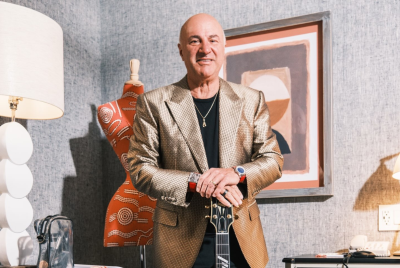
Inside George Kamel's Portfolio: Real Estate, Equities, and the Ramsey Strategy Behind His Wealth
George Kamel transformed his financial life by focusing on equities and disciplined savings

Ramsey Solutions personality George Kamel, who went from $40,000 (£29,600) in consumer debt to millionaire status in under a decade, laid out the full breakdown of his investment portfolio during an appearance on the Iced Coffee Hour podcast with Graham Stephan.
His home accounts for roughly half his entire net worth. The other half is spread across retirement accounts, a taxable brokerage account and cash. No bonds. No treasuries. No cryptocurrency. 'I'm an equities man,' Kamel said.
Kamel co-hosts The Ramsey Show and Smart Money Happy Hour. He joined Ramsey Solutions as a temp in 2013, cleared his debts within 18 months through the company's Financial Peace University programme, and paid off his house by 2021. He and his wife live in Williamson County, Tennessee, where the average home price sits at roughly $1 million (£740,000).
100% Equities, Zero Bitcoin, and a Vanguard Brokerage
The core of Kamel's portfolio sits in mutual funds inside his 401(k) at Ramsey Solutions. His wife, who now stays at home, rolled her old 401(k) into a traditional IRA and a Roth IRA. He holds a separate rollover IRA, and maintains a taxable brokerage account invested in Vanguard index funds. Cash sits at roughly 10%.
'The asset allocation theory is kind of bunk,' he said, explaining why he avoids bonds entirely.
On Bitcoin, Kamel was blunt. 'Close to zero. And by close to, I mean I have zero.' Stephan offered $40 (£30) for a single share of BlackRock's iShares Bitcoin Trust ETF, which Kamel accepted as a joke. 'If you gave me the choice of an S&P 500 index fund or a Bitcoin ETF, I'm going to go index fund every time.'
He automates contributions to his children's 529 college savings plans and brokerage account so the money leaves before he can spend it. 'Paycheck hits, the money disappears. I'm basically living like I'm broke, which is great.'
From 15% To 50%: How Kamel Scaled His Savings Rate
While carrying a mortgage, Kamel invested 15% of his income into retirement accounts and directed everything else at the home loan. Once the house was paid off in his early 30s, he scaled to 50%.
'We didn't really increase our lifestyle by much,' he said. His family of four runs on approximately $5,000 (£3,700) to $6,000 (£4,440) per month. In a pinch, he could trim that to $4,000 (£2,960).
That margin proved its worth when one of his French bulldogs suffered a ruptured spinal disc. The total bill ran to over $11,000 (£8,140) between surgery, scans, and rehabilitation. A high-deductible pet insurance policy returned $5,000 (£3,700). 'That sucked, but I'm glad we didn't have to suffer financially too,' he said.
On borrowing, Kamel accepts only a 15-year fixed-rate mortgage kept at or below 25% of after-tax income. Asked whether he would take $1 billion (£740 million) at 0% interest for 10 years—a question that went viral when Dave Ramsey refused the same hypothetical— Kamel also said no. 'The idea of owing anybody any amount of money at this stage is simply uninteresting to me,' he said.
The Debt Backdrop to Kamel's Portfolio Strategy
Kamel's approach sits against a bleak national backdrop. Total US household debt hit $18.8 trillion (£13.9 trillion) by the end of 2025, a record, according to the Federal Reserve Bank of New York. Credit card balances stood at $1.28 trillion (£947 billion) and auto loans at $1.67 trillion (£1.24 trillion).
A Goldman Sachs study from October 2025 found 25% of workers earning above $100,000 (£74,000) described themselves as living paycheque to paycheque. Among earners pulling in $300,000 to $500,000, the figure hit 41%. Kamel cited a Ramsey Show caller with a $340,000 (£252,000) household income who was sinking deeper each month.
'It's not about income,' Kamel said. 'Get good with money now, no matter what you're making, and then work to get your income up, and then everything will scale.'
His portfolio is the proof of that principle. No exotic instruments, no leverage, no crypto positions. A paid-off house, index funds on autopilot, and monthly spending that barely dents a six-figure income.
© Copyright IBTimes 2026. All rights reserved.
- Recommended For You