

Luke Aikins Eyes 330,000-Foot Space Jump After Surviving Record 25,000-Foot Fall Without a Parachute
The American skydiver, who set a 2016 no-parachute record, says the proposed feat remains an ambition with no launch date or aerospace partner announced
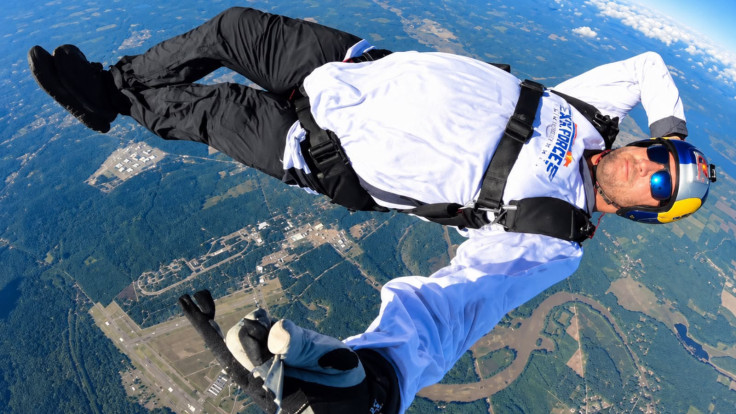
Luke Aikins, the American skydiver who jumped 25,000 feet without a parachute in 2016, hopes to attempt a far higher leap from a rocket. The 52-year-old wants to jump from approximately 330,000 feet above Earth, near the conventionally recognised boundary of space. However, the proposed stunt remains an ambition, with no confirmed launch date or named aerospace partner.
'That's the dream, the drop-the-mic thing,' Aikins said in an interview with The Times. 'I've been pursuing that pretty hard, it's my big project.'
His proposal would take him to an altitude roughly 13 times higher than his previous record-setting leap. At that height, the challenges would differ considerably from those involved in his earlier stunt. The project would require extensive technical planning, although the precise arrangements have not been announced.
On 30 July 2016, Aikins jumped from a Cessna aircraft over Simi Valley, California, without a parachute or wingsuit. He landed in a specially designed net measuring 100 feet by 100 feet. Guinness World Records recognises the achievement as the highest skydive without a parachute.
The details of Aikins' proposed space jump were reported by People following an interview with The Times. His stated ambition should not be confused with a confirmed launch or an approved aerospace mission.
Why Luke Aikins Wants One More Record
Aikins estimates that he has completed approximately 22,000 skydives throughout his career. Nevertheless, he does not want his most famous achievement to define his professional legacy.
'I never wanted the no-parachute jump to be the only thing I'm known for,' he told The Times. He also acknowledged that the 2016 stunt might remain his best-known achievement if he cannot complete the proposed rocket jump.
Aviation and skydiving have played significant roles in his family history. His grandfather was a military pilot during the Second World War, while his father became a naval aviator before flying for United Airlines. His mother was also a keen skydiver, according to the interview.
Aikins completed his first tandem skydive at 12 and began jumping regularly at 16. His experience has since extended to thousands of jumps, although the proposed space project would represent a different challenge from conventional skydiving.
The Kármán line is commonly used to mark the boundary between Earth's atmosphere and outer space. It sits approximately 100 kilometres, or 62 miles, above Earth. NASA notes that there is no exact physical boundary where the atmosphere ends and space begins.
At approximately 330,000 feet, Aikins' proposed starting altitude would be close to that conventional boundary. The altitude alone, however, does not establish how the jump would be conducted or whether the project could proceed.
Inside the Record-Breaking No-Parachute Jump
Aikins has described his 2016 stunt as 'a giant science project.' The preparation included extensive testing and practice, reflecting the precision required to land safely in a relatively small target.
He told The Times that he completed approximately 350 practice jumps before the attempt. His team also dropped dummies into the net to examine impact forces and deceleration. Aikins said he had landed in the net 81 times during practice.
'I wasn't 99% sure it was going to work, I was 100%,' he said.
During the 2016 jump, Aikins used his body position and a GPS device to guide his descent towards the net. He later recalled that the final approach felt different from what he had anticipated. His successful landing established the record documented by Guinness World Records.
Aikins has also credited his wife, Monica, with playing an important role in evaluating his stunts. She is a skydiver herself and considers the preparation and testing behind each proposed challenge.
'We do this as a team,' he said. 'She has to buy into it and say that she's in. Otherwise, I probably wouldn't do it.'
Their son, Logan, has also completed solo jumps, according to the interview. Aikins described the teenager as a risk-taker who follows the rules. The family's involvement provides personal context for the decisions surrounding his high-risk career.
For now, the proposed rocket jump has no publicly confirmed launch date. Aikins hopes a private aerospace company developing commercial rocket technology could help make the idea possible, but no partnership has been confirmed in the reporting.
The distinction matters because a stated ambition is not the same as a funded, approved or scheduled mission. Until further details emerge, the project should be treated as a proposal rather than an imminent event.
Aikins continues to share his skydiving activities on social media, where he says his videos attract millions of views. His ambition to attempt a jump from the edge of space would extend a career built around technically demanding aerial challenges.
Asked about those who consider the proposed feat impossible, Aikins offered a brief response: 'Impossible is just an opinion.' Whether the project advances will depend on the technical planning, resources and arrangements required to turn that ambition into reality.
© Copyright IBTimes 2026. All rights reserved.