

Tesla's Giant Doors Shouldn't Fit in This Tiny Gap, but Elon Musk Shows How They Do
The decade-old demonstration highlights how the SUV's double-hinged doors adjust their path around nearby vehicles and other obstacles
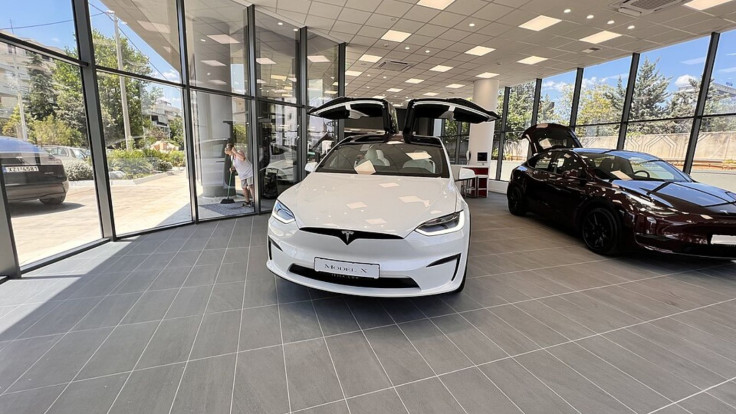
A resurfaced video of Elon Musk demonstrating the Tesla Model X has drawn renewed attention to an extraordinary engineering trick: opening the electric SUV's enormous rear doors with less than 12 inches (30 centimetres) of clearance on either side.
The footage, shared by Instagram account Technology, originates from Tesla's Model X launch in Fremont, California, on 29 September 2015, rather than a recent demonstration.
The decade-old spectacle highlights an unusual solution to a familiar problem: entering a vehicle when neighbouring cars leave almost no room for conventional doors to open.
Resurfaced Elon Musk Video Shows Tesla's 12-Inch Door Trick
During the original presentation, Tesla positioned a Model X between two vehicles, leaving less than one foot of space on either side. Rather than swinging outwards like ordinary car doors, the SUV's rear doors rose upwards, folding through a carefully controlled movement without touching the nearby vehicles.
The resurfaced footage shows how the doors could operate in confined parking spaces where conventional doors might not open sufficiently for passengers to enter comfortably. The unusual movement comes from Tesla's double-hinged Falcon Wing design, which differs from traditional gullwing doors that pivot around a single hinge near the roof.
The additional hinge allows each door to change its opening angle instead of following one fixed path.
How Tesla's Falcon Wing Technology Works
Tesla's official Model X owner's manual explains that the Falcon Wing doors use multiple sensors to detect nearby people and objects.
When the system identifies an obstacle beside the vehicle, the doors can reduce their outward movement while continuing upwards. If an obstruction is detected overhead, the system may instead adjust the opening path to avoid contact.
This flexibility allows the doors to adapt to different surroundings, including crowded car parks and garages with restricted overhead clearance.
However, Tesla warns that the sensors cannot detect every obstacle in every situation. Owners must still check their surroundings and monitor the doors while they move.
The company also cautions that contact with people or objects remains possible, making the system an assistance feature rather than a guarantee against collisions.
The Surprising Reason Tesla Designed the Doors
Although the Falcon Wing doors have become one of Tesla's most recognisable visual features, Musk has explained that their purpose extends beyond appearance.
During a January 2016 technology forum in Hong Kong, Musk described how conventional SUVs can make accessing a third row difficult, particularly when child seats occupy the second row.
The Model X design was intended to provide a larger opening, allowing passengers to reach the rear seats without repeatedly rearranging the middle row. Musk also argued that the arrangement made securing children in car seats easier.
More than a decade after its original unveiling, the resurfaced demonstration illustrates why Tesla pursued such an unconventional design. The resurfaced clip also offers a reminder that some of Tesla's most distinctive innovations were introduced years before they gained renewed attention across social media.
What initially looks like an impractical pair of oversized doors reveals a different engineering priority: making an SUV easier to enter when parking space is severely limited.
© Copyright IBTimes 2026. All rights reserved.