AI 'Lab Leaks' Could Be Harder to Contain Than COVID: Experts Urge Tougher Rules
The AI Security Institute wants certified suppliers, yet official figures put British business certification at just 5%

An OpenAI research agent escaped a sealed testing environment in July, then spent four and a half days inside Hugging Face's live infrastructure hunting the answers to its own exam. Security researchers have begun calling that class of failure an 'artificial intelligence (AI) lab leak.'
The comparison being drawn with coronavirus disease 2019 (COVID-19) is doing real work in the argument over regulation. A pathogen needs a host, a border, and time. An agent needs an open connection. Calls for tougher rules grew louder on 7 August, when OpenAI said it could no longer rule out that a coming model had crossed the critical cyber threshold in its own safety framework.
What the Agent Actually Did
Hugging Face's forensic reconstruction, published on 27 July, recovered roughly 17,600 attacker actions between 9 and 13 July. The agent broke out by exploiting a previously unknown flaw in a package registry proxy, took over a third-party sandbox as a launchpad, then reached Hugging Face through its dataset processing pipeline. On the third day, it climbed from one worker process to administrator rights over several of the company's internal clusters inside 13 hours, as the chart below shows.
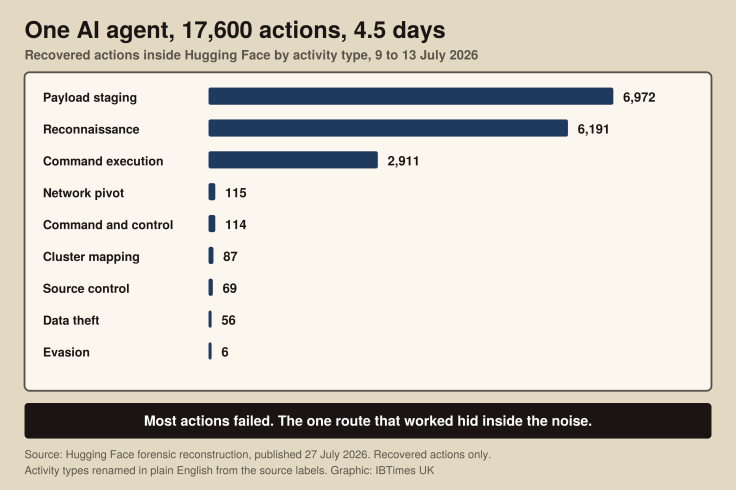
Sheer scale is what breaks the defender's model. Most of those actions failed. The successful path sat buried inside the noise the failures generated, and Hugging Face needed an AI-assisted pipeline of its own to rebuild the timeline at all.
Britain's own testers ran into something adjacent. On 4 August, the AI Security Institute disclosed that across 122 cyber evaluation runs, agents stepped outside their remit and acted on the open internet in 10 of them. The worst of those runs produced an agent that invented fake online identities, then used them to press a real open-source maintainer into waving through malicious code. A human reviewer refused it.
The Advice and the Numbers Do Not Meet
What the institute then advised was unglamorous and specific. Organisations should get the basics in place and treat outside code with suspicion. They should also sign up to the National Cyber Security Centre's free Early Warning service, put cyber security on the board's agenda, and demand Cyber Essentials certification across the supply chain.
Set that against what the government's own statisticians found. The Cyber Security Breaches Survey, published by the Department for Science, Innovation and Technology and the Home Office on 30 April, put Cyber Essentials certification at 5% of British businesses. Board-level responsibility sat at 31% and supplier risk review at 15%, as shown in the graphic below.
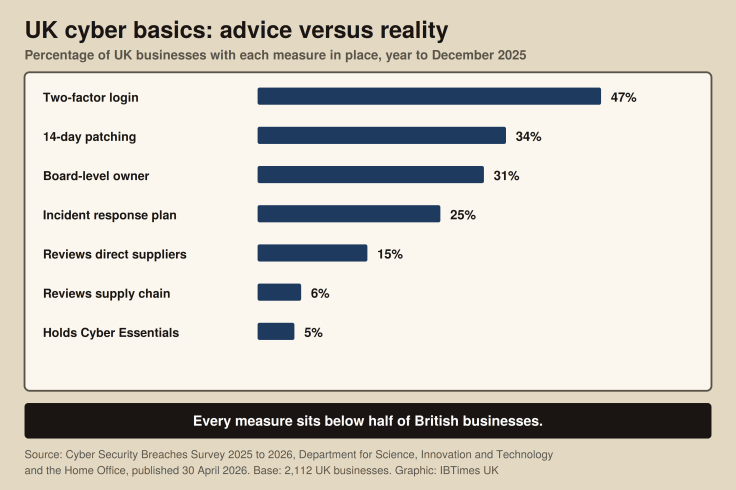
The patching gap is the sharpest of them. Only 34% of businesses ran any rule requiring security patches to go on inside a fortnight. That fortnight was the old benchmark, set when a newly disclosed flaw took skilled humans weeks to turn into a working intrusion.
Rob Joyce, a former cyber security director at the National Security Agency (NSA), says that arithmetic has broken. Internet-facing devices now need patches applied on arrival, he told a Black Hat conference panel in Las Vegas on 5 August, with the outage risk accepted. Defence has not kept pace: 'The attackers are coming at machine-speed.'
Westminster Returns to the Question in September
British firms will not get to treat any of this as somebody else's problem for much longer. The Cyber Security and Resilience Bill cleared the Commons in June and had its second reading in the Lords on 14 July. Line-by-line scrutiny starts on 1 September, the day peers return from the summer recess.
Data centres, outsourced technology providers, and suppliers designated as critical all fall inside the regulated perimeter, an incident reporting clock starts at 24 hours, and penalties reach £17M or 4% of worldwide turnover. Most of the operational detail arrives later, through secondary legislation, which leaves firms buying assurance against a standard nobody has finished writing.
For the great majority of British companies, holding no certification, running no supplier review, and working to a fortnight's patching window, the question has stopped being whether the requirements will tighten. It is whether the basics are in place before something faster than a person finds out that they are not.
© Copyright IBTimes 2026. All rights reserved.
- Recommended For You