

Donald Trump Threatens To 'Bomb the S*** Out Of' Oman, Prompting Conservative Doctor To 'Question His Sanity'
A conservative doctor and National Review contributor says he now 'seriously' questions Donald Trump's sanity after the president threatened to bomb US ally
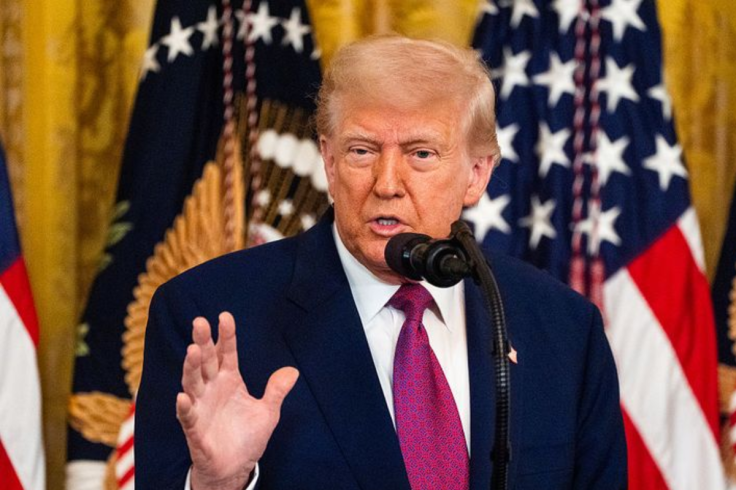
Donald Trump sparked fresh alarm in Washington on Monday after threatening to 'bomb the s*** out of' Oman, prompting a conservative doctor and columnist to publicly question the president's 'sanity' over a string of foreign policy comments made in just 48 hours.
The warning came from Dr Pradheep Shanker, a practising physician and contributor to the right-leaning National Review, who is no habitual Trump-basher.
Shanker posted on social media that, taken together, Trump's recent remarks about Oman, a Saudi-led defence pact and the Korean peninsula were disturbing enough that 'we may have to question his sanity Seriously.'
His intervention underlined something Republicans often prefer not to admit in public: concern about Trump's judgment is not confined to Democrats or liberal pundits.
Donald Trump, Oman Threat and a Longtime US Ally
The immediate flashpoint was Trump's latest broadside at Oman, a small Gulf monarchy that has quietly been one of Washington's most useful partners for decades. On Monday morning, Trump said he would 'bomb the s–– out of' Oman if it 'got in the way' of his efforts to end the war with Iran, adding that he was 'not in a hurry' to reach a deal.
It was not the first time he had singled out the country. The Guardian has previously described Oman as a 'longtime US strategic partner' and an essential backchannel between Washington and Tehran.
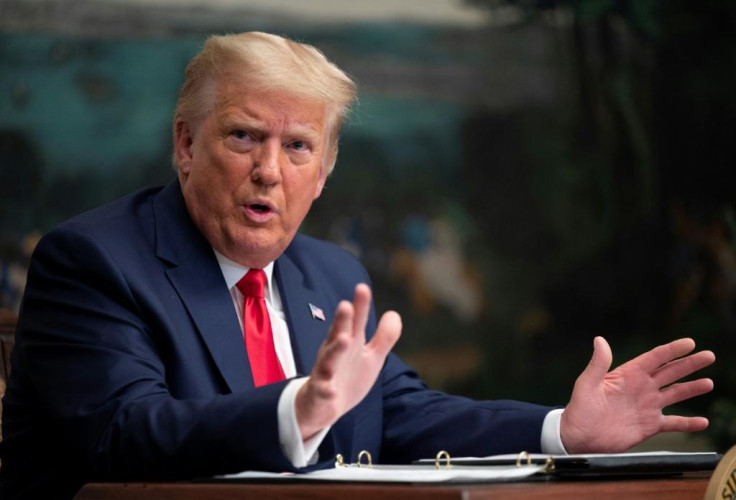
In diplomatic speak, that is about as valuable as it gets. Trump's casual threat to flatten an ally that has helped the US talk to Iran when no one else could was, to put it mildly, unconventional.
Shanker bundled that statement with two others from the preceding days as part of what he saw as a troubling pattern. 'So in the last couple days,' he wrote, '1. Trump threatened to bomb ally Oman. 2. Applauded a defence pact between the Saudis and Pakistan. 3. Claimed North Korea is more peaceful than South Korea.' None of these claims has been denied by Trump or his team.
Defence Pact Praise and 'Unthreatening' North Korea
A day before the Oman threat, Trump had welcomed a newly signed defence pact between Saudi Arabia, Turkey and Pakistan.
On social media, he hailed it as a sign that 'the Middle East is coming together' and said countries would 'finally be able to defend themselves in a more meaningful way,' calling the agreement a 'BIG, BOLD, IMPORTANT FIRST STEP.'
The deal itself attracted relatively little attention in the US press but outlets such as Al Jazeera have reported that it could force the region to rethink decades of American-led security arrangements and potentially upend the Middle East balance of power.
According to the report, Iran has also praised the pact, describing it as 'a shift away from alliances with the US.' In other words, Trump was cheering on an agreement that some analysts view as nudging Washington to the margins.
Then came his comments on the Korean peninsula. On Sunday night, just hours before large-scale joint military exercises with South Korea were due to begin, Trump abruptly announced that the US would scale them down. He blamed Seoul's refusal to join the war in Iran and cited his 'very good' relationship with North Korea's Kim Jong Un.
Trump described the drills as sending a signal 'totally inappropriate and hostile' to Pyongyang, which is a nuclear-armed state and has no formal diplomatic relations with Washington.
Trump insisted that as long as he had been president, North Korea had been 'unthreatening and respectful'. 'Based on the fact that it is too late to cancel,' he wrote, 'I have instructed Secretary of War, Pete Hegseth, to substantially reduce the Joint Military Exercises!' That phrasing jarred with long-standing US policy, which has rested on deterrence alongside South Korea.
It also raised an awkward question: why was a close democratic ally being implicitly punished, while a regime described by another conservative journalist as 'blood-soaked communists' was portrayed as courteous and non-threatening?
Conservative Backlash to Donald Trump's Foreign Policy
What has stood out in the reaction is not so much liberal outrage as the tone of criticism from Trump's own ideological neighbourhood. One National Review journalist described Trump's position as 'reprehensible,' writing that 'the president covers a great and good country in shame.
Again.'He later added that while Trump and the Republican Party were seeking votes to defeat supposed 'communists' at home, his stance on 'actual blood-soaked communists' abroad was that they were 'unthreatening and respectful.'
Michael Sobolik, another conservative commentator, argued that Chinese president Xi Jinping would be drawing his own conclusions from Trump's approach. If you convince Trump you are 'unthreatening and respectful,' Sobolik suggested, he will 'offer unilateral concessions and blame America's partners for being hostile.'
For Shanker, the sequence of Oman, the defence pact and the scaling back of exercises with South Korea over Iran coalesced into something darker than mere erratic messaging. As negotiations with Iran appeared to stall, he wrote that 'this is truly pathetic,' adding that he was 'almost getting to the point where random Democrats would be handling this better than Trump is.'
Nothing in these exchanges proves clinical instability. But the fact that conservative professionals who once tried to stay onside are openly wondering about Trump's fitness to handle crises is, in itself, a data point that Republican voters and America's allies alike will have to weigh.
© Copyright IBTimes 2026. All rights reserved.