

Donald Trump Calls Iran Nuclear Sites 'Drug Factories' While Recounting 2025 US Strikes
Trump's unexpected description of the 2025 targets contrasts with official records that identify them as nuclear facilities
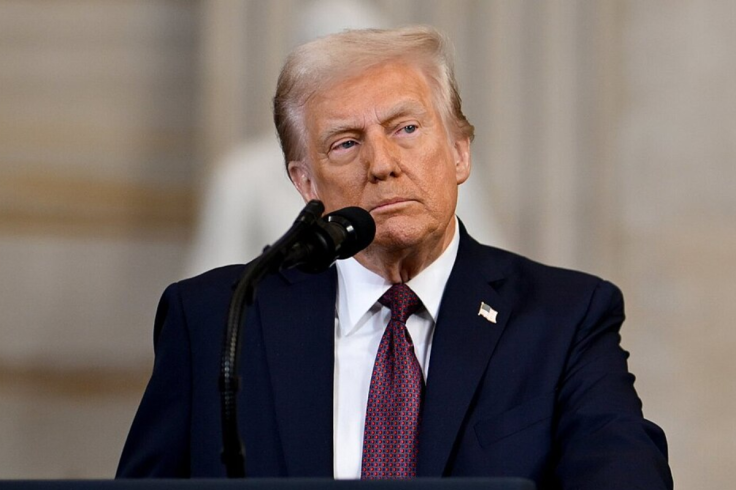
President Donald Trump called Iranian nuclear sites targeted during a 2025 US military operation 'drug factories' at a rally in Durant, Oklahoma, on Thursday, 1 October.
Trump did not explain what he meant by 'drugs' or provide evidence that the facilities had any drug-related role. Pentagon and International Atomic Energy Agency records identify Fordow, Natanz and Isfahan as nuclear facilities.
His statement came as Trump recounted Operation Midnight Hammer, carried out overnight on 21-22 June 2025. His comments did not clearly describe alleged drug activity as a reason for launching the current US-Israel conflict with Iran, which began on 28 February 2026.
Trump praised the B-2 crews and refuelling aircraft involved in the earlier operation before describing the Iranian targets in unusual terms.
'They were nuclear and drugs. They were doing drugs, but they were doing the nuclear,' Trump said.
He later called them 'drug factories/nuclear factories.' Trump did not identify a drug, describe an alleged production process or say who was supposedly involved. He presented no supporting evidence for a drug-related role in the remarks reported from the rally.
Trump Adds 'Drug Factories' Claim to 2025 Strike Retelling
The official account of Operation Midnight Hammer focused on Iran's nuclear infrastructure. Gen. Dan Caine, chairman of the Joint Chiefs of Staff, said seven B-2 Spirit bombers formed the main strike package.
The aircraft flew east from the continental United States on a mission that required multiple aerial refuellings.
B-2 bombers dropped 14 GBU-57 Massive Ordnance Penetrator bombs on Fordow and Natanz, according to subsequent Pentagon accounts. A US submarine separately launched more than two dozen Tomahawk missiles towards surface infrastructure at Isfahan.
That distinction makes it inaccurate to describe all three facilities simply as sites struck by B-2 bombers.
IAEA documentation also identifies the locations as part of Iran's nuclear programme. Before the strikes, the agency documented enrichment operations at Fordow and Natanz and monitored nuclear activities at Isfahan.
No official material reviewed for this report identifies any of the three locations as a drug-production facility. Trump's description therefore remains an unsupported claim rather than an established fact.
Pentagon officials said in June 2025 that Operation Midnight Hammer was intended to 'destroy or severely degrade' Iran's nuclear programme. Drug production was not cited as a military objective.
Official Accounts Focused on Iran's Nuclear Programme
Trump has repeatedly described the 2025 operation as having devastated Iran's nuclear capabilities. The extent of the damage, however, became disputed soon after the strikes.
A preliminary Defense Intelligence Agency assessment concluded that the attack had not destroyed Iran's nuclear capability and might initially have delayed the programme by only months, Reuters reported. The Trump administration rejected that early assessment.
Pentagon officials later said their intelligence indicated that Iran's nuclear programme had been set back by roughly two years. The IAEA's director general offered a more cautious assessment at the time, saying Iran could potentially resume uranium enrichment within months.
The wider intelligence picture before the strikes was also more nuanced than claims that Iran was already building a bomb. In March 2025, the US intelligence community assessed that Iran was not building a nuclear weapon and that its supreme leader had not authorised a weapons programme. It also warned that Iran's enriched uranium stockpile had reached unprecedented levels for a country without nuclear weapons.
After the current conflict began in February 2026, Trump went further. On 4 March, he said Iran would have obtained a nuclear weapon 'within two weeks' without the previous B-2 strike.
Trump's Oklahoma comments now add another description to his retelling of Operation Midnight Hammer. They do not establish that Fordow, Natanz or Isfahan had a drug-related function, or that alleged drug activity was a reason the United States attacked them.
The clearest public records reviewed identify all three locations as nuclear facilities. On the evidence currently available, Trump's 'drug factories' description remains unverified.
© Copyright IBTimes 2026. All rights reserved.