

A Guide to Day Trading by eToro
Learn the fundamentals, strategies, and markets suited for day trading, along with practical tips to manage risk and improve your trading skills

Day trading is a popular method of trading, but what exactly is it and how is it done? This guide will help you understand what day trading means, the strategies involved, the key terminology used by day traders, and which approach might best help you achieve your investment goals.
As the name suggests, day trading is a strategy that involves opening and closing trades on the same day. It is best suited for individuals looking to take advantage of short-term price movements in the financial markets. Day trading differs greatly from traditional investing and requires additional time, effort, and understanding. It should only be undertaken by traders who are aware of the risks.
'Where you want to be is always in control, never wishing, always trading, and always, first and foremost protecting your butt.'
— Paul Tudor Jones
Day trading is a strategy that involves buying and selling securities or assets within the same trading day and not holding positions overnight. Typical day trading strategies involve executing a large number of trades, which may last minutes or hours, but always during exchange hours.
Day trading can be applied to any asset, including stocks, indices, forex, cryptocurrencies, and commodities.
Tip: Closing positions at the end of the trading day removes the risk of overnight events affecting asset prices.
How do you start day trading?
Day trading is defined by a simple time parameter. This means that there is a lot to learn and numerous different ways of engaging in day trading.
Beginners should focus on one strategy and market at first. It is also important to start trading small amounts initially. This will allow traders to learn from their mistakes, revisit their research and gradually develop a trading psychology.
Fundamental and technical analysis are the two main building blocks of any trading strategy, but day traders tend to favour the latter, which focuses on identifying short-term pricing anomalies. Technical analysis indicators, such as the relative strength index (RSI) and chart trendlines, can help traders spot moments when a market has temporarily overshot to one side or the other.
In addition, short selling is a tactic employed by some day traders, who, trading CFDs, can try to take advantage of both downward and upward price moves.
What markets can you day trade?
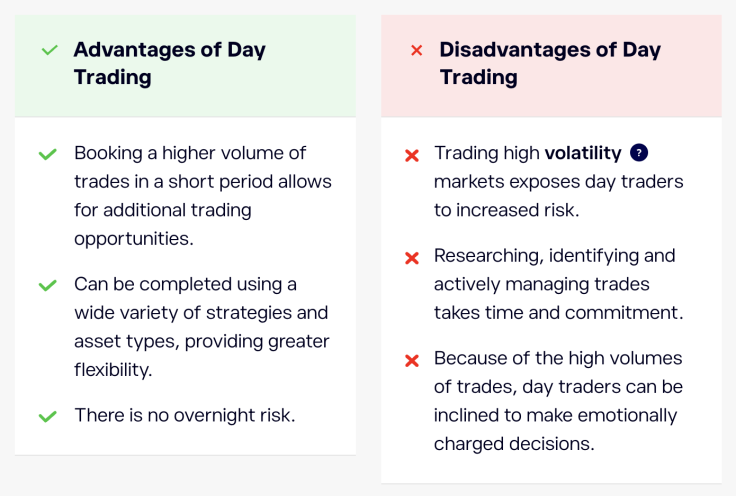
The day trading approach can be used to trade any asset class. The key is to find a market that has the right amount of price volatility to allow you to open and close trades in the same trading session.
Day Trading Stocks: Stocks are a popular choice for day traders, especially those with higher volatility or liquidity, or those experiencing significant price movements due to news or upcoming announcements.
Day Trading Forex: Forex markets are open around the clock (24/5). Local trading sessions overlap at times, such as the London and New York sessions, which can provide high-volume trading opportunities.
Day Trading Crypto: Crypto markets are highly volatile, making them appealing to day traders. Cryptocurrencies can be traded 24/7, allowing flexibility in defining a 'trading day'.
Note: Crypto CFDs are banned in the UK.
Tip: Day traders actively seek high-volatility markets known for large short-term price movements.
Swing Trading vs. Day Trading
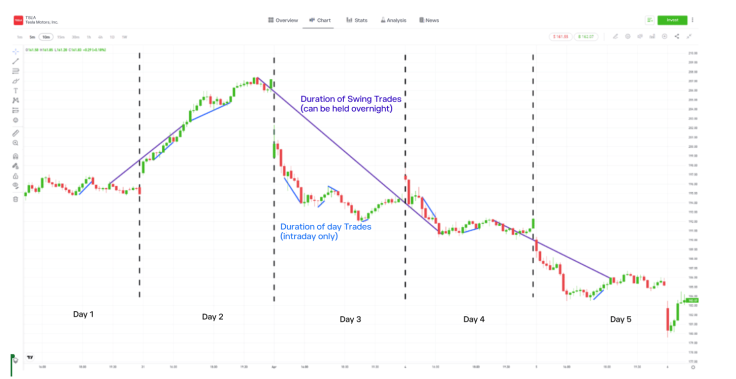
Swing trading shares similarities with day trading, relying heavily on technical analysis and targeting short-term price moves. However, swing trading allows positions to be held for days, weeks, or months, introducing overnight risk but expanding potential opportunities.
Tips for Day Trading
Day traders must dedicate time to manage positions in fast-moving markets. Using a demo account and starting with small volumes helps develop skills and the right mindset before risking significant capital.
Risk management is essential. Not every trade will be profitable. Metrics such as win-loss ratios help monitor performance. Stop-loss and take-profit orders automate position closure at pre-set levels to protect portfolios.
Day trading doesn't always require watching the markets from open to close. Certain intervals are more suitable for executing day trading strategies.
Reviewing past trades helps identify strengths and weaknesses, the most profitable times of day, and the strategies that work best. Price volatility changes over time, so day traders must monitor markets and adapt.
Final Thoughts
Day trading can appeal to those seeking flexibility and new skills, but it is a challenging strategy. Statistics show many day traders do not succeed. To increase the chances of success, dedicate time to learning, research, and practice before trading significant capital.
Visit the eToro Academy to learn more about day trading in the financial markets.
eToro is a multi-asset investment platform. The value of your investments may go up or down. Your capital is at risk.
© Copyright IBTimes 2026. All rights reserved.