

Bryan Johnson's Girlfriend Tracks 'Nighttime Erections' With $15,700 'Techno Tampon' to Study Female Health
Tolo said women's nighttime erections are 'barely measured' compared with men's
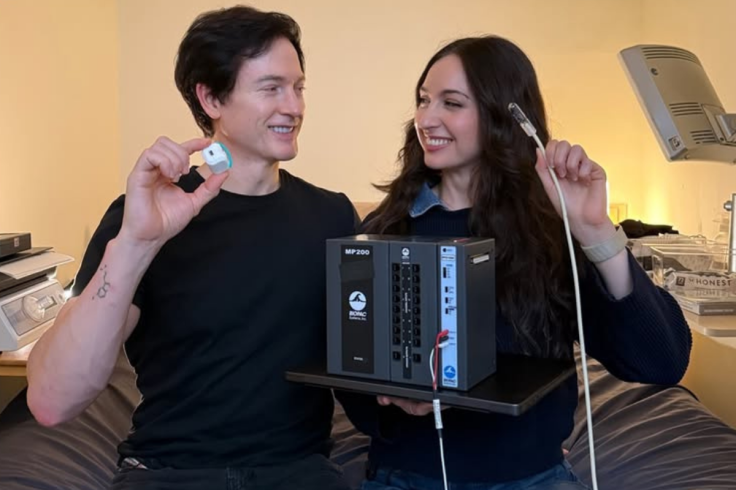
Bryan Johnson's girlfriend Kate Tolo is using a $15,723.68 (£11,881) research device dubbed a 'techno tampon' to track changes in genital blood flow during sleep. She says the experiment could help address gaps in female health research.
Tolo, a biohacker and business partner of Johnson, has been documenting the experiment as part of her goal to become the 'world's most measured woman'. The device uses a 5cm internal probe containing a light sensor to monitor blood flow overnight, with the data sent through wired laboratory equipment to a laptop.
Johnson has also shared details of the experiment, describing it as an attempt to measure what he calls women's 'nighttime erections.'
Inside the 'Techno Tampon'
Tolo said her equipment costs $15,723.68 (£11,881) and is essentially laboratory equipment being used in her bedroom. The probe is connected by a thick wire taped to her leg and feeds data into a machine and laptop, which must remain running overnight.
By comparison, Johnson said his own wireless erection tracker costs $275 (£208). It connects to his phone via Bluetooth and records the number, duration and quality of his nighttime erections.
Tolo said the equipment has not been substantially improved in decades and that there is no comparable consumer device for women. 'Men's nighttime erections have been studied extensively for decades... Women's are barely measured,' she said.
Why Kate Tolo Is Tracking Female Erections
Tolo and Johnson say the experiment is intended to explore whether nighttime genital blood flow could eventually provide a useful health marker for women. The clitoris contains erectile tissue, and research has documented changes in vaginal blood flow during REM sleep.
A 1979 study published in the Journal of Sex & Marital Therapy found phasic changes in vaginal blood flow during REM sleep, similar to changes observed in penile blood flow during REM sleep.
Johnson has argued that erectile function can provide information about vascular health in men. Medical research supports an association between erectile dysfunction and cardiovascular disease in men, although the extent to which comparable measurements could predict cardiovascular problems in women remains unestablished.
Kate Tolo's Female Health Experiment
Tolo has described the project as part of a much broader effort to collect data about her body. She says she is monitoring about 1,900 biomarkers across her menstrual cycle using more than 50 devices.
In another post, Johnson wrote: 'I am measuring my girlfriend's erections,' before explaining that he believes the data could become another health marker. He said nighttime erections are influenced by factors including blood vessels, nerves, hormones, sleep stages, stress, glucose and cardiovascular health.
Tolo has similarly argued that female nighttime erections have been under-researched and said she plans to share the results of her experiment publicly. The latest experiment follows another viral moment in April, when Johnson shared Tolo's vaginal microbiome test results on X.
He claimed the report gave her a '100/100 score' and placed her in the 'top 1% of all vaginas'. The report, from vaginal microbiome testing company Tiny Health, showed that 98.7% of her sample consisted of Lactobacillus crispatus, according to the data Johnson posted.
This is her vaginal microbiome report. 100/100 score.
— Bryan Johnson (@bryan_johnson) April 30, 2026
Top 1% of all vaginas.
Her sample is dominated by the single most protective bacterial species a vagina can host (Lactobacillus crispatus).
Only about 25-30% of reproductive age women globally are L. crispatus-dominant,… pic.twitter.com/Pt1JbKM5y0
For now, the project remains a personal data-gathering experiment rather than an established medical screening method. Its findings will need to be studied and independently validated before nighttime genital blood-flow measurements can be considered a reliable health marker for women.
© Copyright IBTimes 2026. All rights reserved.