

NASA Explains the Spooky 'Negative-Space Jellyfish' Hovering Over Mars in New Curiosity Rover Image
A smudge on a lunar photo and a stray line in an old NASA meeting are all it takes to send humanity's imagination spinning back into the dark
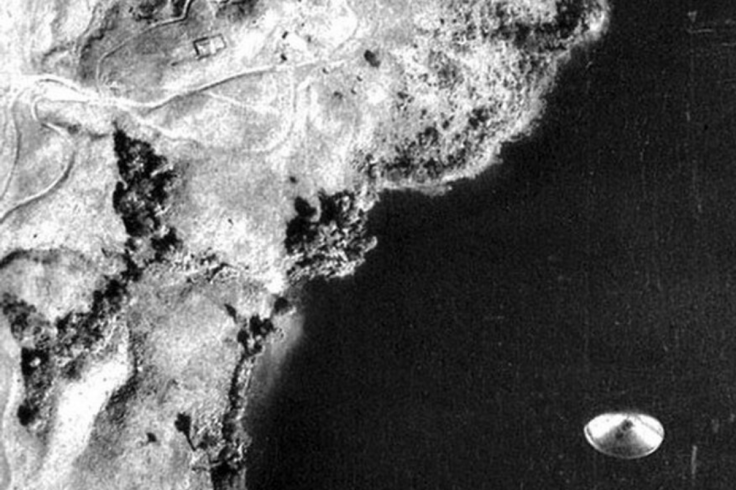
NASA has moved to explain a decades old lunar photograph that some UFO enthusiasts claim shows a 3.4-mile-long alien spacecraft hovering above the moon, after the 1967 image resurfaced online and reignited speculation about extraterrestrial life.
The black and white picture was captured by NASA's Lunar Orbiter 3 in February 1967 as the agency mapped potential landing sites ahead of the first crewed missions.
The frame shows a stark stretch of the moon's surface dominated by Theophilus crater, a vast impact site that NASA lists as about 68 miles across and 2.7 miles deep. Tucked into that landscape is an elongated smudge that has become the latest canvas for people determined to see more than geology.
UFO Blogger Claims NASA is Hiding the 'Smoking Gun'
One of the loudest voices is Scott Waring, a long-time UFO blogger, who argues that NASA's own archive hides the smoking gun. On his site, UFO Sightings Daily, he claims the strange streak is 'a long spacecraft hovering over the moon's surface' and insists the object is no trick of light or dust on the lens.
According to Waring, the scale alone should make people sit up. He writes that he compared the length of the disputed feature with Theophilus crater, taking NASA's 110 kilometre diameter figure, then judging the object to be about one twentieth as long. From that, he concludes the craft measures roughly 5.5 kilometres, or 3.4 miles, end to end.
'That's huge to us humans, but to aliens, it's considered a small shuttle craft,' he tells his readers, doubling down on the idea that we are glimpsing only a minor piece of someone else's space hardware.
He goes further, arguing that the photograph carries a chilling implication. 'This is 100 percent proof that aliens were watching humans before we ever stepped on the moon,' Waring writes, treating the picture as evidence of quiet surveillance of the Apollo programme before it even began.
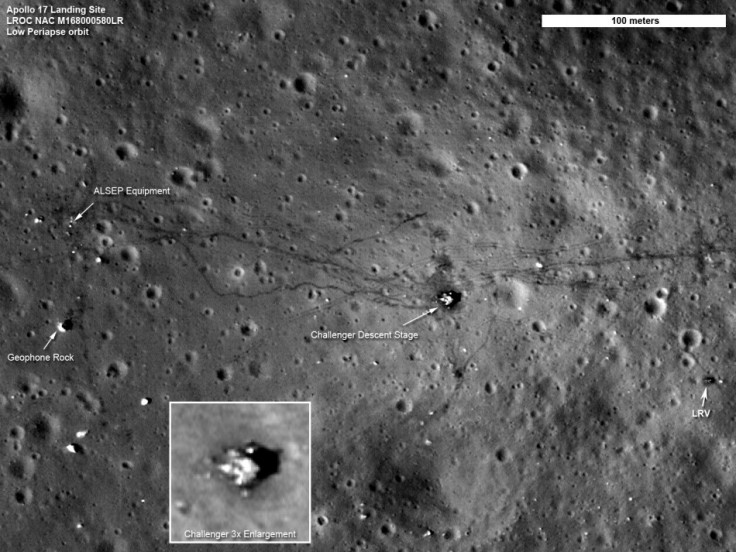
NASA, for its part, has said nothing of the sort. The agency has repeatedly stated that it has no evidence of extraterrestrial life and that it has yet to find any sign of past or present life on the moon or on Mars.
The elongated mark has not been classified by NASA as a craft, and neither Waring's size estimate nor his interpretation has been validated by independent imaging experts.
NASA Image Spurs Fresh Extraterrestrial Life Debate
The renewed focus on the 1967 NASA image lands in a wider political and cultural moment where official UFO files are being shuffled out of locked cabinets and into public view. The Trump administration has overseen the release of several batches of classified documents on unexplained aerial and space phenomena, giving UFO believers fresh material and, unsurprisingly, new fuel.
On 8 May, the US Department of War released hundreds of pages of documents, images and audio recordings that officials said documented reports of possible extraterrestrial sightings going back to the 1940s. Among them were transcripts from the Apollo 12 and Apollo 17 missions, the second and final crewed landings on the moon.
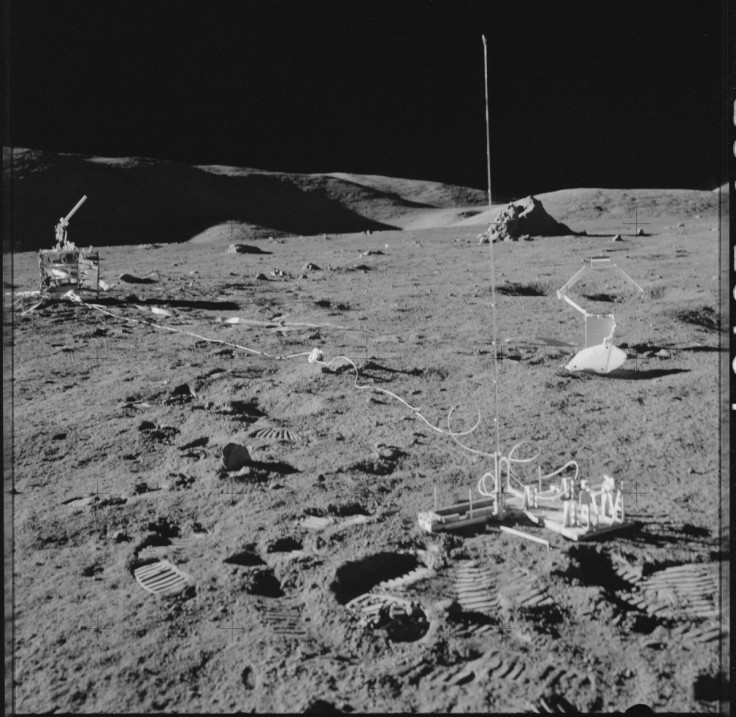
Those Apollo records, along with photographs taken by astronauts on the surface, detail multiple encounters with bright, fast-moving objects that appeared to dance around lunar landers or drift past capsule windows. The tone is more puzzled than panicked, but you can feel the astronauts straining to make sense of what they are seeing.
During Apollo 17 in 1972, commander Gene Cernan, lunar geologist Jack Schmitt and command module pilot Ron Evans reported a bright, flashing object some distance from their spacecraft.
In one exchange, recorded in mission transcripts, Cernan says: 'It is a bright object, and it's obviously rotating because it's flashing. It's way out in the distance, as I say, because there are particles that are close by and it's obviously not one of those.'
He adds that the flashes appear in a 'very rhythmic fashion,' estimating that the object sits several Earth diameters away in their field of view as they look back at the home planet. Cernan is careful, stressing that the comparison might not 'do you any good,' but the bafflement is clear.
Later, as Apollo 17's crew fired their thrusters to change direction, Evans reported 'very bright particles or fragments or something' drifting past the windows. Schmitt chimes in that it looks like 'the Fourth of July' outside Evans' window, with 'big bright pieces tumbling slowly around the capsule.'
Evans describes the fragments as jagged, angular and solid, not fluid, and says they are mostly moving with the spacecraft but with some faster pieces zipping by. According to the mission records, he also reported taking photographs of them for analysis back on Earth.
Three years earlier, Apollo 12 astronauts also noted odd lights and objects on approach to the lunar surface, material that appears again in the newly released Trump era files. None of these reports are categorised by NASA as proof of alien craft.
Mission engineers have long pointed to mundane explanations, from ice crystals and insulation fragments to weird lighting in the vacuum. Yet the raw transcripts still make strange reading today.
NASA Briefings Mention 'Alien Starbase' in Moon Anomaly Talk
The Trump administration's third batch of UFO related files, published on 12 June, has added another wild detail to the pile. Within recorded NASA briefings held after Apollo 16 in 1972, officials can be heard referring, apparently half in jest, to an 'alien starbase' on the far side of the moon.
These briefings, which run for about 55 minutes, discuss unusual gravity readings, laser measurements and anomalies detected on the moon's far side, particularly near the Van de Graaff crater region.
One speaker notes 'a great big hole' around what the transcript calls 'Fendi graph', believed to be a garbled reference to Van de Graaff, a crater already known for its strange magnetic and geochemical quirks.
'On the backside of the moon around Fendi graph, that's where we get our big hole,' the participant says, before the discussion suddenly veers. Another voice remarks: 'It could be an alien star base or something. Anyway, the next slide shows the front side of the moon.'
The line, buried in a technical briefing, does not appear in the formal Apollo 16 mission transcript from 1972. NASA has not formally clarified whether the 'alien starbase' reference was a joke, a casual shorthand or something else entirely.
That ambiguity, paired with the Lunar Orbiter 3 photograph and Trump era document dumps, has given UFO believers a field day. For scientists trying to keep public expectations tethered to evidence, it is proving to be an exhausting game of cosmic whack a mole.
© Copyright IBTimes 2026. All rights reserved.