

'It's Not the Rover': Unearthed NASA Mars Photo Triggers Wild Speculation Over Alien Tracks
A NASA photo from Mars has sparked debate over potential alien tracks, with enthusiasts and sceptics discussing whether the marks are evidence of extra-terrestrial life or mere visual artifacts
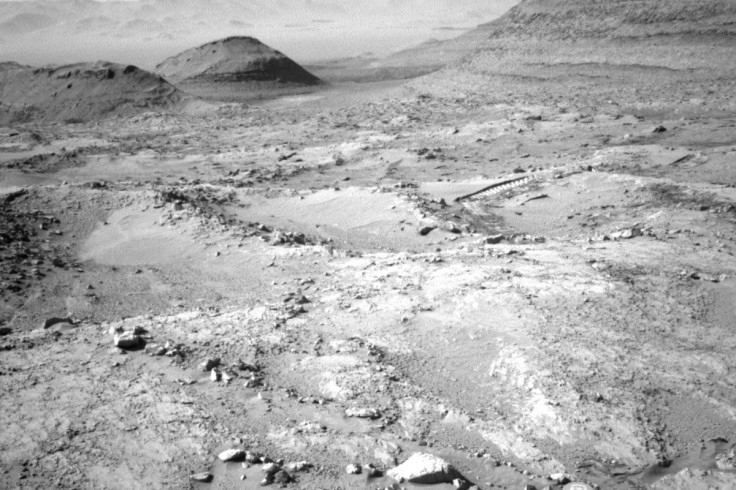
An unearthed NASA photograph taken by the Curiosity rover on Mars has triggered wild speculation over potential alien tracks.
The single image, captured in May 2025, reveals an unexplained, uniform tire-like pattern etched into the dusty surface.
The image was captured at 2:40am Coordinated Universal Time and shows a distinct, straight line with evenly spaced prints that online commentators suggest cannot belong to the human-made explorer.
This debate comes just a year after NASA announced in September 2025 that its Perseverance rover had found some of the clearest potential signs yet of ancient microbial life on the Red Planet.
Despite that history-making revelation, both the space agency and the White House have continuously maintained that no evidence of intelligent extraterrestrial life has ever been discovered.
Dissecting the Alien Tracks in the NASA Mars Photo
The controversy gained fresh momentum on Tuesday when space enthusiast Kari Sivertzen republished the archival image on the social media platform X. Sivertzen regularly shares public NASA files containing anomalies that defy immediate explanation.
'Sometimes I spot things that catch my eye, and I share them here. I believe there is life on other planets, and since NASA has found potential traces of life on Mars, it's the perfect place to look,' Sivertzen posted on X.
While viewers were immediately captivated by the apparent wheel marks, Sivertzen originally shared the photograph for an entirely different reason. She wanted to point out geological clues suggesting a body of water might have existed there in the distant past.
'What I'm actually highlighting here are the depressions in the surrounding area, which look quite distinct and could be consistent with past water activity or an impact,' she explained online.
Internet users, however, quickly bypassed her geological observations to focus entirely on the tracks. One user initially questioned whether the marks simply belonged to Curiosity. Others challenged that theory by comparing the anomaly to the rover's known mechanical footprint.
'It's not the rover, at least what I think, since that would have left two tracks and the 'pattern' doesn't match other rover tracks,' one individual replied.
Observers pointed out that Curiosity's wheels lack a central line, leaving instead a jagged tread pattern interspersed with large square blocks.
In contrast, the mysterious tracks in the May 2025 photograph feature a continuous straight line down the middle with evenly distributed impressions, appearing exactly like a terrestrial tire in motion.
Fueling further debate, a subsequent image taken by Curiosity just two minutes later captured the exact same pattern from a slightly different angle.
This secondary photograph suggests the formation was a physical feature on the landscape rather than a fleeting trick of the light or a camera glitch.
NASA released no further public images from that day to indicate whether the rover moved closer for a detailed inspection.
Pareidolia and the Search for Ancient Martian Life
NASA and military officials frequently classify strange phenomena in space photography as visual artifacts, often attributing them to unusual lighting conditions or corrupted data during transmission back to Earth.
Sceptics similarly argue that these viral sightings are textbook examples of pareidolia. This psychological phenomenon causes the human brain to subconsciously recognise familiar shapes in ambiguous visual data.
It is the exact same effect that makes people see animals in rock formations across the barren Martian landscape. Perhaps the most famous example of this is the 'Face on Mars,' captured by the Viking 1 orbiter in 1976.
Later high-resolution imaging proved that the face was merely an ordinary eroded hill, distorted by shadows and poor photographic quality.
Yet, astronomy enthusiasts remain vigilant for true anomalies. Just last month, Sivertzen shared another unusual Curiosity photograph from 2023.
That particular panorama appeared to show a small, black, jellyfish-like being or mechanical device perched on two spindly legs in Gale Crater. Images taken of the exact same spot less than a minute earlier showed empty terrain.
Curiosity has been exploring Gale Crater since 2012. The area is a massive impact basin roughly the combined size of Connecticut and Rhode Island, featuring a towering mountain rising from its centre.
Like Perseverance, Curiosity is using onboard instruments to study rock layers, clay deposits, and climate history in search of traces of microbial life.
As NASA and the US government prepare for future crewed missions to Mars in the coming decades, the Red Planet clearly continues to offer a steady stream of mysteries that capture public interest and drive scientific study.
© Copyright IBTimes 2026. All rights reserved.