

Donald Trump Hosts Viral California Lifeguard Rescue Hero Ryder Williams and Rescued Boy at White House
A split-second rescue in rough surf pushes a quiet teenage lifeguard from Santa Cruz straight into the Oval Office spotlight

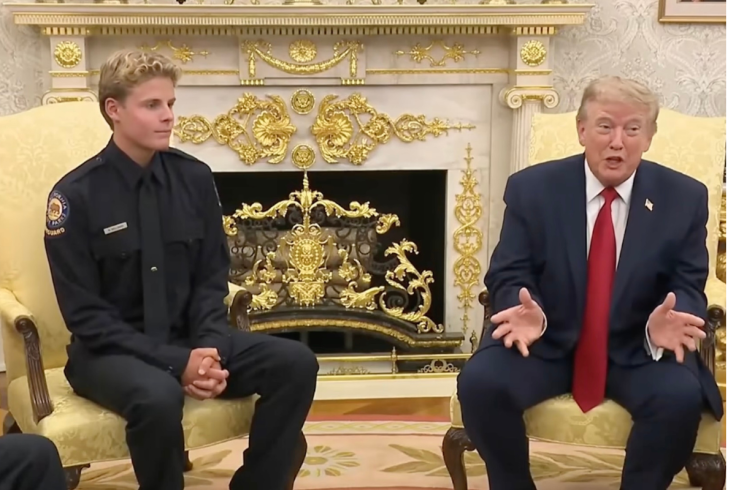
Donald Trump welcomed teenage California lifeguard Ryder Williams and 10-year-old rescue victim Nathaniel Rai to the White House on Monday, praising the viral lifeguard rescue that gripped US social media and joking that he himself probably would not have braved the powerful surf.
The visit followed a dramatic incident at Seabright State Beach in Santa Cruz, California, on 25 July, when Nathaniel lost his footing in ankle-deep water and was swept into dangerous surf, prompting 16-year-old lifeguard Ryder to launch a risky rescue that was captured on video and quickly went viral nationwide.
Trump Honours Teen Lifeguard After Viral Ocean Rescue
The footage, widely shared online, showed Ryder clinging to Nathaniel as huge waves pummelled them both, with the pair repeatedly vanishing beneath the water before reappearing as each wave receded.
A second lifeguard, later identified as Aaron Bohnen, eventually entered the surf and helped Williams bring Nathaniel back to shore.
The White House meeting, staged inside the Oval Office, placed Williams, Nathaniel and their families alongside Bohnen, who also helped with the rescue. Nathaniel, dressed in a dark suit and maroon tie, sat beside his father, Sumit Rai, as Trump recounted the ordeal and praised the lifeguards' actions.
Trump had first commented on the rescue after footage circulated online in July, eventually announcing that Williams, his family and Nathaniel would be invited to the White House.
President Donald Trump welcoming 16-year-old lifeguard Ryder Williams to the White House for rescuing a 10-year-old boy swept into dangerous waves at Seabright State Beach in Santa Cruz on July 25, 2026
— Bella (@stockbella) August 17, 2026
.
Williams, on his first season as a California State Parks lifeguard, ran…
In the Oval Office, Trump turned that earlier invitation into a public tribute, gesturing towards Ryder as he spoke directly to Nathaniel and calling the teenager 'a real hero' before adding with a half-grin, 'I don't know if I'd do it, I wouldn't, probably, you're lucky I wasn't on the service that day.'
The quip drew laughter in the room, but the rescue itself underscored the dangers lifeguards can face even when swimmers are initially standing close to shore.
Nathaniel's father, Sumit, offered a quieter assessment of Williams' actions, telling the Associated Press that he would be 'forever grateful' to the teenager who saved his son.
Viral Rescue Becomes a Political Backdrop
What began as a frightening few minutes for one family quickly became a national story about the risks faced by lifeguards and the training required to respond when beach conditions deteriorate without warning.
As the video began circulating in late July, viewers were struck by Williams' composure and the severity of the conditions. Waves at Seabright reached as high as 10 feet that day, while officials described conditions as volatile.
President Trump graciously said Ryder Williams is a REAL hero for the rescue, admitting he himself probably wouldn’t have done the same thing himself, joking that Ryder is lucky President Trump wasn’t the lifeguard on duty that day. 😆
— JJ🕊️ (@jesseyjay94) August 17, 2026
POTUS thinks the whole rescue is just…
California State Parks subsequently provided a detailed account of the rescue. Williams said he saw Nathaniel lose his footing while standing in ankle-deep water, radioed for help and immediately ran towards him.
'I put my fins on my wrist, popped my buoy and entered the water to get ahold of the child,' Williams said. 'Due to the volatility of the water, I was unable to tube up the victim.'
Williams said that after the first wave, Nathaniel was limp and the force of the water prevented him from pulling the boy out. Another two or three waves hit them before Bohnen entered the water to help.
Bohnen said they were struck by waves measuring between six and eight feet before they managed to bring Nathaniel onto dry sand.
The timing of the incident also coincided with a wider debate in California over whether lifeguards should formally be classified as first responders, a change supporters argue could bring greater professional recognition and support.
Those backing the measure have argued that, given lifeguards are often the first to respond to drowning incidents or coastal emergencies, the first-responder label would more accurately reflect their responsibilities and could affect areas including training requirements and employment protections.
Lifeguards' Role Under the Microscope
Some beachgoers have questioned why lifeguards are not already formally categorised as first responders, reflecting the public perception that their work often overlaps with other emergency services.
Yet the politics of official designations can involve more complicated questions around standards, training and funding. State Sen. John Laird, who represents Santa Cruz, has acknowledged that lifeguards effectively perform first-responder work while raising questions about how a formal designation would operate.
President of the United States, Donald Trump, has announced that he will honor a 16-year-old boy who dramatically rescued a child from the water.
— Michel 🇷🇼 (@MichelDblessed) July 29, 2026
The teenager, who works as a lifeguard and rescue swimmer at Santa Cruz Beach, was seen in a widely shared video on Tuesday battling… pic.twitter.com/fwhEJMtybO
Those questions include the level of training that would accompany such a classification, how it would be implemented and who would pay for any additional requirements.
The debate has gained added visibility following Williams' rescue, which California State Parks held up as an example of the preparation and teamwork required of its lifeguards.
State Parks employs about 600 seasonal and 70 permanent lifeguards, who carry out an average of 10,000 rescues and one million preventative actions each year, according to the agency.
Since 1 July alone, lifeguards had performed 3,600 rescues, 110,000 preventative actions and more than 1,600 medical assists by the end of that month.
Back in Washington, those policy questions were secondary during Trump's meeting with Ryder and Nathaniel, which functioned primarily as a ceremonial thank you to the teenager and the other people involved in the rescue.
For Ryder, still a teenager and suddenly receiving national attention and an Oval Office invitation, the aftermath has been markedly different from his response immediately after the rescue.
Once Nathaniel was safe and assessed, Williams simply returned to his tower and finished his shift.
'I'm grateful to have had the opportunity to return the child to his family safely,' Williams said after the rescue. 'This is my job and I love what I do.'
Whether California lawmakers ultimately decide to formally classify lifeguards as first responders, and what additional resources such a designation might bring, remains to be seen. Williams' rescue, however, has provided a dramatic example of why the question has attracted renewed attention.
© Copyright IBTimes 2026. All rights reserved.