

Trump Aide Natalie Harp's Access to Trump Under Fire: 'Outrageous' Handling of National Security
Natalie Harp reportedly filters much of the information Trump sees on a daily basis

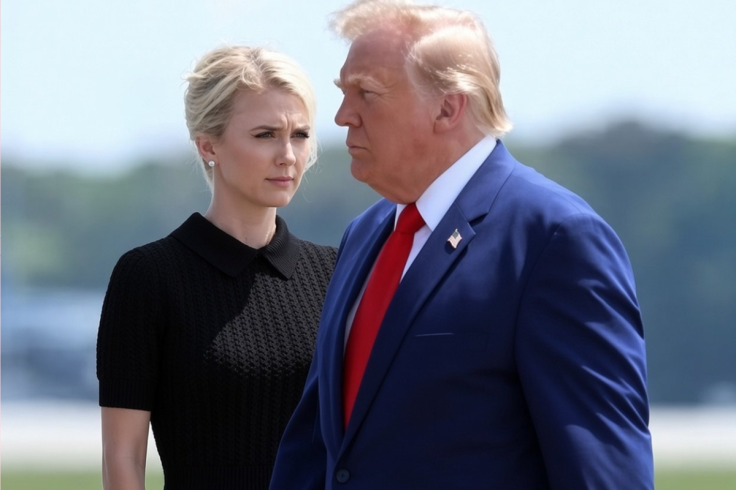
Natalie Harp, one of Donald Trump's closest aides, reportedly worked inside the White House for nearly a year without a routine security clearance, raising questions about unauthorised access to sensitive government information.
Harp, who serves as an executive assistant to Trump, initially declined to complete the paperwork required for a federal background investigation. She even received multiple extensions to fill out the form, called SF-86, but she refused to apply for the clearance, although her reasons were not disclosed.
The security issue was eventually raised by the White House counsel's office. However, Trump had himself intervened, and Harp finally filled out the forms in recent months to launch a formal federal background investigation. She received clearance eventually.
While it is not yet confirmed if Harp actually obtained or disclosed classified information when she lacked clearance, her proximity to the president has experts as well as White House officials worried about any potential security gaps.
As former Obama senior adviser David Axelrod put it on X, if the reporting is accurate, 'it's a deadly serious issue' for someone so close to the president to have lacked clearance while refusing to undergo the process.
'The person closest to the POTUS and his thinking on a daily basis has no security clearance and refuses to submit to the process of getting it, it's a deadly serious issue,' Axelrod noted.
The Guardian also quoted former White House ethics official Norm Eisen, who described the situation as 'shocking'. Eisen warned that an aide with potential exposure to highly sensitive information should not have gone without clearance for such a long time.
'Treating access to confidences as a casual job perk is an outrageous way to handle our national security,' Eisen had noted, arguing that the episode raised broader questions about the administration's handling of established security procedures, saying the American public 'deserves answers'.
Karoline Leavitt Defends Harp
The White House has not accused Harp of mishandling classified material. Press secretary Karoline Leavitt, who will step down by the end of August, defended Harp, telling MS NOW: 'Natalie Harp has a security clearance like everyone else, and she is a loyal and hardworking member of President Trump's team.'
However, Richard Painter, the former chief ethics lawyer for George W. Bush, said that if Harp is accompanying Trump on his Air Force One trips, in a proximity where she can overhear conversations that could include classified information, she must have security clearance.
'You could be in a situation where, if the president wants her on his trips, and he's in Air Force One, and he is on the phone, and she's sitting in the cabin there because she's doing something else, even if she doesn't give advice on how to handle Iran and he's on the phone talking about the next strike on Iran, right then and there she needs a security clearance,' he had reportedly said.
From Trunk Rides to Secret Flights
Harp's unusual proximity to Trump makes the controversy particularly significant. She has become a familiar presence around the president and reportedly filters much of the information Trump sees on a daily basis.
Her loyalty has attracted attention before. During Trump's 2023 court appearance in New York, Harp reportedly climbed into the trunk of an SUV after discovering there was no seat available for her in the motorcade. She was determined to accompany the president.
More recently, she was among a small group who travelled with Trump on a military aircraft after the president secretly changed aircraft in Turkey during an alleged Iranian assassination threat, while other officials and journalists remained on a decoy Air Force One.
Those details help explain why the clearance question has become more than a routine personnel dispute. Harp was not simply a distant White House employee. She was frequently near the president, including during periods when highly sensitive national-security matters could potentially have been discussed.
Overall, there is currently no public evidence showing that Harp heard classified conversations, accessed classified documents, or compromised national-security information during the period before she received clearance.
However, the central unanswered question is why someone with such access to Trump spent nearly a year without completing a process normally expected of West Wing staff.
© Copyright IBTimes 2026. All rights reserved.